Leaving my office job one evening in early 1982, I descended the stairway into the Lexington Avenue E train station and spotted a young man furiously chalking up the blank black surface that (temporarily) covered an empty billboard. I immediately recognized Keith Haring; his graffiti-inspired subway drawings were attracting attention all around Manhattan, and he was quickly becoming a well-known figure himself downtown.
*
In 2024, purchasable items bearing Keith Haring’s imagery include:
MOMA Design Shop magnet set with barking dogs and break dancers.
Uniqlo baseball hat with the Radiant Baby.
Urban Outfitters lounge pants with flowering-head people.
Zara high-top sneakers with Haring’s signature thick black lines.
*

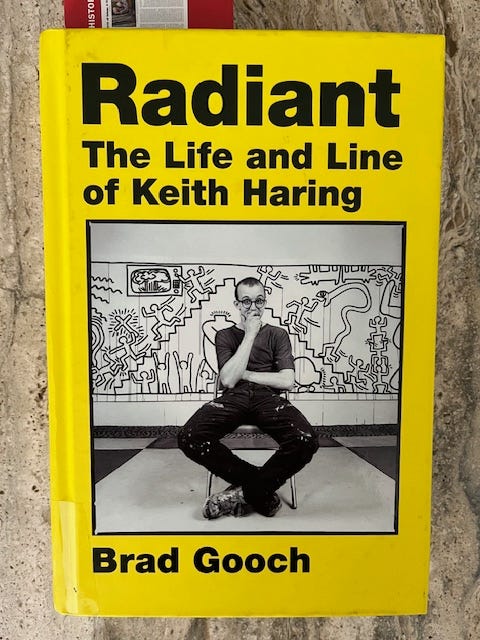
A line in art is an identifiable path created by a point moving in space. In Radiant: The Life and Line of Keith Haring, biographer Brad Gooch ably documents the artist’s blazing and tragically brief trajectory. Born in 1958, Keith Haring grew up in Kutztown, Pennsylvania, a rural college town near the city of Reading in the eastern part of the state. Keith displayed a talent for art as soon almost as he wrapped his fingers around a crayon or pencil. His art teachers noted the distinctive line in his drawings and comics from the beginning. Pop culture, especially the wonderful world of Disney, was a primal, and enduing inspiration for this pure product of the Sixties.
*
As many teenagers did in the Seventies, Keith tried on and discarded various identities (though deep down he always considered himself an artist at heart). During his period as a so-called Jesus Freak, around ages 14–15, he plastered Kutztown with handmade “Jesus Saves” stickers. A premonition of the public art that would follow?
*
Throughout his foreshortened life, we can draw a line tracing Keith Haring’s search for a community of like-minded souls, which he usually found. From Jesus Freak to high school burnout to Grateful Deadhead to Club 57 cool kid on St Marks Place to outlaw graffiti writer in the subway system to Andy Warhol-associated pop celebrity to AIDS activist with Act Up, he embedded with compatriots and made his indelible contributions.
*
In between graduating from Kutztown Area High School in 1976 and moving to New York City in 1978, Keith attended the Ivy School of Professional Art in Pittsburgh.
“Within six months I came to realize that no matter what, I wasn’t going to be a commercial artist. I mean, a lot of the students and a lot of the teachers were saying that they were becoming commercial artists only to support their own work as real painters and sculptors. But I saw through that right away. I realized that if I spent the whole day doing mechanicals and pasteups, I wouldn’t have any interest left in doing my own work afterwards. Well, I decided if I was going to be an artist, that’s what I was going to be.”
*
In fall of 1978, Keith Haring began classes at School of Visual Arts. According to Brad Gooch:
“Without any sort of formal campus, SVA was oriented toward the urban streets, with most students about on busy Twenty Third Street or in the laxly guarded first-floor lobby.”
Most of the faculty were working artists, rather than full-time teachers.
*
“Keith soon found a way to wed his night-time cruising and his daytime activities: he began drawing penises, obsessively.”
*
“Also enrolled [with Keith] in Barbara Schwartz’s Sculpture course that semester was Kenny Scharf, another twenty-year-old first-year student. Looking like a long-haired surfer, he had just arrived from Southern California, where he, too, had been a self-styled hippie and where he, too, had grown up infatuated by the bright colors and zany story lines of Hanna-Barbera TV cartoons as well as by the futurism of space-age dreams of intergalactic travel and extraterrestrial beings — the stuff of the Star Trek TV series.”
Kenny Scharf became Keith Haring’s lifelong friend, confidante and sometime rival.
*
“One day while Keith was on his way into SVA, a teenage kid with severely cut hair and a look that registered as ‘cool in a way’ asked Haring if he could walk him past the security guard. Keith said ‘sure’ and they chatted so the guard would know they were together. Keith disappeared into his class and when he emerged an hour later, he noticed fresh tags and screwed poems on the corridor walls. He recognized they had been done by Jean-Michel Basquiat, the street artists of Haitian and Puerto Rican descent who, along with his partner, Al Diaz, went under the name SAMO, short for Same Old Shit.”
Never close friends, Keith Haring and Jean-Michel Basquiat nevertheless remained friendly over the next ten years. Competitive at times, they always held each other’s work in high regard.
*
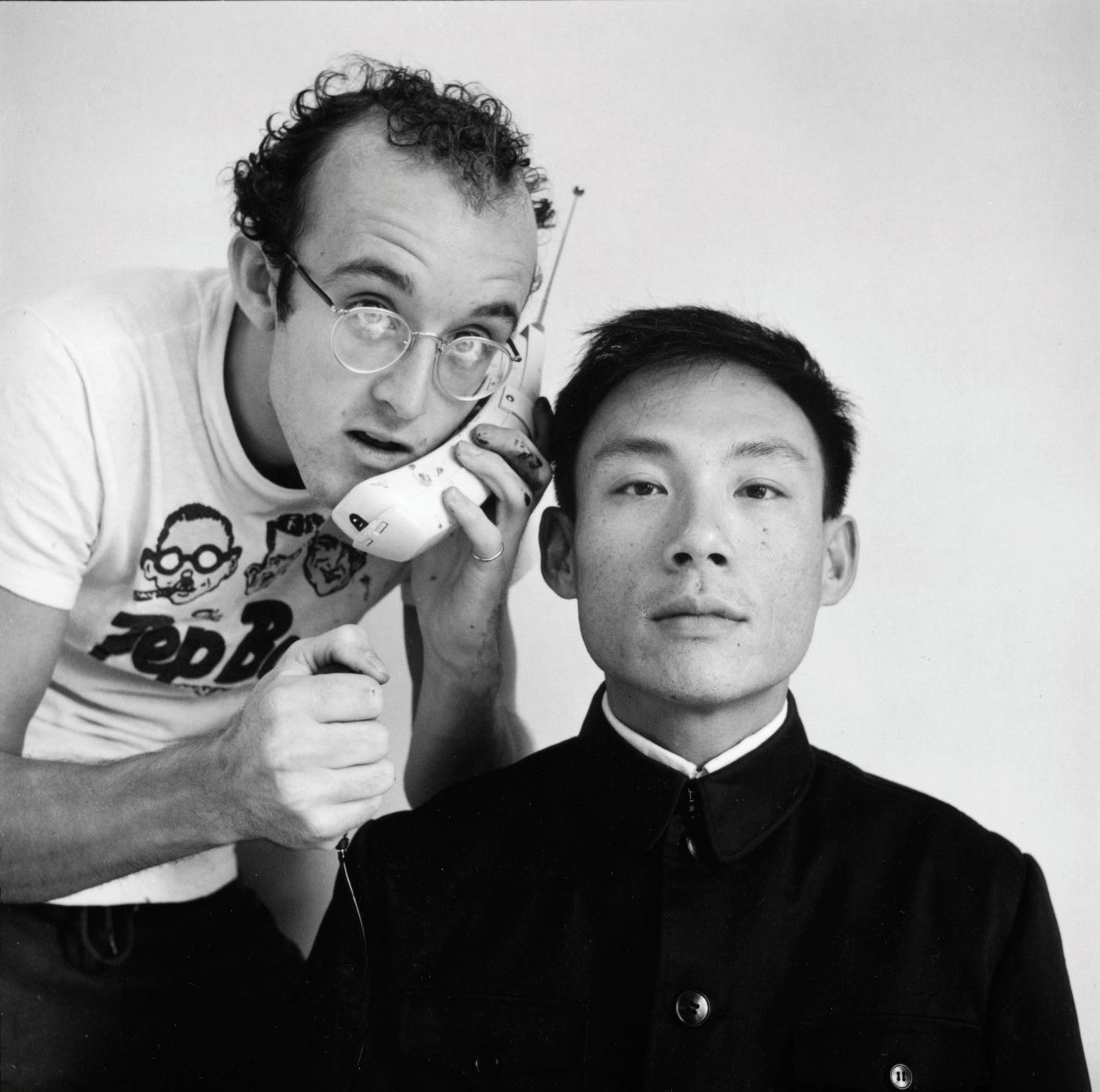
Another SVA friend and fellow Club 57 partygoer and performer, photographer Tseng Kwong Chi made it his project to document Keith Haring in action. Beginning with the subway drawings in 1980–81 and continuing through the decade, until he succumbed to AIDS in 1990 just two months after Haring died, Tseng Kwong Chi shot more than 40,000 photos of Keith at work and play.
*
“Throughout the summer of 1982, Haring, back in New York, was immersed in creating work at one studio or another, sometimes alone, sometimes with [teenage graffiti artist] LA II, yet never at the expense of his public art. He simply doubled his output, setting up a syncopated rhythm that persisted throughout his career, as he would usually accept invitations to galleries or museums at home or abroad — when the offers began to multiply — only if a mural or other (usually unpaid) public project could be set up, too. His main public access channel in 1982 remained the subway, and his chalk creations did not lag.”
*
The charge of appropriating grafitti never stuck to Haring; he was widely accepted and even revered by the urban subway artists. As Keith explains:
“The stereotyped idea of a graffiti writer is a Black or Puerto Rican kid from the ghetto. It’s not really what it turned out to be at all. There are equal amounts of white, black and Puerto Rican graffiti writers, or Chinese or whatever. Most of them grew up in the city. If I had grown up in the city, I would probably have been doing it also.”
*
Keith Haring took part in the 1983 Whitney Biennial, alongside Jean-Michel Basquiat, Jenny Holzer, Barbara Kruger, David Salle and Cindy Sherman.
*
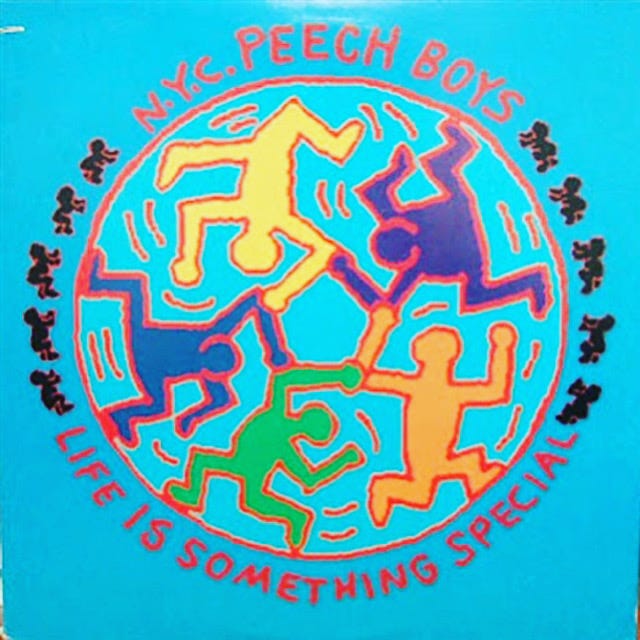
By 1984, Keith Haring had established a long-term, live-in relationship with Juan Dubose. He’d also become a devotee of DJ Larry Levan, religiously attending weekend parties at Paradise Garage the way some people went to church every Sunday.
“Throughout the Eighties, I always knew I could easily be a candidate for AIDS.”
*
One of Keith Haring’s most famous commissions was body-painting white lines of the statuesque body of choreographer Bill T. Jones. Haring and Jones became friendly, and here the dance master comments on Keith’s relationship with Juan Dubose.
“Keith loves people from a class lower than his own. Well, there’s a responsibility that goes with that. And that responsibility is not just how generous you are, but how you can bring that person up through his emotional perils and feelings of inadequacy. Does Keith really know what it means to set up house with someone who is not as educated as he and is more emotionally and financially handicapped? So I talked to Keith about these things. But you can only push Keith so far …. until he’s finally not there. So I called him the Ice Man, and because he’s an Ice Man he loves hot and passionate people.”
*
Actress and performer Ann Magnuson, Keith’s compatriot from Club 57, recalls how the downtown scene transformed during the middle Eighties.
“Everyone was in the same boat. Then Jean-Michel changed the equation and made it uncool to be poor. Jean-Michel was the first. Keith came not long after. With Keith, it was just explosive. it wasn’t just getting by. It was a massive amount of money. That was part of the tsunami that came in with Reagan’s second term. Jay MacInerny published Bright Lights Big City. The go-go yuppie thing happened. The tenor of New York City changed. It was a new ballgame, at which Keith excelled. He was hitting home runs all the time. We were all thrilled for him. He wasn’t a snob about it.”
*
Not all of Keith Haring’s old friends were thrilled about his newfound celebrity status. In the words of Keith’s early Eighties roommate Drew Straub:
“He had gone jet set and everyone had one name. It was ‘Brooke’ and ‘Michael’ and ‘Madonna’ and ‘Grace’ and ‘Yoko.’ It was his one-name period and he was completely starstruck and everyone was a celebrity. He was so excited to be there.”
Even Andy Warhol found Keith’s star gazing to be over the top when they attended the MTV Awards together in 1985. “The TV cameras had already left so Keith was really upset,” he wrote in The Andy Warhol Diaries. “I mean, I like Keith, but it was so sick.”
*
Around 1985 he started making sculpture, to mixed reviews, but Keith Haring clearly enjoyed the challenge. “I really love to work” he wrote in his journal. And he did, judging all the evidence presented by Brad Gooch. Partying and hanging out with one- named celebrities seemed to fuel him rather than distract him, or dissipate his creative energy in the slightest.
*
Keith Haring’s Pop Shop grand opening was April 19, 1986. Haring-branded merch included T-shirts ($12-$25), magnets ($5-$12), buttons (50 cents), coloring books ($5) and skateboards ($55-$155).

Brad Gooch documents a Keith Haring working trip to Paris in 1987:
“Arriving in the morning, he took a taxi into town to drop off an unpainted canvas tarp at the Center Pompidou, to be finished by him for an exhibition of painters who had risen over the last ten years; and to take a meeting at Hôpital Necker, a children’s hospital where he hoped to do a mural on an exterior concrete stairwell about ten stories high. Some of the hospital directors were nervous because Haring worked without any preliminary plans and the tower was highly visible, so he had rushed over to draw a quick sketch for them and to explain his improvisatory technique to allay their fears.”
*
Jean-Michel Basquiat died on August 12, 1988.
“Over the next few months, Keith never stopped honoring his departed friend. [Haring] painted a homage to Basquiat, A Pile of Crowns for Jean-Michel Basquiat. On a triangular canvas ten feet by nine feet, bordered in a STOP sign shade of red and limned in black, Haring painted a vibrant pile of three-pointed crowns, Basquiat’s tag, along with his familiar copyright symbol.”
*
Keith’s AIDS diagnosis in early 1988, long suspected, adjusted his focus without slowing down his Herculean productivity. He threw in with Act Up, donating his time, money and what would become one of his best-known series of word-images: Silence = Death.
“Everything I do now is a chance to put a crown on the whole thing. It adds another kind of intensity to the work that I do now; it’s one of the good things that comes from being sick. if you’re writing a story, you can sort of ramble on and go in a lot of directions at once, but when you’re getting to the end of the story, you have to start pointing all the things toward one thing. That’s the point I’m at now, not knowing where it stops, but knowing how important it is to do it now. The whole thing is getting more articulate. In a way, it’s really liberating.”

*
“Keith Haring lived until 4:40 AM on February 16, 1990.”
In his final waking hours he struggled with paper and a black Sharpie, attempting to draw one last Radiant Baby.
*
Roaming the Upper West Side of Manhattan on an undistinguished day during the pandemic year of 2020, I walked past a public middle school. It was closed but student art projects were visible behind a fence. “Haring and Basquiat” read the sign above, though that was unnecessary as the graffiti-inspired sculpture and Godzilla-with-crown painting on display made for instantly recognizable homages to the two deceased artists. I realized that my peers Keith and Jean-Michael, gone more than thirty years now, were no longer Andy Warhol’s inheritors but his stand-ins, the definition of an artist for today’s young people: the new Warhols. Art is eternal, even if artists aren’t.

 Mark Coleman