
Reading reviews by the late author Gary Indiana during the second half of the 1980s, I figured the guy was a lunatic, to be honest. Vituperation and vendetta marked his tenure as art critic of The Village Voice, from 1985 to 1989 — alongside viperish wit and deadly-stiletto targeted prose. That’s why I never missed reading his column.
For instance: the critic was not amused when the 1985 Whitney Biennial included work by a celebrity/fashion magazine photographer. “Bruce Weber should not be in the same room with Ron Bleckner and Annette Lemieux. He should have his own room. It should be in New Jersey.” Or when he encountered, in 1987, the portrait of an already ubiquitous Manhattan real estate mogul, glaring from the cover of Vanity Fair: “Trump looks like an especially virulent, shifty-eyed loudmouthed accumulation of baby fat.”
Born Gary Hoisington in 1950, this New Hampshire native adopted his pen name somewhere between his godforsaken hometown of Derry and the so-called City of Angels in California, where he tread water through most of his twenties, toiling for Legal Aid and trawling gay bars, enmeshing himself in the nascent punk scene, reading voraciously and slowly accepting the realization that he was a natural-born writer. Once he landed in New York City, just before the dawn of the 1980s, his pen hit paper and then came the deluge: plays, screenplays, short stories, novels, reviews and essays poured forth until October 23, 2024, when Gary Indiana succumbed to cancer.
“After I came to New York in 1978, I experienced about three years of chaotic, impoverished, youthful excitement and desperate creative improvisation,” he told The White Review’s Michael Barron in April 2016. “Followed by a decade of nonstop death of people around me from AIDS…people who keep dredging up what a great place New York was thirty or forty years ago should just shut up and open a funeral home, where nobody minds if you talk about dead people all day.”
I first encountered his writing in the pages of Bomb, a pioneering art and cultural magazine covering the downtown scene. Bomb also introduced artists such as Cindy Sherman and Robert Longo; back then I found their images to be more accessible than the accompanying stories by Gary Indiana and Kathy Acker. Those two transgressive writers were way above my intellectual pay grade in 1982. But they snugly fit next to each other in my mental file cabinet: I’d get to them (and get them) at a later date.
Not for the first time, it took the death of an author for me to realize how much I’d missed by not keeping up. There were intimations along the way; over the last decade I began seeing Gary Indiana name-dropped online by sharp literary-minded millennials.
Reviewing the anthology Fire Season: Selected Essays 1984–2021 in New Left Review, Ryan Ruby succinctly captures Gary Indiana’s newfound relevance.
“American readers born in the ’80s, in particular, have been drawn not just to his nuclear-grade pithiness, his brazenly queer and bohemian narrative persona and his marriage of the techniques of American New Journalism and French avant-garde fiction, but also to the refreshing absence, rare among members of his generation, of nostalgia and apologetics in his accounts of the political events that have formed the pre-history of their lives.”
I take that last bit to mean that Gary Indiana, nominally a baby boomer, expends little or no energy dwelling on cliched subjects such as Vietnam and Civil Rights, which of course he doesn’t because there was so much going on right in front of his face.
“We were the first generation of people to have a Salk vaccine, flu shots, so you didn’t get diphtheria, smallpox, measles,” Indiana told Bomb editor Betsy Sussler, upon the 1989 publication of his first novel, Horse Crazy. “We are the first generation to actually not have these kinds of illnesses. And low and behold we get into our thirties and this thing is coming along that’s killing everybody. And the additional fact that it’s sexually transmitted is very freaky. It’s the thing that affects people most. The idea that it has to do with sexuality is what makes it so hideous.”
The AIDS epidemic haunts and informs the novels of Gary Indiana. It’s not merely theme or metaphor but a persistent menacing presence, an inescapable cruel tide that ebbs and flows without ever fully receding.
From Horse Crazy onward, through novels Gone Tomorrow (1993), Rent Boy (1994), Do Everything In The Dark (2003) and the elliptical memoir I Can Give You Anything But Love (2015), characters and narrators alike hurtle through an existence split between the open-ended possibilities offered by living “alternative lifestyles” and the impending doom of a possible (likely) early death. These rent-stabilized downtown Manhattan melodramas are not so much ominous as realistic, reliably gritty and full of mordant humor. His characters’ haphazard paths render Indiana’s almost plotless novels compelling despite their lack of direction. Depressed and/or dissolute, these offbeat people persevere because what else can you do?
When Ryan Ruby refers to the influence of avant-garde French fiction we can safely assume he means auto-fiction. Large swaths of the novels are frankly autobiographical; even if you didn’t know Gary (and I didn’t) his various narrator’s voices, their depictions of milieu and social circles — romantic fixations, former lovers, fast friends, sleazy hangers-on, not-so-innocent bystanders — all feel so familiar as to be transparent.
But never, ever nostalgic.
Consider another snippet from the 1989 Bomb interview between Indiana and Betsy Sussler. He was relentlessly clear-eyed, and on point about East Village bohemia.
BS: There is a demi-monde in New York that embraces sleaze. All those desperate people who still think it’s cool to die young. Horse Crazy is the quintessential New York novel. It isn’t a wacky, safe (as in homogenized and palatable) vision of what people would like to think New York is like.
GI: Yeah. Gregory [barely reformed addict and the narrator’s obsessive love object] is the kind of kid, who came from Connecticut, eighteen or nineteen, went to the Mudd Club, saw all those people in their late twenties being cool and striking poses — but they were doing work — and he didn’t get that part of it. To him, it was all about the pose. You see it now. It hasn’t stopped. There are people who still think crawling from one nightclub to another every night is some kind of glamorous activity. He’s like that.
This is a crucial aspect of the 1980s NYC aesthetic that often gets lost or left out of the endless recounting of junkie squalor and outré sexuality. Whatever else you got up to you had to do the work or risk setting yourself adrift — becoming a purposeless poser. For some, the imminent threat of early demise only increased that sense of urgency.
I disagree with Ryan Ruby about the influence of New Journalism on Gary Indiana or anyway with the notion that he did especially notable work in his various magazine stories: largely routine fish-out-of-water travel pieces. Branson, Missouri is an easy — too easy — target. His efforts in this area are perfectly serviceable but hardly innovative.
While avoiding the perfumed deceptions of nostalgia, Gary Indiana sought to unearth the funky truths of his own past, throughout all his novels. “All the recent necrophiliac nostalgia for the late 1970s and early 1980s New York — a period that I did draw on a lot in Horse Crazy and Rent Boy, also in Do Everything In The Dark — is so off-base that I didn’t want to engage with it at all.” Paraphrasing Martin Amis, a novelist we can guess Gary Indiana had no use for, when men reach middle age they become aware of a new continent within themselves and that is the past. Gary Indiana fearlessly explored this shadowy region, minutely examining the ramifications and repercussions of his own messy life history. He was mercilessly frank, and constitutionally incapable of cheap sentiment.
The aforementioned Horse Crazy traces the jagged outline of an emotionally doomed love affair. If not quite the quintessential New York novel of the period as Betsy Sussler suggested, it’s authentically bleak and memorably unsettling, haunting on multiple levels.
I must be a square or squeamish because the relentless, detailed scatology in Rent Boy grossed me out. Later I realized that may be part of the point; Indiana forces his readers to confront the numbing repetition of sex work, the dehumanizing nature of peddling your ass on a daily basis.
Gone Tomorrow resembles an early low-budget film by Rainer Werner Fassbinder, or more properly an on-set diary from the making of one. I didn’t think there were any taboos left to be violated until this novel’s concluding sequence. No spoilers: suffice to say the genuinely shocking and tasteless behavior documented is well, credible in context. Here is the rare instance where Gary Indiana brazenly dares you to be offended, or flinch. In general, what makes him such a vital and incisive writer is the way he (mostly) avoids gratuitous violations of propriety as he dives head first into the netherworld.
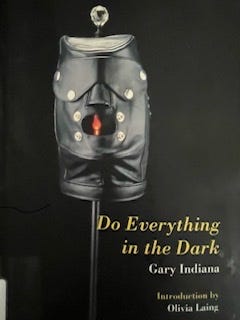
Discussing the early 1980s New York scene in The Paris Review, Indiana said: “Many of us went on to do things that were infinitely more interesting and complex than what we were doing then.” Do Everything In The Dark documents this downtown diaspora, twenty years later. There’s a beautiful melancholy to the interlocked stories, with the unforeseen 9/11 attacks subtly looming like an inevitable hangover and AIDS still hanging over everybody’s heads albeit at a lessened threat level for some.
The following passage is so resonant I can’t isolate a handy quote. Here’s Gary Indiana, from Do Everything In The Dark,remembering people who passed through his life, and he through theirs, as a “flicker of lightning, a single facial expression, a faint breath, a photograph, a faint tug of the heart.”
“…the people who showed up and left again so quickly that they only left an image dissolving in a doorway; the people who hung around for years familiar as an old shoe and one day transformed themselves, changed everything from the ground up, flew off like butterflies or crashed to earth from a preposterous height; the people who withdrew, monastically, into a harsh discipline of silence; people who cleaned up their acts and went nowhere with them; people we envied for their great looks, their money, their mastery of situations, who crumbled physically and mentally collapsed after decades of furtive dissipation; the people we still know but never see; the people we disliked for years, but came to appreciate; the people we liked at first and grew to despise after long periods of almost unconscious study; people we wanted to sleep with but didn’t; people we slept with impulsively, more or less by accident; people we yearned for and made fools of ourselves over, who rejected us then, and years later, when everything that inflamed us about them had long sputtered out, attached themselves to us with fierce unwanted desire; the famous who dropped into obscurity, befriended us in those luckless times, and dropped us when fortune smiled again; the people who lived in a different world, and mistook us for other kinds of people than we were; the people we could never quite look in the eye.”
The memoir I Can Give You Everything But Love is where it all comes together, Gary Indiana’s gimlet eye and poetic ear, his acerbic mind and carefully guarded heart. The 21st Century sections set in Cuba constitute masterful postmodern travel writing, while the interspersed look-backs are deeply revealing and cumulatively moving. And oh yeah, they’re also mean in a thoroughly entertaining way: just bitchy enough to be wildly funny. And the sections on his protracted coming-of-age in 1970s California prove that Gary Indiana could be harder on himself than anyone.
Saved for a rainy day are Gary Indiana’s “untrue true crime novels,” or in the words of his great friend and fellow author Lynne Tillman, documentary novels — literary riffs on real-life scandals: Resentment: A Comedy on the Menedez Brothers, Three Month Fever: The Andrew Cunanan Story and Depraved Indifference, about the murderous mother-and-son scammers Sante and Kenneth Kimes. I plan to read the last one first.
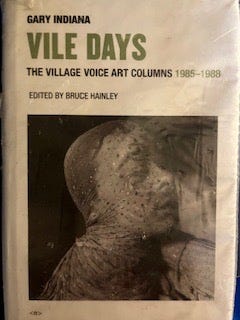
Vile Days: The Village Voice Art Columns 1985–88 confirms his oft-stated ambivalence about the basic project of art criticism. It comes across loud and clear in the actual art reviews. The best pieces in Vile Days are about art books, other art journalists, the “art scene” in general, The New York Flower Show, a furniture exhibit, live performances by Marianne Faithful and Sandra Bernhard, garbage in the street, and the death of Andy Warhol (“I’ll Be Your Mirror.”)
“Andy was a working boy. He worked hard, he made his money, they buried him with the blessings of his church. A saint for all the wrong reasons. And isn’t that what America is all about?”
Reviewing his late frenemy Kathy Acker for the London Review of Books in 2006, Gary Indiana deploys his withering on-the-mark aim as a literary critic.
“Acker often claimed that she was ‘doing something new with language’, meaning something on a par with Gertrude Stein or William Burroughs. But one can’t avoid noticing what she wasn’t doing with it: making sense, communicating with readers, contacting a world outside her cerebellum. Acker pre-empted criticism of her solipsistic procedures by pronouncing them elements of her master strategy: she wrote badly because she intended to; she did everything wrong because that was her technique for deconstructing ossified literary conventions. How such a writer came to be regarded, by a substantial cult, as feminist oracle and literary innovator has a lot to do with academic fashion.”
Ouch. Still he ends generously, even sympathetically.
“Acker had begun to acknowledge the existence of the reader. I like to think that one day she would have surprised everyone with a truly important book, one that wouldn’t need defending with arabesques of pataphysical jargon.”
An unfinished Gary Indiana novel, recently unearthed, is another untrue true crime story. Using a pseudo-journalistic oral history approach, the remnants are tantalizing. At the very end he was, once again, onto something — a refreshed approach to familiar fascinations.
If Gary Indiana never wrote that one “important” book, then the sum total of his oeuvre is something better than important: it’s alive. The pulsing, throbbing document of a city and a way of life that are almost forgotten or fading fast, told in an utterly original voice.
 Mark Coleman