
In early 1979 I first experienced Andy Warhol’s cinematic oeuvre when a campus film society screened the Paul Morrissey-directed Trash. Originally released in 1970, this plotless wallow in depravity accompanies a junkie hustler (Joe Dallesandro) and his trans roommate (Holly Woodlawn) on their daily rounds. To say Trash transported my Midwestern sensibility to an unexplored continent would be obvious, and beside the point. What struck and stayed with me was the sequence where Holly and Joe retrieve battered furniture from the street — “garbage picking.” Somehow I found this ineffably moving, even tragic, while everyone else seated nearby erupted in laughter.
And it turned out to be prescient. Two years later I encountered another, even craftier urban prospector living downstairs in my first Manhattan apartment building. Appropriating abandoned couches, appliances and houseware from the city streets was apparently a New York thing: a hobby for some and others, a way of life.
*
Moving into 78 Washington Place, during early spring 1981, didn’t take long. My possessions consisted of two suitcases, briefcase, clock radio, electric typewriter.
Apartment 3C came furnished. The metal bed was fitted with a thin mattress and itchy blanket, reminding me of the bottom bunk at summer camp. (It proved to be considerably less comfortable.) There was a reasonably clean and functioning mini-refrigerator, the boxy kind found in college dormitories. The institutional-beige paint on the walls smelled fresh. Nudging the shadowy corner wall were a flimsy-looking wood table and mismatched kitchen chair. Dirt encrusted windows didn’t admit much sun and a lonely overhead bulb barely helped. An antique hotplate sat on the table, its twin burners supporting a dented kettle and warped frying pan. The shallow closet was the size of a cupboard; a chipped porcelain sink clung to the wall beneath a mirror dotted with paint drips. As advertised, the communal toilet and shower facilities were located near the stairway in the hall.
My first day began on an industrious note. I deposited the teapot and filthy frying pan in a garbage can on my way out to grab a cup of coffee. Later I took a ten-minute stroll up to West 14th Street and stumbled on a block of rock-bottom discount stores between Sixth and Fifth Avenues. There I purchased two plates, small pot and pan, pair of place settings plus serrated knife, two drinking glasses, cereal/soup bowl and large mug for coffee or tea. The whole deal me back $15 with no mention of tax.
At home I tried to draw up a grocery list, but it was hard to determine what I could actually cook on the hotplate besides an egg or can of soup. Frying bacon or a burger would no doubt trigger the lunar-shaped smoke alarm on the wall. The vast limitations of this minuscule “studio” sunk in fast. My first apartment was no more than a room. The panic switch in my stomach flipped for a few swirling seconds, but I vowed to hang tight.
Just then I heard a knock on the door, followed by a voice instantly familiar from my first visit to the building.
“Mark, hi Mark? It’s Jeff, Jeff The Super, you know…oh Hi.”
“What’s up?
I must’ve looked distracted because he blanched and hesitated, waiting a few seconds before edging his way through the open door.
“Well I heard the radio so I knew you were in here. Where did you go earlier? When I came by before, there was no answer.”
“Yeah I wandered up to 14th Street and bought a couple things for the place, like some glasses and stuff. A new frying pan.”
“Wha-what was wrong with the ones here? You bought new…”
His eager green eyes opened wide in astonishment.
“Jeff, the glasses in the cupboard had spiders living in them.”
This seemed to placate him for a moment.
“You know, this apartment did sit vacant for awhile. Glen, the guy who lived here, he ah died a couple months ago.”
Here Jeff went silent for a moment, reflecting. I anticipated a memorial of sorts, some revealing fact or anecdote about the late tenant.
“That’s why you got this nice new paint job.”
I noticed that Jeff had a plastic shopping bag in hand.
“Looks like you went to the store, too.” I nodded at his bag. This forced social encounter felt like making conversation with one of my widowed great aunts.
“Oh this,” he replied, hoisting it aloft. “That’s why I stopped by. Thought you’d need some toilet paper.”
Four individually wrapped jumbo rolls tumbled onto the table.
“How about some toothpaste? Do you have a toothbrush?”
Whatever illusion I had about Jeff’s visit as a magnanimous get-acquainted session went straight out the window. The toilet paper was no Welcome Wagon gift. This old weirdo was trying to hustle me!
“Jeff I think I’m set on toothpaste and stuff. I never thought to ask about toilet paper, though, doesn’t the building provide it?”
“Oh no,” he said with an ashen look.
“Well I can pick some up when I go to the grocery. Thought I’d try Sloane’s over on West 4th Street.”
“B-but you’ll be needing toilet paper.” Suddenly Jeff was upset, almost shaking, plainly offended by my polite demurral. So I wound up paying him $4, undoubtedly an absurd markup, mostly because I felt sorry for him. But my blinders had been removed. Or so I thought at the time.

The superintendent position at 78 Washington Place in 1981 was, how shall we say, a low-impact job. At least it was the way Jeff Reidel performed it. His duties consisted of (sporadically) collecting the trash and (superficially) cleaning the shared bathroom on each floor. His main gig and true calling, his métier, was scavenging. Jeff was a garbage broker, a speculator in recyclables, a trash tout. He picked investments out of the staggering array of flotsam and jetsam left to rot in the city streets. He combed the urban beaches, the New York equivalent of those borderline-derelict Florida retirees who used to patrol the oceanfront, wielding their metal detectors like divining rods.
Generously, Jeff offered to share his finds with me, asking for a nominal fee only after he’d hauled the junk up to my apartment. None of this was desired nor encouraged. Jeff would show up, plunk down a tattered lamp or rusty toaster oven and start to admire it aloud, conducting a sort of hard-sell seduction until I’d finally fork over the suggested $5 or $10 just to get rid of him. Returning all this weather-beaten house ware to the street wasn’t an option, not after his wounded inquiry the one time I tried it.
“You’re not going to believe this but I found another table fan like yours…hey wait a minute…” Eventually, the unbidden furniture and appliance deliveries wound down. There just wasn’t much room left in my room.
Another template was established during my first week on Washington Place. Accepting Jeff’s offer to show me “some good cheap restaurants I know about” immediately opened the door to daily invitations. As a compromise, I joined him for dinner maybe twice a week.
Jeff was a creature of habit, orbiting around a dozen-plus homey favorites (mostly Greek-American diners or Cuban-Chinese “rice & beans” joints), while keeping his eyes peeled for the occasional off-night discount or “all you can eat” special at slightly more costly eateries. Getting him to leave even the skimpiest tip anywhere required the application of a full-on guilt trip.
But as the summer wore on, I avoided eating with Jeff anywhere east of Broadway. The Ukrainian and Polish fare on offer throughout the East Village was right up Jeff’s alley: starchy, filling and cheap. Borscht, pierogis stuffed with meat or potato, kielbasa with sauerkraut. But for me, there was a catch. Unlike the Greek-American diners Jeff frequented in the West Village and Chelsea, east side coffee shops like Kiev, Leshko’s, Veselka, and Odessa were full of people closer to my age not to mention appearance. As I began to fit into the downtown scene, or at least not stand out quite as much, I became aware of how incongruous Jeff appeared as my dining companion. We were one odd couple.
More and more, I dined out alone (another hallowed New York City tradition).
Jeff became visibly confused and hurt by my sudden reluctance to discuss the day’s New York Times over leisurely meals. Looking back, I’m stunned by my callow behavior — bordering on cruelty — toward the unfailingly kind (and oddball) advisor who’d mentored me: “showing me the ropes,” as he often phrased it. But as my raw hunger for human company abated, or became sated in other situations, socializing with Jeff Reidel started to seriously cramp my style.
*
“Hello? M-M-Mark? It’s me, Jeff. Your old super.” He always spoke haltingly, but this time Jeff sounded downright nervous, stuttering. It had been a solid year since I escaped the dangerously decaying 78 Washington Place for a tiny studio on far west 14th Street.
We’d kept in touch for six months or so after I relocated, though our dinner dates soon grew infrequent and increasingly strained, at least from my perspective. When I barely knew anyone in New York, Jeff supplied a psychological lifeline: for all his cagey eccentricity he was definitely intelligent and intellectually curious. Apart from reading the same newspaper, however, we had basically nothing in common. And as I began to carve out a life in the city, making friends and establishing myself as a writer, spending time with Jeff became an irritating obligation. After I abruptly turned down a series of near-pleading invitations, he stopped calling. Until this autumn day in 1982.
“Have you h-h-heard of this play Torch Song Trilogy? It just moved to Broadway from Circle In The Square in the Village?”
“Sure I read about it the Times. Harvey Fierstein, right?”
“He’s marvelous. Well I got two tickets from the language school and I’ve already seen it so I could let you have them for $10 each. Too bad we can’t see it together.”
This was one of Jeff’s fund-raising schemes; he’d re-sell the free theatre tickets and museum passes that were intended for his ESL students. I’d always resisted his offers in the past, but I’d never been to a Broadway show. The price was right.
“I’m strapped for cash these days but I would like to see it. So yeah, I’ll take ’em off your hands. Hey, wait, when’s the show?”
“N-N-Next Saturday night. We…well…why don’t we meet for dinner tonight at the Courtney and I can give you the tickets there.”
“Just like old times. OK, Jeff, I’ll see you there at seven.”
“Thanks, Mark. Don’t forget the $20.”
*
It was cold for an October evening; I shivered in my denim jacket as I walked east across 14th Street. Gus the counterman greeted me with a big smile when I entered Jeff’s favorite coffee shop. I still ate at the Courtney every so often but I was careful to arrive when I calculated Jeff wouldn’t be there, usually for a late morning breakfast or early lunch. At the time I felt pangs of guilt about avoiding him, but running into Jeff would have been even more uncomfortable. That’s how I felt then, anyway.
I slid into the cramped booth in back and splashed milk into the scalding cup of coffee that Gus delivered seconds after I sat down. I faced the door so I could see Jeff arrive but his entrance was still a shock.
He showed up in a what appeared to be a woman’s coat, a tan number with fur collar, ragged cloth, a size too small. I gathered it was warm if nothing else but he’d buttoned it unevenly so the collar hung open in a way that suggested depression, desperation, even derangement. Clearly this was an act of pragmatism — of sheer survival — rather than a failed attempt at cross-dressing. Jeff’s discerning eye for functional cast-offs clearly didn’t extend to clothing.
We got through dinner and made our exchange. I can’t recall what we ate or talked about; I know I didn’t say much. All I remember is how lost he looked, this bent bony stork of a man in clothes the Salvation Army or Goodwill would’ve rejected. That spring day when we met just 18 months before felt like a lifetime ago. Whatever debt I owed him was paid, I quietly decided to myself.
I never saw Jeff Reidel again.
Looking back I’m shocked by my younger self, appalled at my indifference. When I moved to New York, Jeff took me under his wing as he undoubtedly would’ve said, and instead of saying thank you by keeping in touch, I brutally ghosted him. Though it’s way too late for redress or regrets, only now I can acknowledge all he did for me.

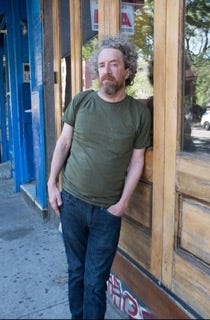
The late Hal Hirshorn was a singular artist, a unique photographer and painter. He used 19th Century techniques such as salt print photography to create uncanny, out-of time images. As it turned out, Hal Hirshorn and I had some more recent history in common. In early 2023, Hal emailed me after reading some of my online posts about NYC during the early 1980s. Hal had moved into 78 Washington Place — the same dump that was my first Manhattan address — in 1989. We had a friendly and fascinating exchange about our similar experiences with Jeff Reidel, the super-eccentric building super. What Hal didn’t mention was that he continued living at 78 Washington Place right up until his death on February 4, 2025.
The building was poorly maintained when I got there. Jeff was super and he provided various things, in my case a fridge from the sidewalk that I helped him haul up and paid him $5 for, it turned out to be a dud as the freon was gone, the fridge had that peculiar gassy smell of leaked freon. Gradually the building was renovated with new owners and it’s become quite posh with NYU students, people in the fashion industry and other wealthy types, as with most of the West Village.
Jeff passed away in 2011, l think. At the end he had a substantial amount of money he was able to live off, from the sale of a property in Florida that was once the proverbial swampland in the 1930s but turned out to be of some value as well as some property in Linesville, PA. A friendly but persistent man used to wait on the stoop for him in order to buy the properties, as Jeff had no phone. As a result he had some money — more than he’d ever had. Adult protective services had to come by at one point with an entire dumpster and a crew of workmen to clear out everything he accumulated over the years.
I think he lived into his 90s. [According to another longtime resident, Jeff was 55 in 1981 so he would have been 95 when he died.] He had Alzheimer’s but before that he would tell me stories about being in the Army of Occupation in Germany after WWll, and would tell me anecdotes in his peculiar way, he relished telling me about Goering’s suicide and how the Germans celebrated this as it was a comeuppance to the Americans whom the occupied Germans despised. He had other stories which will probably come back to me.
It was pleasantly surprising to me that he had a clean apartment and money after everything he endured.
However I imagined Jeff Reidel ending up it wasn’t with a pile of money and a clean apartment! I’m not sure which is more astonishing. Well, at this point nothing about the man should come as a surprise. More than once, Jeff mentioned that he’d lived somewhere in Pennsylvania and worked at a YMCA before coming to New York City. He also said he’d been mugged and wound up in St Vincent’s hospital right before I moved into 78 Washington Place. Throughout my tenancy, he constantly dodged bill collectors.
As Hal Hirshorn wrote, Jeff Reidel had survived all kinds of wars in his life. It makes me feel better learning that he achieved some kind of comfortable situation in his later years, at least until Alzheimer’s stole him away. I hope my telling of his story — or the version of his story that he shared with me — repays that debt and honors his memory.
 Mark Coleman