Villa Triste, Missing Person, Young Once, Honeymoon, In The Café of Lost Youth
“Sometimes you remember certain episodes of your life and you need proof that you haven’t dreamed them.”
— Patrick Modiano, In The Cafe Of Lost Youth
We’ve all experienced a silver summer: a season or period in our lives that glows, inflamed with retrospective significance. While it’s happening we may sense some looming consequence, or not. Over time these magical moments become embedded in memory and endure, gathering profundity even as the remainder of life mundanely accumulates and all our subsequent memories jumble and meld together.
At some point, usually in middle age, we begin to reflect: examining and polishing the impressions of that special time. Every silver season is deeply entwined with recalled images of other people, or a certain person. And in the novels of Patrick Modiano, all silver seasons are irrevocably tarnished.
Over the last month I’ve read five novels by Modiano. In varying measures, a silver season or formative era figures in each of these slender volumes.
Although he’s the author of more than 40 books, Patrick Modiano (born in 1945) wasn’t widely known outside of his native France before he won the Nobel Prize for Literature in 2014. As well as novels, he’s also written plays and children’s books. At age 27 he co-wrote the screenplay for Louis Malle’s 1974 film Lacombe, Lucien and beginning in the late 1960s, he wrote song lyrics, some recorded by Françoise Hardy and other French pop singers.
Between their terse prose and propulsive pace, the five novels I read — devoured, really — resemble detective fiction and/or tales of espionage. Yet crimes in Modiano World are ambiguous, and characters spy on their own histories. The past is a nagging, devilishly persistent vision that can neither be fully remembered or forgotten. In Missing Person,detective Guy Roland is an amnesiac struggling to piece together his identity: sifting through old photos and fitfully interviewing secondhand witnesses to his former life.
In Villa Triste, 18 year old Victor Chamara (“that’s the name I used on the registration form”) arrives in a resort town. His desire to escape a hazy troubled past for the anonymity of a “safe zone” in nearby Switzerland serves both as a metaphor for post-adolescent discovery, and a reference to the Nazi-dominated Paris that he’s fleeing. This is Modiano’s underlying theme, surfacing in all these novels: how France suffered collective amnesia with regard to the German occupation during World War II.
Victor falls in with an oddball dynamic duo. Yvonne (“family name? I’ve forgotten it”) and her sidekick, the gay doctor René Meinthe, are only a few years older than Victor but seem to be far more worldly and experienced. At least on the surface. “What brought them together was their shared boredom with small-town life and their plans for the future.”
Yvonne and Victor conduct an affair, alternately torrid and languid, with René relishing the role of their hedonistic, borderline-creepy mentor. This summer romance sparks, and fizzles suddenly, as the season itself wanes.
“Time has shrouded all things in a mist of changing colors: sometimes a pale green, sometimes a slightly punk blue. A mist? No an indestructible veil that smothers all sound and through which I can see Yvonne and Meinthe but not hear them. I’m afraid their silhouettes may blur and fade in the end, and so, to preserve a little of their reality…”
In Young Once, Louis and Odile are a comfortable couple, parents of two small children, who take stock of their lives at age 35. They recall meeting in their early twenties, as new fresh-faced arrivals in Paris during the late 1950s or early 1960s. Odile hoped to launch a singing career while Louis, fresh from military service, knocked around: basically open to anything. So he was especially vulnerable to recruitment by the dubious Brossier, a sketchy entrepreneur cum bullshit slinger who pulls Louis into his money laundering schemes. Odile gets similiarly entangled with Georges Bellune, a sleazy music-biz promoter. Joining forces, Odile and Louis manage to pull back from the brink before descending into criminality or worse. A decade later, their louche and disreputable coming of age recedes in the distance.
“Something — he wondered later if it was simply his youth — something that weighed upon him until that moment broke off him, the way a piece of rock slides slowly into the sea and disappears in a spray of foam.”
The past resurfaces, and refuses to recede in the concise (even by Modiano standards) Honeymoon. Killing time in a bar, documentary filmmaker Jean B. hears a triggering news report. “My heart missed a beat: the woman who had taken her own life, as the barman put it, was somebody I had known.” Jean puts his own life on hold, ghosting his wife and work partner Annette, while he reconstructs that silver summer on the Riveria decades earlier, when the late Ingrid and her husband Rigaud befriended him. Memorably (or not), they accompanied him to a jazz festival in Provence Juan-les-Prins.
“We lived only at night. I have not the slightest recollection of Juan-les-Prins in the daytime. Except at the fleeting moment when the sun rose. There were so many faces around us that they have all become merged and I can’t make out which one belonged to Dodo Mamaroso (real-life jazz musician). The orchestras played in the pine forest, and that same summer I met Annette. In those days, I thought I was happy.”
In the present, Jean can only speculate about what drove Ingrid to suicide, though Modiano subtly suggests she might be Jewish, raising the spectre of Occupation once again. “It was as if she had jumped from a sinking ship just in time. She didn’t want to think about her father because she still felt too close to that dark, silent zone from which no one would ever be able to escape now. For her part, she had only just managed it.”
In The Cafe Of Lost Youth was my favorite, and possibly the place to start with Modiano because this novel reads like the oral history of an au courant underground scene. Set in 1950s Paris, it could just as well be downtown NYC in the 1980s or any local bohemian place and time of your choosing.
“I watched the customers. Most of them weren’t more than twenty-five years old. A nineteenth-century novelist might’ve described them as ‘the student bohemians.’ But few of them, in my opinion, were enrolled at the Sorbonne or the Écoledes des Mines. I must admit that watching them up close, I didn’t have high hopes for their futures.”
A charismatic young woman known as Louki becomes a beloved regular at a funky bar called the Condé, and then disappears. Each chapter recounts her story in a different patron’s voice, hers included. Gradually, we learn Louki’s real name was Jacqueline Delanque; she entered a brief marriage, mostly to escape a claustrophobic home life with her single mother, who worked as a hostess at the Moulin Rouge. The Condé was her oasis, where she became close with an aspiring writer named Roland. He recalls their milieu:
“I remembered the text I was trying to write back when I knew Louki. I had called it On Neutral Zones. There was a series of transitional zones in Paris, where we were on the border of everything else, in transit, or even held suspended. Within, we benefited from a certain kind of immunity. I might have called them free zones, but neutral zones was more precise.”
For Louki, Roland and other colorful Condé barflies such as Zacharias, Jean-Michel, Fred, Tarzan and La Houpa, what feels lost is not just youth but any sense of advancement, opportunity or adventure. They’re stuck in time, preserved in amber before they even begin to live their adult lives.
“For me, the Condé was a refuge from all the drabness I anticipated in life. There will one day be a part of me — the best part — that I will be forced to leave behind there.”
Looking back to a silver season is at best a dangerous proposition. Reading Patrick Modiano, especially In The Café Of Lost Youth, constantly reminded me of Marcel Proust’s masterpiece In Search of Lost Time (À la recherche du temps perdu), especially this passage from The Guermantes Way.
“Poets claim that we recapture for a moment the self we were long ago when we enter some house or garden in which we used to live in our youth. But these are most hazardous pilgrimages, which end as often in disappointment as in success. It is in ourselves that we should rather seek to find those fixed places, contemporaneous with different years.”
Donna Summer defined the disco era. Her brazenly sexual hits “Love To Love You Baby” and “I Feel Love” horrified some and delighted many more when they came out. They also helped to propel disco into a national phenomenon. Even now, the sound of her voice – controlled yet passionate – summons up the hedonistic, willful spirit of the late 1970s.
Summer died from cancer Thursday at 63. Her passing offers an opportunity to reconsider her musical contributions and the legacy of disco. But she deserves more than nostalgic praise, because her records with producer Giorgio Moroder have had a lasting effect on pop music.
Listen to Lady Gaga’s “Born This Way,” for starters. Not only does the disco-inflected rhythm evoke Summer’s dance tunes, but as a gay-pride anthem, it recalls the roiling, joyful setting in which Donna Summer’s music first found its audience. Disco originated in the 1970s New York club scene, and it was Summer’s “Love To Love You Baby” and then the Bee Gees’ “Saturday Night Fever” that catapulted it onto the national stage. In “Love To Love You Baby,” a strong-voiced woman gives herself over to pure pleasure. This feeling of abandon reflected the spirit of the emerging gay liberation movement.
Back then, the music and its culture was huge. But to be honest, these days Donna Summer – and the disco craze she embodied – sometimes get a bum rap. Disco is a kind of guilty pleasure for people of a certain age, a slightly embarrassing hangover from the simultaneously wild and innocent days of their youth.
But they – we – have nothing to be ashamed of, and neither does Donna Summer. Because underneath the flashy exterior and dated trappings of the best disco records lurks true heart and soul. And disco records don’t get better than the ones Donna Summer made with Moroder.
“Love To Love You Baby,” a Top 10 hit in 1976, largely consists of vocal moans and sighs over an orchestrated rhythm track. “At first it was startling, almost embarrassing – even in this age of rampant pornography,” wrote critic Albert Goldman in 1978. And Summer’s sexy album covers fed into the disco diva persona. But she was no moonlighting fashion model. Born in Boston, she had performed in European productions of “Godspell” and “Hair” before she met Moroder in Germany.
Moroder crafted a sleek musical background for her creamy vocals, cushioned by strings, synthesizers and a fluid dance beat. When the tingling “I Feel Love” hit the Top 10 in 1977, her sound became almost purely electronic. Perhaps this is the moment when the machines began to take over the music business. In reality, Donna Summer never conformed to the stereotype of disco singer as producer’s plaything, despite Moroder’s commanding presence. She was ambitious, releasing concept albums such as “A Love Trilogy” and “Four Seasons of Love” and an epic disco-fied version of “Macarthur Park,” by 1960s songwriter Jimmy Webb.
And at the end of the 1970s, Summer came into her own. The double album “Bad Girls” was her magnum opus. Even disco-hating rock fans were taken aback. “Bad Girls” added soaring lead guitar lines and more varied songwriting to the mix. The singles “Bad Girls” and “Hot Stuff” took this disco-rock fusion to the top of the pop charts, while the slow-dance “Dim All the Lights” revealed more of Donna Summer’s personality than her earlier hits.
Later in the ’70s, Summer became a born-again Christian and began to distance herself ever so slightly from her sexy image. In the 1980s, America moved on from disco, and so did Summer. She dabbled in Las Vegas schmaltz, made an ambitious album with Quincy Jones (“Donna Summer”) and came bouncing back with the assertive “She Works Hard for the Money” at the dawn of the MTV era.
She continued to record comeback albums well into the 1990s, but over the past decade or so, the new music came less frequently. And her music gained hipster cachet, even fully divorced from the cultural flash of its time. Indeed, every synth-pop group from Depeche Mode on down owes Donna Summer a big thank you, if not a royalty check, for the influence and innovation of “I Feel Love.”
“Generally I don’t think there is too much art involved in what I do,” said Moroder in 1978 at the peak of his career. “But I do know that I achieved something specially different with ‘Love To Love You Baby’ and ‘I Feel Love.’ These songs will endure.”
The opinions expressed in this commentary are solely those of Mark Coleman.
Appropriating abandoned couches, appliances and houseware from the city streets was apparently a New York thing: a hobby for some and others, a way of life.
In early 1979 I first experienced Andy Warhol’s cinematic oeuvre when a campus film society screened the Paul Morrissey-directed Trash. Originally released in 1970, this plotless wallow in depravity accompanies a junkie hustler (Joe Dallesandro) and his trans roommate (Holly Woodlawn) on their daily rounds. To say Trash transported my Midwestern sensibility to an unexplored continent would be obvious, and beside the point. What struck and stayed with me was the sequence where Holly and Joe retrieve battered furniture from the street — “garbage picking.” Somehow I found this ineffably moving, even tragic, while everyone else seated nearby erupted in laughter.
And it turned out to be prescient. Two years later I encountered another, even craftier urban prospector living downstairs in my first Manhattan apartment building. Appropriating abandoned couches, appliances and houseware from the city streets was apparently a New York thing: a hobby for some and others, a way of life.
*
Moving into 78 Washington Place, during early spring 1981, didn’t take long. My possessions consisted of two suitcases, briefcase, clock radio, electric typewriter.
Apartment 3C came furnished. The metal bed was fitted with a thin mattress and itchy blanket, reminding me of the bottom bunk at summer camp. (It proved to be considerably less comfortable.) There was a reasonably clean and functioning mini-refrigerator, the boxy kind found in college dormitories. The institutional-beige paint on the walls smelled fresh. Nudging the shadowy corner wall were a flimsy-looking wood table and mismatched kitchen chair. Dirt encrusted windows didn’t admit much sun and a lonely overhead bulb barely helped. An antique hotplate sat on the table, its twin burners supporting a dented kettle and warped frying pan. The shallow closet was the size of a cupboard; a chipped porcelain sink clung to the wall beneath a mirror dotted with paint drips. As advertised, the communal toilet and shower facilities were located near the stairway in the hall.
My first day began on an industrious note. I deposited the teapot and filthy frying pan in a garbage can on my way out to grab a cup of coffee. Later I took a ten-minute stroll up to West 14th Street and stumbled on a block of rock-bottom discount stores between Sixth and Fifth Avenues. There I purchased two plates, small pot and pan, pair of place settings plus serrated knife, two drinking glasses, cereal/soup bowl and large mug for coffee or tea. The whole deal me back $15 with no mention of tax.
At home I tried to draw up a grocery list, but it was hard to determine what I could actually cook on the hotplate besides an egg or can of soup. Frying bacon or a burger would no doubt trigger the lunar-shaped smoke alarm on the wall. The vast limitations of this minuscule “studio” sunk in fast. My first apartment was no more than a room. The panic switch in my stomach flipped for a few swirling seconds, but I vowed to hang tight.
Just then I heard a knock on the door, followed by a voice instantly familiar from my first visit to the building.
“Mark, hi Mark? It’s Jeff, Jeff The Super, you know…oh Hi.”
“What’s up?
I must’ve looked distracted because he blanched and hesitated, waiting a few seconds before edging his way through the open door.
“Well I heard the radio so I knew you were in here. Where did you go earlier? When I came by before, there was no answer.”
“Yeah I wandered up to 14th Street and bought a couple things for the place, like some glasses and stuff. A new frying pan.”
“Wha-what was wrong with the ones here? You bought new…”
His eager green eyes opened wide in astonishment.
“Jeff, the glasses in the cupboard had spiders living in them.”
This seemed to placate him for a moment.
“You know, this apartment did sit vacant for awhile. Glen, the guy who lived here, he ah died a couple months ago.”
Here Jeff went silent for a moment, reflecting. I anticipated a memorial of sorts, some revealing fact or anecdote about the late tenant.
“That’s why you got this nice new paint job.”
I noticed that Jeff had a plastic shopping bag in hand.
“Looks like you went to the store, too.” I nodded at his bag. This forced social encounter felt like making conversation with one of my widowed great aunts.
“Oh this,” he replied, hoisting it aloft. “That’s why I stopped by. Thought you’d need some toilet paper.”
Four individually wrapped jumbo rolls tumbled onto the table.
“How about some toothpaste? Do you have a toothbrush?”
Whatever illusion I had about Jeff’s visit as a magnanimous get-acquainted session went straight out the window. The toilet paper was no Welcome Wagon gift. This old weirdo was trying to hustle me!
“Jeff I think I’m set on toothpaste and stuff. I never thought to ask about toilet paper, though, doesn’t the building provide it?”
“Oh no,” he said with an ashen look.
“Well I can pick some up when I go to the grocery. Thought I’d try Sloane’s over on West 4th Street.”
“B-but you’ll be needing toilet paper.” Suddenly Jeff was upset, almost shaking, plainly offended by my polite demurral. So I wound up paying him $4, undoubtedly an absurd markup, mostly because I felt sorry for him. But my blinders had been removed. Or so I thought at the time.
78 Washington Place in the 21st Century
The superintendent position at 78 Washington Place in 1981 was, how shall we say, a low-impact job. At least it was the way Jeff Reidel performed it. His duties consisted of (sporadically) collecting the trash and (superficially) cleaning the shared bathroom on each floor. His main gig and true calling, his métier, was scavenging. Jeff was a garbage broker, a speculator in recyclables, a trash tout. He picked investments out of the staggering array of flotsam and jetsam left to rot in the city streets. He combed the urban beaches, the New York equivalent of those borderline-derelict Florida retirees who used to patrol the oceanfront, wielding their metal detectors like divining rods.
Generously, Jeff offered to share his finds with me, asking for a nominal fee only after he’d hauled the junk up to my apartment. None of this was desired nor encouraged. Jeff would show up, plunk down a tattered lamp or rusty toaster oven and start to admire it aloud, conducting a sort of hard-sell seduction until I’d finally fork over the suggested $5 or $10 just to get rid of him. Returning all this weather-beaten house ware to the street wasn’t an option, not after his wounded inquiry the one time I tried it.
“You’re not going to believe this but I found another table fan like yours…hey wait a minute…” Eventually, the unbidden furniture and appliance deliveries wound down. There just wasn’t much room left in my room.
Another template was established during my first week on Washington Place. Accepting Jeff’s offer to show me “some good cheap restaurants I know about” immediately opened the door to daily invitations. As a compromise, I joined him for dinner maybe twice a week.
Jeff was a creature of habit, orbiting around a dozen-plus homey favorites (mostly Greek-American diners or Cuban-Chinese “rice & beans” joints), while keeping his eyes peeled for the occasional off-night discount or “all you can eat” special at slightly more costly eateries. Getting him to leave even the skimpiest tip anywhere required the application of a full-on guilt trip.
But as the summer wore on, I avoided eating with Jeff anywhere east of Broadway. The Ukrainian and Polish fare on offer throughout the East Village was right up Jeff’s alley: starchy, filling and cheap. Borscht, pierogis stuffed with meat or potato, kielbasa with sauerkraut. But for me, there was a catch. Unlike the Greek-American diners Jeff frequented in the West Village and Chelsea, east side coffee shops like Kiev, Leshko’s, Veselka, and Odessa were full of people closer to my age not to mention appearance. As I began to fit into the downtown scene, or at least not stand out quite as much, I became aware of how incongruous Jeff appeared as my dining companion. We were one odd couple.
More and more, I dined out alone (another hallowed New York City tradition).
Jeff became visibly confused and hurt by my sudden reluctance to discuss the day’s New York Times over leisurely meals. Looking back, I’m stunned by my callow behavior — bordering on cruelty — toward the unfailingly kind (and oddball) advisor who’d mentored me: “showing me the ropes,” as he often phrased it. But as my raw hunger for human company abated, or became sated in other situations, socializing with Jeff Reidel started to seriously cramp my style.
*
“Hello? M-M-Mark? It’s me, Jeff. Your old super.” He always spoke haltingly, but this time Jeff sounded downright nervous, stuttering. It had been a solid year since I escaped the dangerously decaying 78 Washington Place for a tiny studio on far west 14th Street.
We’d kept in touch for six months or so after I relocated, though our dinner dates soon grew infrequent and increasingly strained, at least from my perspective. When I barely knew anyone in New York, Jeff supplied a psychological lifeline: for all his cagey eccentricity he was definitely intelligent and intellectually curious. Apart from reading the same newspaper, however, we had basically nothing in common. And as I began to carve out a life in the city, making friends and establishing myself as a writer, spending time with Jeff became an irritating obligation. After I abruptly turned down a series of near-pleading invitations, he stopped calling. Until this autumn day in 1982.
“Have you h-h-heard of this play Torch Song Trilogy? It just moved to Broadway from Circle In The Square in the Village?”
“Sure I read about it the Times. Harvey Fierstein, right?”
“He’s marvelous. Well I got two tickets from the language school and I’ve already seen it so I could let you have them for $10 each. Too bad we can’t see it together.”
This was one of Jeff’s fund-raising schemes; he’d re-sell the free theatre tickets and museum passes that were intended for his ESL students. I’d always resisted his offers in the past, but I’d never been to a Broadway show. The price was right.
“I’m strapped for cash these days but I would like to see it. So yeah, I’ll take ’em off your hands. Hey, wait, when’s the show?”
“N-N-Next Saturday night. We…well…why don’t we meet for dinner tonight at the Courtney and I can give you the tickets there.”
“Just like old times. OK, Jeff, I’ll see you there at seven.”
“Thanks, Mark. Don’t forget the $20.”
*
It was cold for an October evening; I shivered in my denim jacket as I walked east across 14th Street. Gus the counterman greeted me with a big smile when I entered Jeff’s favorite coffee shop. I still ate at the Courtney every so often but I was careful to arrive when I calculated Jeff wouldn’t be there, usually for a late morning breakfast or early lunch. At the time I felt pangs of guilt about avoiding him, but running into Jeff would have been even more uncomfortable. That’s how I felt then, anyway.
I slid into the cramped booth in back and splashed milk into the scalding cup of coffee that Gus delivered seconds after I sat down. I faced the door so I could see Jeff arrive but his entrance was still a shock.
He showed up in a what appeared to be a woman’s coat, a tan number with fur collar, ragged cloth, a size too small. I gathered it was warm if nothing else but he’d buttoned it unevenly so the collar hung open in a way that suggested depression, desperation, even derangement. Clearly this was an act of pragmatism — of sheer survival — rather than a failed attempt at cross-dressing. Jeff’s discerning eye for functional cast-offs clearly didn’t extend to clothing.
We got through dinner and made our exchange. I can’t recall what we ate or talked about; I know I didn’t say much. All I remember is how lost he looked, this bent bony stork of a man in clothes the Salvation Army or Goodwill would’ve rejected. That spring day when we met just 18 months before felt like a lifetime ago. Whatever debt I owed him was paid, I quietly decided to myself.
I never saw Jeff Reidel again.
Looking back I’m shocked by my younger self, appalled at my indifference. When I moved to New York, Jeff took me under his wing as he undoubtedly would’ve said, and instead of saying thank you by keeping in touch, I brutally ghosted him. Though it’s way too late for redress or regrets, only now I can acknowledge all he did for me.
“Seabury Treadwell’s Family At His Deathbed” By Hal Hirshhorn
The late Hal Hirshorn was a singular artist, a unique photographer and painter. He used 19th Century techniques such as salt print photography to create uncanny, out-of time images. As it turned out, Hal Hirshorn and I had some more recent history in common. In early 2023, Hal emailed me after reading some of my online posts about NYC during the early 1980s. Hal had moved into 78 Washington Place — the same dump that was my first Manhattan address — in 1989. We had a friendly and fascinating exchange about our similar experiences with Jeff Reidel, the super-eccentric building super. What Hal didn’t mention was that he continued living at 78 Washington Place right up until his death on February 4, 2025.
The building was poorly maintained when I got there. Jeff was super and he provided various things, in my case a fridge from the sidewalk that I helped him haul up and paid him $5 for, it turned out to be a dud as the freon was gone, the fridge had that peculiar gassy smell of leaked freon. Gradually the building was renovated with new owners and it’s become quite posh with NYU students, people in the fashion industry and other wealthy types, as with most of the West Village.
Jeff passed away in 2011, l think. At the end he had a substantial amount of money he was able to live off, from the sale of a property in Florida that was once the proverbial swampland in the 1930s but turned out to be of some value as well as some property in Linesville, PA. A friendly but persistent man used to wait on the stoop for him in order to buy the properties, as Jeff had no phone. As a result he had some money — more than he’d ever had. Adult protective services had to come by at one point with an entire dumpster and a crew of workmen to clear out everything he accumulated over the years.
I think he lived into his 90s. [According to another longtime resident, Jeff was 55 in 1981 so he would have been 95 when he died.] He had Alzheimer’s but before that he would tell me stories about being in the Army of Occupation in Germany after WWll, and would tell me anecdotes in his peculiar way, he relished telling me about Goering’s suicide and how the Germans celebrated this as it was a comeuppance to the Americans whom the occupied Germans despised. He had other stories which will probably come back to me.
It was pleasantly surprising to me that he had a clean apartment and money after everything he endured.
Hal Hirshorn photo by James Maher
However I imagined Jeff Reidel ending up it wasn’t with a pile of money and a clean apartment! I’m not sure which is more astonishing. Well, at this point nothing about the man should come as a surprise. More than once, Jeff mentioned that he’d lived somewhere in Pennsylvania and worked at a YMCA before coming to New York City. He also said he’d been mugged and wound up in St Vincent’s hospital right before I moved into 78 Washington Place. Throughout my tenancy, he constantly dodged bill collectors.
As Hal Hirshorn wrote, Jeff Reidel had survived all kinds of wars in his life. It makes me feel better learning that he achieved some kind of comfortable situation in his later years, at least until Alzheimer’s stole him away. I hope my telling of his story — or the version of his story that he shared with me — repays that debt and honors his memory.
Author Gary Indiana in 1989, photo by Robert Mapplethorpe
Reading reviews by the late author Gary Indiana during the second half of the 1980s, I figured the guy was a lunatic, to be honest. Vituperation and vendetta marked his tenure as art critic of The Village Voice, from 1985 to 1989 — alongside viperish wit and deadly-stiletto targeted prose. That’s why I never missed reading his column.
For instance: the critic was not amused when the 1985 Whitney Biennial included work by a celebrity/fashion magazine photographer. “Bruce Weber should not be in the same room with Ron Bleckner and Annette Lemieux. He should have his own room. It should be in New Jersey.” Or when he encountered, in 1987, the portrait of an already ubiquitous Manhattan real estate mogul, glaring from the cover of Vanity Fair: “Trump looks like an especially virulent, shifty-eyed loudmouthed accumulation of baby fat.”
Born Gary Hoisington in 1950, this New Hampshire native adopted his pen name somewhere between his godforsaken hometown of Derry and the so-called City of Angels in California, where he tread water through most of his twenties, toiling for Legal Aid and trawling gay bars, enmeshing himself in the nascent punk scene, reading voraciously and slowly accepting the realization that he was a natural-born writer. Once he landed in New York City, just before the dawn of the 1980s, his pen hit paper and then came the deluge: plays, screenplays, short stories, novels, reviews and essays poured forth until October 23, 2024, when Gary Indiana succumbed to cancer.
“After I came to New York in 1978, I experienced about three years of chaotic, impoverished, youthful excitement and desperate creative improvisation,” he told The White Review’s Michael Barron in April 2016. “Followed by a decade of nonstop death of people around me from AIDS…people who keep dredging up what a great place New York was thirty or forty years ago should just shut up and open a funeral home, where nobody minds if you talk about dead people all day.”
I first encountered his writing in the pages of Bomb, a pioneering art and cultural magazine covering the downtown scene. Bomb also introduced artists such as Cindy Sherman and Robert Longo; back then I found their images to be more accessible than the accompanying stories by Gary Indiana and Kathy Acker. Those two transgressive writers were way above my intellectual pay grade in 1982. But they snugly fit next to each other in my mental file cabinet: I’d get to them (and get them) at a later date.
Not for the first time, it took the death of an author for me to realize how much I’d missed by not keeping up. There were intimations along the way; over the last decade I began seeing Gary Indiana name-dropped online by sharp literary-minded millennials.
Reviewing the anthology Fire Season: Selected Essays 1984–2021 in New Left Review, Ryan Ruby succinctly captures Gary Indiana’s newfound relevance.
“American readers born in the ’80s, in particular, have been drawn not just to his nuclear-grade pithiness, his brazenly queer and bohemian narrative persona and his marriage of the techniques of American New Journalism and French avant-garde fiction, but also to the refreshing absence, rare among members of his generation, of nostalgia and apologetics in his accounts of the political events that have formed the pre-history of their lives.”
I take that last bit to mean that Gary Indiana, nominally a baby boomer, expends little or no energy dwelling on cliched subjects such as Vietnam and Civil Rights, which of course he doesn’t because there was so much going on right in front of his face.
“We were the first generation of people to have a Salk vaccine, flu shots, so you didn’t get diphtheria, smallpox, measles,” Indiana told Bomb editor Betsy Sussler, upon the 1989 publication of his first novel, Horse Crazy. “We are the first generation to actually not have these kinds of illnesses. And low and behold we get into our thirties and this thing is coming along that’s killing everybody. And the additional fact that it’s sexually transmitted is very freaky. It’s the thing that affects people most. The idea that it has to do with sexuality is what makes it so hideous.”
The AIDS epidemic haunts and informs the novels of Gary Indiana. It’s not merely theme or metaphor but a persistent menacing presence, an inescapable cruel tide that ebbs and flows without ever fully receding.
From Horse Crazy onward, through novels Gone Tomorrow (1993), Rent Boy (1994), Do Everything In The Dark (2003) and the elliptical memoir I Can Give You Anything But Love (2015), characters and narrators alike hurtle through an existence split between the open-ended possibilities offered by living “alternative lifestyles” and the impending doom of a possible (likely) early death. These rent-stabilized downtown Manhattan melodramas are not so much ominous as realistic, reliably gritty and full of mordant humor. His characters’ haphazard paths render Indiana’s almost plotless novels compelling despite their lack of direction. Depressed and/or dissolute, these offbeat people persevere because what else can you do?
When Ryan Ruby refers to the influence of avant-garde French fiction we can safely assume he means auto-fiction. Large swaths of the novels are frankly autobiographical; even if you didn’t know Gary (and I didn’t) his various narrator’s voices, their depictions of milieu and social circles — romantic fixations, former lovers, fast friends, sleazy hangers-on, not-so-innocent bystanders — all feel so familiar as to be transparent.
But never, ever nostalgic.
Consider another snippet from the 1989 Bomb interview between Indiana and Betsy Sussler. He was relentlessly clear-eyed, and on point about East Village bohemia.
BS: There is a demi-monde in New York that embraces sleaze. All those desperate people who still think it’s cool to die young. Horse Crazy is the quintessential New York novel. It isn’t a wacky, safe (as in homogenized and palatable) vision of what people would like to think New York is like.
GI: Yeah. Gregory [barely reformed addict and the narrator’s obsessive love object] is the kind of kid, who came from Connecticut, eighteen or nineteen, went to the Mudd Club, saw all those people in their late twenties being cool and striking poses — but they were doing work — and he didn’t get that part of it. To him, it was all about the pose. You see it now. It hasn’t stopped. There are people who still think crawling from one nightclub to another every night is some kind of glamorous activity. He’s like that.
This is a crucial aspect of the 1980s NYC aesthetic that often gets lost or left out of the endless recounting of junkie squalor and outré sexuality. Whatever else you got up to you had to do the work or risk setting yourself adrift — becoming a purposeless poser. For some, the imminent threat of early demise only increased that sense of urgency.
I disagree with Ryan Ruby about the influence of New Journalism on Gary Indiana or anyway with the notion that he did especially notable work in his various magazine stories: largely routine fish-out-of-water travel pieces. Branson, Missouri is an easy — too easy — target. His efforts in this area are perfectly serviceable but hardly innovative.
While avoiding the perfumed deceptions of nostalgia, Gary Indiana sought to unearth the funky truths of his own past, throughout all his novels. “All the recent necrophiliac nostalgia for the late 1970s and early 1980s New York — a period that I did draw on a lot in Horse Crazy and Rent Boy, also in Do Everything In The Dark — is so off-base that I didn’t want to engage with it at all.” Paraphrasing Martin Amis, a novelist we can guess Gary Indiana had no use for, when men reach middle age they become aware of a new continent within themselves and that is the past. Gary Indiana fearlessly explored this shadowy region, minutely examining the ramifications and repercussions of his own messy life history. He was mercilessly frank, and constitutionally incapable of cheap sentiment.
The aforementioned Horse Crazy traces the jagged outline of an emotionally doomed love affair. If not quite the quintessential New York novel of the period as Betsy Sussler suggested, it’s authentically bleak and memorably unsettling, haunting on multiple levels.
I must be a square or squeamish because the relentless, detailed scatology in Rent Boy grossed me out. Later I realized that may be part of the point; Indiana forces his readers to confront the numbing repetition of sex work, the dehumanizing nature of peddling your ass on a daily basis.
Gone Tomorrow resembles an early low-budget film by Rainer Werner Fassbinder, or more properly an on-set diary from the making of one. I didn’t think there were any taboos left to be violated until this novel’s concluding sequence. No spoilers: suffice to say the genuinely shocking and tasteless behavior documented is well, credible in context. Here is the rare instance where Gary Indiana brazenly dares you to be offended, or flinch. In general, what makes him such a vital and incisive writer is the way he (mostly) avoids gratuitous violations of propriety as he dives head first into the netherworld.
Discussing the early 1980s New York scene in The Paris Review, Indiana said: “Many of us went on to do things that were infinitely more interesting and complex than what we were doing then.” Do Everything In The Dark documents this downtown diaspora, twenty years later. There’s a beautiful melancholy to the interlocked stories, with the unforeseen 9/11 attacks subtly looming like an inevitable hangover and AIDS still hanging over everybody’s heads albeit at a lessened threat level for some.
The following passage is so resonant I can’t isolate a handy quote. Here’s Gary Indiana, from Do Everything In The Dark,remembering people who passed through his life, and he through theirs, as a “flicker of lightning, a single facial expression, a faint breath, a photograph, a faint tug of the heart.”
“…the people who showed up and left again so quickly that they only left an image dissolving in a doorway; the people who hung around for years familiar as an old shoe and one day transformed themselves, changed everything from the ground up, flew off like butterflies or crashed to earth from a preposterous height; the people who withdrew, monastically, into a harsh discipline of silence; people who cleaned up their acts and went nowhere with them; people we envied for their great looks, their money, their mastery of situations, who crumbled physically and mentally collapsed after decades of furtive dissipation; the people we still know but never see; the people we disliked for years, but came to appreciate; the people we liked at first and grew to despise after long periods of almost unconscious study; people we wanted to sleep with but didn’t; people we slept with impulsively, more or less by accident; people we yearned for and made fools of ourselves over, who rejected us then, and years later, when everything that inflamed us about them had long sputtered out, attached themselves to us with fierce unwanted desire; the famous who dropped into obscurity, befriended us in those luckless times, and dropped us when fortune smiled again; the people who lived in a different world, and mistook us for other kinds of people than we were; the people we could never quite look in the eye.”
The memoir I Can Give You Everything But Love is where it all comes together, Gary Indiana’s gimlet eye and poetic ear, his acerbic mind and carefully guarded heart. The 21st Century sections set in Cuba constitute masterful postmodern travel writing, while the interspersed look-backs are deeply revealing and cumulatively moving. And oh yeah, they’re also mean in a thoroughly entertaining way: just bitchy enough to be wildly funny. And the sections on his protracted coming-of-age in 1970s California prove that Gary Indiana could be harder on himself than anyone.
Saved for a rainy day are Gary Indiana’s “untrue true crime novels,” or in the words of his great friend and fellow author Lynne Tillman, documentary novels — literary riffs on real-life scandals: Resentment: A Comedy on the Menedez Brothers, Three Month Fever:The Andrew Cunanan Story and Depraved Indifference, about the murderous mother-and-son scammers Sante and Kenneth Kimes. I plan to read the last one first.
Vile Days: The Village Voice Art Columns 1985–88 confirms his oft-stated ambivalence about the basic project of art criticism. It comes across loud and clear in the actual art reviews. The best pieces in Vile Days are about art books, other art journalists, the “art scene” in general, The New York Flower Show, a furniture exhibit, live performances by Marianne Faithful and Sandra Bernhard, garbage in the street, and the death of Andy Warhol (“I’ll Be Your Mirror.”)
“Andy was a working boy. He worked hard, he made his money, they buried him with the blessings of his church. A saint for all the wrong reasons. And isn’t that what America is all about?”
Reviewing his late frenemy Kathy Acker for the London Review of Books in 2006, Gary Indiana deploys his withering on-the-mark aim as a literary critic.
“Acker often claimed that she was ‘doing something new with language’, meaning something on a par with Gertrude Stein or William Burroughs. But one can’t avoid noticing what she wasn’t doing with it: making sense, communicating with readers, contacting a world outside her cerebellum. Acker pre-empted criticism of her solipsistic procedures by pronouncing them elements of her master strategy: she wrote badly because she intended to; she did everything wrong because that was her technique for deconstructing ossified literary conventions. How such a writer came to be regarded, by a substantial cult, as feminist oracle and literary innovator has a lot to do with academic fashion.”
Ouch. Still he ends generously, even sympathetically.
“Acker had begun to acknowledge the existence of the reader. I like to think that one day she would have surprised everyone with a truly important book, one that wouldn’t need defending with arabesques of pataphysical jargon.”
An unfinished Gary Indiana novel, recently unearthed, is another untrue true crime story. Using a pseudo-journalistic oral history approach, the remnants are tantalizing. At the very end he was, once again, onto something — a refreshed approach to familiar fascinations.
If Gary Indiana never wrote that one “important” book, then the sum total of his oeuvre is something better than important: it’s alive. The pulsing, throbbing document of a city and a way of life that are almost forgotten or fading fast, told in an utterly original voice.
If Richard Meltzer didn’t invent the post-grammatical mode of discourse utilized on the internet, then he prefigured it to a degree that’s uncanny.
I’m living for giving the devil his due
— Blue Oyster Cult, “Burnin’ For You” (lyrics by Richard Meltzer)
Today the mainstream media covers pop music so extensively — exhaustively? — that it’s impossible to imagine the situation during the swinging late Sixties. When monolith media ruled there was an informal consensus: big-city daily newspapers, weekly newsmagazines such as Time and Newsweek, three television networks — all the major outlets — barely deigned to acknowledge rock and roll during its purported heyday. The young folks’ music was handled gingerly if at all, regarded from a lofty height, treated with disdain or condescension or both. Until the emergence of the underground press, and eventually Rolling Stone, anyone interested in learning more about the songs and singers they encountered on radio and records had to swallow their pride and peruse teenage-focused fan magazines such as 16 and Tiger Beat.
As the hippie counterculture flourished, new periodicals arose that were, in varying degrees, dedicated to the new music, covering it in relative depth. Filling these pages were writers and editors such as Jon Landau, Robert Christgau, Ellen Willis, Greil Marcus, Jann Wenner, Paul Nelson: they proudly pursed a self-consciously cerebral or anyway a more considered approach than the breathless teenybopper gazettes.
And then there was Richard Meltzer.
From the start, he was sui generis: never a thoughtful essayist, user-friendly consumer advocate or conscientious record-rating reviewer. Publishing in pre-Rolling Stone journals such as Fusion and Crawdaddy, Meltzer practiced criticism as Beat poetry, performance art, juvenile prank, standup comedy — all at once. His first book, The Aesthetics Of Rock was almost impenetrable on purpose. Published in 1970, Aesthetics had been largely composed several years before, as Meltzer’s college thesis in philosophy (rejected). It stands as both an academic parody, and a boldly convoluted statement of purpose.
My thesis here is straightforward: Richard Meltzer is the most influential writer to arise out of the boomer rock and roll cognoscenti. Reviled by many of his peers and respected by few even at his zenith (forget about now), Richard Meltzer nevertheless stands as the sole cultural critic of his generation with any sustained contemporary relevance. Because, this: If Meltzer didn’t flat-out invent the post-grammatical mode of discourse utilized on the internet over the last couple decades, in both form and to a lesser degree content, then he for damn sure prefigured it to a degree that’s uncanny.
Let’s get the big claim out of the way: Richard Meltzer, born in 1945 and thankfully still with us, pioneered the way people write online. Many of the prose tricks ‘n tics that millions of people utilize daily, in text messages and social media posts, originated with Meltzer’s groundbreaking writing on popular music and other cultural detritus during the Sixties and Seventies. (He kept on writing until very recently, in an expanded yet still “difficult” style on a wider range of subjects — more about that later.) Meltzer was part of the aforementioned first wave of writers who addressed rock and roll on its own terms, as opposed to pandering to or patronizing its fan base. Yet he disrupted the nascent field of rock criticism. You want creative destruction? In the anything-goes Sixties, Richard Meltzer regularly went too far. Even hippies thought he was too much.
From the start, he displayed a tactile, physical sense of letters and words. The clunky old typewriter was his painter’s palette. His artistic practice came to include:
*CAPITALIZATION and italics used as emphatic and rhythmic devices
*playful deployment of “punctuation”
*misspelling on porpoise
*strategic and/or tactical abbrv & contr’t’n
*puns and the lowest of low humor — gross dirty jokes! — plus oodles of SMUT
*embarrassing self-disclosure employed as both true confession and assault weapon
Alarmingly prolific from the start, he also published as R Meltzer and under pseudonyms such as Borneo Jimmy, Lar Tsub, Ozzard Dobbs, Audie Murphy Jr.
“Everybody picked his own little niche,” Meltzer said of the Sixties in a late Nineties interview. “I remember doing a piece at the time of [The Rolling Stones LP] Between the Buttons and “Strawberry Fields/Penny Lane” [Beatles 45 rpm single] that was 20 pages long, talking about just those two events. At the very least, it didn’t feel anything like journalism. If anything, it was like ringside coverage of the sun coming up.”
Before his irreverence about rock tipped into cynicism (around 1972), Meltzer could connect with the right subject on an essential, nearly spiritual level. The mere titles of these two reviews speak volumes: “Pythagoras The Cave Painter” (Axis: Bold As Love by The Jimi Hendrix Experience) and “Getting It On And Taking It Off With Iggy & The Stooges” (Iggy Pop live at Ungano’s during the summer of 1970). Almost equal to his love for The Beatles was his deep affection for The Grateful Dead.
By his own admission he fell out of love with rock music early in the Seventies (The Dead were never the same after Pigpen died), though perversely his output of music writing increased exponentially as the Me Decade lumbered on. Even his overstuffed anthology, A Whore Just Like The Rest: The Music Writings of Richard Meltzer (2000), doesn’t capture everything he published during the Seventies. Generous to a fault, AWJLTR manages to simultaneously skim the surface and scrape the barrel-bottom.
Rolling Stone’s short-lived book division Straight Arrow Press published a Meltzer anthology titled Gulcher: Post-Rock Cultural Pluralism in America (1972). It’s a hastily assembled clearance sale, by the author’s own admission, and most readers will agree. It’s bizarre, and also funny. Gulcher corrals discursive discourse on records, movies and TV, plus bottle caps (“The Cap Collector’s Handbook”), cigarettes from a non-smoker’s perspective (“Luckies Vs Camels: Who Will Win?”) and sports (“Grappling’s Cascade of Blood,” “Hot Times From Wrestling’s Golden Quarter Century 1945–70”).
Straight Arrow Press folded not long after, due to mismanagement, and Meltzer’s relationship with Rolling Stone soured around the same time, as his increasingly ah eclectic approach didn’t gibe with the magazine’s increasingly earnest music coverage. Meltzer’s confreres and fellow travelers-on-the-edge Lester Bangs and Nick Tosches were also cut loose from the soon-to-be-mainstream biweekly in the early Seventies.
But the baby-boomer music business boomed at least until 1979; more records released every year meant more music magazine pages to fill with ads — and reviews.
During the Watergate era, Meltzer published in august rags such as Creem, New Haven Rock Press, Phonograph Record Magazine, Zoo World, Rock, Changes, Waxpaper, Coast. That’s a mere sample, culled from A Whore Just Like The Rest.
“So I reviewed albums I didn’t listen to,” Meltzer told Andrea Juno of REsearch in 1987, describing his work routine in the preceding decade. “I reviewed the cover; I reviewed one album as if it were another one. I reviewed concerts I never went to…for example I reviewed a big Neil Young concert in Carnegie Hall that I didn’t go to. I said that in the middle of the show he brought out a stool, sat down and read poems that were really good. Then I quoted three of my poems. That appeared in a New York newspaper.”
Richard Meltzer really did write poetry, not so much out of the Beat tradition like his prose, closer in spirit and affect to the New York School: Frank O’Hara boiled down to a rancid concentrate. Representative title, from a 1980s chapbook: 17 Insects Can Die In Your Heart. His blank verse would be perfectly suited to song lyrics and what do you know, he contributed to a dozen or more tunes by cerebral heavy metal band Blue Oyster Cult. Meltzer became acquainted with the nucleus of that band, and their producer/manager Sandy Pearlman, as an undergraduate at SUNY Stony Brook on Long Island during the mid-to-late sixties.
You can have my autograph
I think I’ll sign it good health to you
Upon the cast, your broken arm
— Blue Oyster Cult, “Stairway to the Stars”
“Burnin’ For You” reached Number 40 on the Billboard Top 100 in 1981. It was Blue Oyster Cult’s second biggest hit (the cowbell-clanging “Don’t Fear The Reaper” hit Number 12 in 1976) and stuck in Meltzer’s craw for decades afterwards. He eventually ended his relationship with the band over disputed royalties. Other Blue Oyster Cult songs co-credited to Richard Meltzer include: “She’s as Beautiful as a Foot,” “Stairway to the Stars,” “Teen Archer,” “Cagey Cretins,” “Harvester of Eyes,” “Death Valley Nights,” “Dr. Music,” “Lips in the Hills,” “Burnin’ for You,” “Veins,” “Spy in the House of Night,” “Stone of Love, ” “The Return of St. Cecilia.”
Another sign of Meltzer’s compulsive productivity during the Seventies is the relatively scant handful of his many contributions to The Village Voice appearing in A Whore Just Like The Rest. Under the exacting editorial eyes of Robert Christgau at the downtown weekly, Meltzer’s freewheeling style may have been slightly reigned in. But the imposed discipline sharpened his attack, whether he was violating the opera house (“Meltzer at the Met”) or trailing free jazz to the heavens (“Dolphy Was Some ‘Weird’ Cat”).
In a typically inexplicable move, Richard Meltzer relocated from New York to Los Angeles just as punk rock reared its brutally shorn head at CBGB in 1975. Once ensconced in LA, Meltzer fronted his own (mercifully short-lived) punk unit Vom, bellowing ditties such as “I’m In Love With Your Mom” and “Electrocute Your Cock.” His cryptic Blue Oyster Cult lyrics and post-beatnik poetry sound Shakespearean in comparison. Though in Los Angeles, his printed-page practice found a more-or-less sympathetic audience. At first. The heavy metal-flaked sound and (barely) post-adolescent stance of much Southern California punk rock was right up Meltzer Alley. Quite possibly he felt more comfortable amid these young suburban rebels than the arty bohemians back on The Bowery.
More importantly, Vom’s handful of gigs inspired Meltzer’s equally short-lived and possibly more infamous radio show. Hepcats From Hell only lasted about one year (1980) on listener-supported KPFK, until Meltzer managed to get dropped (for using curse words without the preceding language disclaimer), despite being on the air between 2:00 and 6:00 on Sunday morning. And as the extended hangover also known as the Eighties rolled in like a marine layer of Pacific Ocean fog over Santa Monica, Richard Meltzer, along with many Sixties survivors, felt compelled to reinvent himself.
So he did. As a lifestyle writer? In authentic Meltzerian fashion he was closer to an anti-lifestyle writer, or a (semi) lovable misanthrope at large, everybody’s favorite curmudgeon about town.
LA Is The Capitol of Kansas: Painful Lessons in Post New York Living ably sums up his Eighties output, primarily drawing from the “alt-weeklies” LA Reader and LA Weekly. This is Richard Meltzer at his most consistently readable.
The two-part dining guide “Burgers I Have ET” is, though far from mouth-watering, an incisive and predictive satire of the nascent foodie phenomenon. Though it’s worth noting that the late and lamented virtuoso LA restaurant critic Jonathan Gold was a vocal Meltzer fan. The dystopian “A Guide to The Ugliest Buildings In LA” is self-explanatory, vividly detailed and revelatory — even or especially if you’ve never been west of the Rockies.
The problem with Richard Meltzer — his Achilles Heel, his soft underbelly — is sexism, possibly tipping into misogyny. He’s guilty as charged, unrepentant at times, beyond what can be expected from a man of his generation. I’ll quietly suggest he’s not an absolute CREEP but I can’t argue if you choose to see him as such. As evidence we’ll examine two pieces from LA Is The Capitol of Kansas. One is damning and the other, maybe, just maybe, partially explanatory though far from exonerating. Consider them a pair of personal essays, or a pair of two-person too-personal essays.
“The Girl Who Never Ate Pizza” is frankly appalling. This is Richard Meltzer the Neanderthal Man. Even if we give him the benefit of doubt, and believe this doomed encounter was as mutually consensual as the author claims, his behavior (fully detailed) falls somewhere between misread signals, unwanted physical attention, and narrowly thwarted date rape. The fact that he finally accepts “no” as an answer is cold comfort. As their one-on-one poetry seminar ends in ashes, the younger (by twenty years) woman shows her would-be mentor to the door.
“‘Mainly, I don’t think I could handle showing up in somebody’s poem.’ I forgot to tell her I also write prose.”
Full disclosure: I’m disgusted, I don’t approve, but I laughed at that last line anyway.
“A Bookstore Story” flips the script. Meltzer journeys across town to a bookstore “specializing in HOMOSEXUAL — authored lit” in search of obscure William Burroughs titles. He finds the books he’s looking for, and more. A pimply late teenage male who’s “showing signs of experimental razoring” on his face follows Meltzer to his car, bumming a ride with the bemused (but not for long) author. He deflects the kid’s verbal advances as gently as possible, displaying unexpected patience, even understanding.
“This guy is worse than me with the ladies… at last I know how females feel. I know how they feel when even verbal is too much to parry, when these persistent S.O.B.’s are just so … annoying. (I learned my lesson — GALS TAKE NOTE — & will never persist with ’em, uninvited, again.)”
I didn’t have the heart to check if “A Bookstore Story” was published after “The Girl Who Never Ate Pizza.”
Richard Meltzer 1988, photo by Anna Statman
Richard Meltzer reached his Nineties apotheosis early in the decade, writing about the Rodney King decision and ensuing riots. The San Diego Reader published “One White Man’s Opinion” in 1992 and after that howl of righteous pain and outrage there wasn’t much left for Meltzer to consider in the Land of Sunshine. Prescient ain’t the word; this white man’s opinion will resonate and sound horribly familiar to many people today.
“L.A. TV’s vilest hour (every channel, every newsperson, no exceptions) from naked live to edited fake in no time flat…running bullshit graphics like The L.A. Riots and Violence In The Streets instead of Travesty of Justice or Racism ’92…airing The Cosby Show for ratings and social control…the most rightwing major town in America — the goddam Bible Belt had nothing on this place.”
It’s easy to understand why Meltzer moved north to not-yet-trendy Portland Oregon around 1995. It’s also easy to understand why the returns on satirical alt-weekly essay writing diminished, aesthetically and emotionally if not financially, for Meltzer as the decade wound down. I recoiled with the acute paranoia of a new parent when I read a late-period Meltzer piece of “stunt journalism” in the LA Reader where the author gamely donned a Santa Claus suit and worked the malls at Christmas time.
Published in 1995, The Night Alone: A Novel was no doubt intended to lift Meltzer to a new level. All too predictably, once again, that didn’t happen. “The best thing I ever wrote, and [publisher Little, Brown] dropped it off a cliff,” he complained to an online interviewer early in the next century. For my money, well honestly I borrowed a copy from the public library, it failed to live up to the A Novel promise in its title. Hey I wasn’t expecting Madame Bovary but The Night (Alone) disappoints even considered on the loose criteria of contemporary autofiction. When the “novelist” wheeled out his anecdote about starting a snowball fight with the New York Dolls on a Manhattan street, for the third or fourth time, I hung my head in despair. In Meltzerian terms: A real crisis of IMAGINATION in an original stylist who previously never lacked “I” — is a bummer.
The ravages of aging are unavoidable so why not write about them? Hence Autumn Rhythm (2003) a collection of essays focused on “Time, Tide, Aging, Dying And Such Biz” and the last (so far) bound volume by Richard Meltzer. His bloody-minded humor and indomitable spirit are unbowed, but speaking as a certified geezer and Medicare recipient, this subject matter is tough if not impossible to render in an interesting or original way. Sympathetic? Sure. The tribute to his ailing cat made this lifelong non-pet-owner feel sad, though his guide to flirting with young barmaids was sad in a less sympathetic sense. Meanwhile complaints about the internet (in 2002, who knew) or being snubbed by initially friendly young folks (OK boomer) were cliched right out of the starting gate.
When he finally gets around to er music, recounting that time he first heard The Beatles (aka the White Album) with a roomful of rapt (wasted) hippies, recommending scratchy old country blues records and a honking Coleman Hawkins saxophone solo, Autumn Rhythm comes full circle. Here Richard Meltzer achieves something akin to closure. No wonder he’s since retired from writing, though a new (or unearthed) “novel” is threatened.
I’ll conclude by paying tribute to the most culturally significant (unintentionally!) piece of writing by Richard Meltzer, possibly his funniest, and surely the most potent distillation of his renegade prose style.
“Buy A VTR And Rule The World” first appeared in the November 13, 1978 issue of The Village Voice and is collected in the long out of print The Village Voice Anthology 1956–1980. Here Meltzer embraces an emergent technology — the video tape recorder — and celebrates the liberation of TV viewing from the “tyranny” of scheduling. After the introduction of video taping came the deluge, the tide of all-conquering acronyms: VCR, CD, DVD, PC. (And I guess AI.) Without knowing what would occur over the decades to come (because nobody did!), Meltzer heralded the bright new dawn of interactive pop culture: from audio taping to digital file sharing and beyond. It’s hard to explain to anyone born after say, 1975, exactly why TV Guide was the best-selling magazine in the United States for decades. But if you get past the dated references, “Buy A VTR And Rule The World” provides a full measure of old world flavor. Not to mention the kind of lead paragraph you can’t learn to write in journalism school.
“Network television’s been shit for years now, I mean name me a goddam current televised anything — exclusive of sporting events — that can even remotely compete with ‘Leave It To Beaver’ or ‘The Night Stalker’. ‘Laverne and Shirley’ is about it, the ‘$1.98 Beauty Show’ is a BIG disappointment. If you said ‘Rhoda’ or ‘Taxi’ or one of them y’might as well be reading something charming like Louisa May Alcott or James Thurber or one of them: y’know, charming literature. TV’s always supposed to’ve been BIG & CRASS which is just jake with me but all it’s become lately is small & bland unto death. I mean you ever try dealing with ‘The Waverly Wonders’? Bland worthless on a FRIDAY NIGHT. Or ‘Dallas’? B.w. on a SATURDAY NIGHT (is worse than cancer).”
Richard Meltzer not only foreshadowed our brave new 21st Century digital existence, he helped pave the way. So remember him the next time you post a meme or drop an emoji. But hey, don’t blame him.
Leaving my office job one evening in early 1982, I descended the stairway into the Lexington Avenue E train station and spotted a young man furiously chalking up the blank black surface that (temporarily) covered an empty billboard. I immediately recognized Keith Haring; his graffiti-inspired subway drawings were attracting attention all around Manhattan, and he was quickly becoming a well-known figure himself downtown.
*
In 2024, purchasable items bearing Keith Haring’s imagery include:
MOMA Design Shop magnet set with barking dogs and break dancers.
Uniqlo baseball hat with the Radiant Baby.
Urban Outfitters lounge pants with flowering-head people.
Zara high-top sneakers with Haring’s signature thick black lines.
*
coustesy of MOMA Design Store
A line in art is an identifiable path created by a point moving in space. In Radiant: The Life and Line of Keith Haring, biographer Brad Gooch ably documents the artist’s blazing and tragically brief trajectory. Born in 1958, Keith Haring grew up in Kutztown, Pennsylvania, a rural college town near the city of Reading in the eastern part of the state. Keith displayed a talent for art as soon almost as he wrapped his fingers around a crayon or pencil. His art teachers noted the distinctive line in his drawings and comics from the beginning. Pop culture, especially the wonderful world of Disney, was a primal, and enduing inspiration for this pure product of the Sixties.
*
As many teenagers did in the Seventies, Keith tried on and discarded various identities (though deep down he always considered himself an artist at heart). During his period as a so-called Jesus Freak, around ages 14–15, he plastered Kutztown with handmade “Jesus Saves” stickers. A premonition of the public art that would follow?
*
Throughout his foreshortened life, we can draw a line tracing Keith Haring’s search for a community of like-minded souls, which he usually found. From Jesus Freak to high school burnout to Grateful Deadhead to Club 57 cool kid on St Marks Place to outlaw graffiti writer in the subway system to Andy Warhol-associated pop celebrity to AIDS activist with Act Up, he embedded with compatriots and made his indelible contributions.
*
In between graduating from Kutztown Area High School in 1976 and moving to New York City in 1978, Keith attended the Ivy School of Professional Art in Pittsburgh.
“Within six months I came to realize that no matter what, I wasn’t going to be a commercial artist. I mean, a lot of the students and a lot of the teachers were saying that they were becoming commercial artists only to support their own work as real painters and sculptors. But I saw through that right away. I realized that if I spent the whole day doing mechanicals and pasteups, I wouldn’t have any interest left in doing my own work afterwards. Well, I decided if I was going to be an artist, that’s what I was going to be.”
*
In fall of 1978, Keith Haring began classes at School of Visual Arts. According to Brad Gooch:
“Without any sort of formal campus, SVA was oriented toward the urban streets, with most students about on busy Twenty Third Street or in the laxly guarded first-floor lobby.”
Most of the faculty were working artists, rather than full-time teachers.
*
“Keith soon found a way to wed his night-time cruising and his daytime activities: he began drawing penises, obsessively.”
*
“Also enrolled [with Keith] in Barbara Schwartz’s Sculpture course that semester was Kenny Scharf, another twenty-year-old first-year student. Looking like a long-haired surfer, he had just arrived from Southern California, where he, too, had been a self-styled hippie and where he, too, had grown up infatuated by the bright colors and zany story lines of Hanna-Barbera TV cartoons as well as by the futurism of space-age dreams of intergalactic travel and extraterrestrial beings — the stuff of the Star Trek TV series.”
Kenny Scharf became Keith Haring’s lifelong friend, confidante and sometime rival.
*
“One day while Keith was on his way into SVA, a teenage kid with severely cut hair and a look that registered as ‘cool in a way’ asked Haring if he could walk him past the security guard. Keith said ‘sure’ and they chatted so the guard would know they were together. Keith disappeared into his class and when he emerged an hour later, he noticed fresh tags and screwed poems on the corridor walls. He recognized they had been done by Jean-Michel Basquiat, the street artists of Haitian and Puerto Rican descent who, along with his partner, Al Diaz, went under the name SAMO, short for Same Old Shit.”
Never close friends, Keith Haring and Jean-Michel Basquiat nevertheless remained friendly over the next ten years. Competitive at times, they always held each other’s work in high regard.
*
Another SVA friend and fellow Club 57 partygoer and performer, photographer Tseng Kwong Chi made it his project to document Keith Haring in action. Beginning with the subway drawings in 1980–81 and continuing through the decade, until he succumbed to AIDS in 1990 just two months after Haring died, Tseng Kwong Chi shot more than 40,000 photos of Keith at work and play.
Keith Haring and Tseng Kwong Chi 1985; photo by Tseng Kwong Chi
*
“Throughout the summer of 1982, Haring, back in New York, was immersed in creating work at one studio or another, sometimes alone, sometimes with [teenage graffiti artist] LA II, yet never at the expense of his public art. He simply doubled his output, setting up a syncopated rhythm that persisted throughout his career, as he would usually accept invitations to galleries or museums at home or abroad — when the offers began to multiply — only if a mural or other (usually unpaid) public project could be set up, too. His main public access channel in 1982 remained the subway, and his chalk creations did not lag.”
*
The charge of appropriating grafitti never stuck to Haring; he was widely accepted and even revered by the urban subway artists. As Keith explains:
“The stereotyped idea of a graffiti writer is a Black or Puerto Rican kid from the ghetto. It’s not really what it turned out to be at all. There are equal amounts of white, black and Puerto Rican graffiti writers, or Chinese or whatever. Most of them grew up in the city. If I had grown up in the city, I would probably have been doing it also.”
*
Keith Haring took part in the 1983 Whitney Biennial, alongside Jean-Michel Basquiat, Jenny Holzer, Barbara Kruger, David Salle and Cindy Sherman.
*
By 1984, Keith Haring had established a long-term, live-in relationship with Juan Dubose. He’d also become a devotee of DJ Larry Levan, religiously attending weekend parties at Paradise Garage the way some people went to church every Sunday.
Keith Haring cover for NYC Peech Boys 1983 LP, produced by Larry Levan
“Throughout the Eighties, I always knew I could easily be a candidate for AIDS.”
*
One of Keith Haring’s most famous commissions was body-painting white lines of the statuesque body of choreographer Bill T. Jones. Haring and Jones became friendly, and here the dance master comments on Keith’s relationship with Juan Dubose.
“Keith loves people from a class lower than his own. Well, there’s a responsibility that goes with that. And that responsibility is not just how generous you are, but how you can bring that person up through his emotional perils and feelings of inadequacy. Does Keith really know what it means to set up house with someone who is not as educated as he and is more emotionally and financially handicapped? So I talked to Keith about these things. But you can only push Keith so far …. until he’s finally not there. So I called him the Ice Man, and because he’s an Ice Man he loves hot and passionate people.”
*
Actress and performer Ann Magnuson, Keith’s compatriot from Club 57, recalls how the downtown scene transformed during the middle Eighties.
“Everyone was in the same boat. Then Jean-Michel changed the equation and made it uncool to be poor. Jean-Michel was the first. Keith came not long after. With Keith, it was just explosive. it wasn’t just getting by. It was a massive amount of money. That was part of the tsunami that came in with Reagan’s second term. Jay MacInerny published Bright Lights Big City. The go-go yuppie thing happened. The tenor of New York City changed. It was a new ballgame, at which Keith excelled. He was hitting home runs all the time. We were all thrilled for him. He wasn’t a snob about it.”
*
Not all of Keith Haring’s old friends were thrilled about his newfound celebrity status. In the words of Keith’s early Eighties roommate Drew Straub:
“He had gone jet set and everyone had one name. It was ‘Brooke’ and ‘Michael’ and ‘Madonna’ and ‘Grace’ and ‘Yoko.’ It was his one-name period and he was completely starstruck and everyone was a celebrity. He was so excited to be there.”
Even Andy Warhol found Keith’s star gazing to be over the top when they attended the MTV Awards together in 1985. “The TV cameras had already left so Keith was really upset,” he wrote in The Andy Warhol Diaries. “I mean, I like Keith, but it was so sick.”
*
Around 1985 he started making sculpture, to mixed reviews, but Keith Haring clearly enjoyed the challenge. “I really love to work” he wrote in his journal. And he did, judging all the evidence presented by Brad Gooch. Partying and hanging out with one- named celebrities seemed to fuel him rather than distract him, or dissipate his creative energy in the slightest.
*
Keith Haring’s Pop Shop grand opening was April 19, 1986. Haring-branded merch included T-shirts ($12-$25), magnets ($5-$12), buttons (50 cents), coloring books ($5) and skateboards ($55-$155).
Vintage T-shirt from The Pop Shop
Brad Gooch documents a Keith Haring working trip to Paris in 1987:
“Arriving in the morning, he took a taxi into town to drop off an unpainted canvas tarp at the Center Pompidou, to be finished by him for an exhibition of painters who had risen over the last ten years; and to take a meeting at Hôpital Necker, a children’s hospital where he hoped to do a mural on an exterior concrete stairwell about ten stories high. Some of the hospital directors were nervous because Haring worked without any preliminary plans and the tower was highly visible, so he had rushed over to draw a quick sketch for them and to explain his improvisatory technique to allay their fears.”
*
Jean-Michel Basquiat died on August 12, 1988.
“Over the next few months,Keith never stopped honoring his departed friend. [Haring] painted a homage to Basquiat, A Pile of Crowns for Jean-Michel Basquiat. On a triangular canvas ten feet by nine feet, bordered in a STOP sign shade of red and limned in black, Haring painted a vibrant pile of three-pointed crowns, Basquiat’s tag, along with his familiar copyright symbol.”
*
Keith’s AIDS diagnosis in early 1988, long suspected, adjusted his focus without slowing down his Herculean productivity. He threw in with Act Up, donating his time, money and what would become one of his best-known series of word-images: Silence = Death.
“Everything I do now is a chance to put a crown on the whole thing. It adds another kind of intensity to the work that I do now; it’s one of the good things that comes from being sick. if you’re writing a story, you can sort of ramble on and go in a lot of directions at once, but when you’re getting to the end of the story, you have to start pointing all the things toward one thing. That’s the point I’m at now, not knowing where it stops, but knowing how important it is to do it now. The whole thing is getting more articulate. In a way, it’s really liberating.”
*
“Keith Haring lived until 4:40 AM on February 16, 1990.”
In his final waking hours he struggled with paper and a black Sharpie, attempting to draw one last Radiant Baby.
*
Roaming the Upper West Side of Manhattan on an undistinguished day during the pandemic year of 2020, I walked past a public middle school. It was closed but student art projects were visible behind a fence. “Haring and Basquiat” read the sign above, though that was unnecessary as the graffiti-inspired sculpture and Godzilla-with-crown painting on display made for instantly recognizable homages to the two deceased artists. I realized that my peers Keith and Jean-Michael, gone more than thirty years now, were no longer Andy Warhol’s inheritors but his stand-ins, the definition of an artist for today’s young people: the new Warhols. Art is eternal, even if artists aren’t.
Star Hits August 1984 “Win A Date With The Thompson Twins”
Since Star Hits readers were predominantly teenage girls, it makes sense that two dynamic young women helped to refine and redefine the magazine’s vision during the months following its successful launch. From the moment Alicia Keshishian followed Phoebe Creswell-Evans as art director in mid 1984, the already-spectacular pages erupted in a blinding, vivacious wash of full-spectrum colors and floating typefaces. Alicia brought a new radiance to the magazine, reflecting and echoing the energy in the music. In person she was a high-spirited, pixie-haired sprite with a ready laugh, who dressed as just colorfully as the layouts she designed.
Alicia and her colleague Michael Ottersen (a notable artist in his own right) were electrifying collaborators, open to amplifying what we trying to do with the words. This relationship was uncommon in print publishing (in my experience), where “art” and “editorial” were all-too-often at odds. Of course editor David Keeps contributed to this process by corralling ambitious photo sessions and conceiving articles not only in terms of words but images too. Learning to visualize stories was the best thing I learned at Star Hits, something I took with me to future editorial jobs.
Around the same time Keeps replaced David Fricke as editor-in-chief, a college student named Suzan Colon segued from intern to associate editor. I won’t say “effortlessly” because that would belie how hard Suzan worked. Sitting beside her for the next 18 months, I watched in growing admiration. She made it look easy, which is of course a sign of true talent.
Suzan kept me in stitches with her keen sense of humor, and kept me sane with her down-to-earth sensibility. Most important she was a natural writer. And since she was a) only a few years older than our readers and b) counted ardent music fandom in her resume (substitute the band Japan for Duran Duran), Suzan knew exactly where our readers were “coming from.” Over time her presence endowed Star Hits with a voice of its own, slightly distinct from the English-accented Smash Hits. Her background as a fangirl and her quick-study intelligence brought grounding — authenticity — to a breathlessly trendy magazine.
In short order Suzan also stepped into my role as Keeps’s concert sidekick and promo-party date. This suited me fine, as my social agenda and musical priorities were in flux. No doubt the balance of power in our small office shifted too. Yet we still enjoyed each others’ company, while the pressure to perform increased exponentially as the year proceeded.
Each issue went to press with the highest of hopes, only to disappoint weeks later when the sales figures rolled in. There were many reasons proffered as to why this or that cover image didn’t move magazines off the newsstand. Yet astonishingly, I don’t recall any mention of the fact Star Hits was no longer advertised on MTV. No surprise: sales dropped like a stone as soon as those commercials were discontinued mid-way through 1984. You can’t buy a magazine if you’ve never heard about it.
And selling ad pages in the magazine itself never appeared to be a priority for our publishers, weirdly, despite the efforts of stalwart ad salesman Steve Korte. Ever buoyant and cheerful, Steve served as our Gibraltar when office life got turbulent. Eventually, his facility with the written word and easy command of all popular culture (from punk to Broadway musicals) proved so editorially useful that he switched sides. The ongoing lack of ad pages doubled the reliance on editorial coverage — especially cover images — to generate income i.e. sell the magazine.
Even as the magazine came into its own aesthetically, every cover choice for Star Hits came to be viewed as a high-stakes dice roll by Felix Dennis and his partners. These bets were preceded by do-or-die debates, and invariably followed by grim postmortems. Would Brian Adams “deliver” though he was a bit acne-scarred not to mention unfashionably “rock and roll” and were Tears for Fears so glum-looking and uncharismatic that they couldn’t sell magazines despite their huge hit singles? No and yes, for the record. Such were the dilemmas of late 1984, continuing into 1985.
*
Win A Date With Duran Duran was so successful that the mail-in contest concept was duplicated with Prince, Thompson Twins and several others. A “date” with Prince meant attending his concert since the purple-costumed recluse refused to meet with journalists, let alone magazine readers. Anyway, all “meeting” the stars usually amounted to was a brief, awkward backstage conversation and maybe a handshake or chaste hug. The coveted prizes also included a free meal — with the ravenous Star Hits staff — at the Hard Rock Cafe, a newly opened boîte on 57th Street. Though popular with visitors, to us this joint fit the definition of a tourist trap, decorated with corny music memorabilia: autographed Fender Stratocasters, Gibson Les Pauls and the like. Naturally, the Hard Rock hashed out mediocre American fare. The most memorable dish served there was an ice cream sundae, ordered by our favorite freelance photographer Andy Freeberg, that contained jutting shards of broken glass. Scant apologies were offered by the management — forget about a refund or gratis treat. Frankly, we were relieved that this potentially fatal desert wasn’t placed in front of the contest winners.
The Star Hits Lookalike Contest was a triumph even though the prizes were less elaborate — Walkmans and Polaroid cameras. Dressing up as your favorite member of Duran Duran, Boy George, Madonna, Cyndi Lauper et al proved irresistible to many readers. I can’t recall who the winner impersonated; as far as I was concerned, I won! The in-house ad soliciting contest entries featured yours truly posed in before and after shots. Styled by the irrepressible Keeps and photographer Stephanie Chernikowski, I appeared twice in the full-page ad; first as the super-nerd character Nervous Norbert, in horn-rims and a hand-me-down tweed sport coat. After an off-camera makeover, I re-emerged as Sir Billy Idol himself, complete with dyed hair, raised fist, ripped leathers, fake tattoo and a snarling Elvis-esque sneer on my lips. This was my only photographic appearance in the magazine, and once the word spread among my friends and family it was impossible to live down. Not that I minded in the least.
Sir Billy Idol’s long-lost American cousin photo by Stephanie Chernikowski
Win A Date With The Thompson Twins
The winner of Star Hits Win A Date With The Thompson Twins will not only see this terrifyingly brilliant trio live in concert but will get to meet these sweethearts in the flesh. Can ya dig it? Though you might. The Grand Prize Winner and a companion will be whisked away on a cloud (or reasonable facsimile) to catch up with the Thompson Twins at the most convenient locations and meet the Twins themselves!
Reality reared its unkempt head with the Thompson Twins contest. Where the previous contest winners had been teenage girls accompanied by more or less protective parents, this time was different. Eyebrows were raised in the office when the 15-year-old-ish winner arrived from upstate New York with her “best friend” in tow, a young woman nearer to my age (27) who registered closer to co-conspirator than chaperone. Dinner and the concert followed without incident, however, and the Twins themselves met-and-greeted backstage with élan, charming our two readers. “It was the best 24 hours of my life!” gushed the Grand Prize Winner in a taped account I later transcribed and printed as a concert review. Representing the magazine that night, I deposited the two women at their hotel around midnight. As far as I could tell, nothing untoward, no post-concert shenanigans, appeared as even a remote possibility on the horizon.
The next afternoon, Felix Dennis entered the editorial sanctuary wearing a mirthless grin and we gathered round. Star Hitscontests were about to become less ambitious. Without mentioning how he found out, Felix informed us that our Grand Prize Winner and her gal pal had exited their room not long after I dropped them off, and proceeded to “party” with members of the Thompson Twins entourage until dawn. The rest of that discussion is a blur, though I distinctly recall the words “pregnant” and “lawsuit” coming up multiple times. The bottom line was no more lucky readers flying into New York and dallying with the stars.
*
Perhaps mercifully for our impressionable young readers, the amount of actual rock and roll decadence I witnessed over the course of reporting Stars Hits stories was almost non-existent; censorship was unnecessary. Hey, I harbored no illusions about some (or most) of our interview subjects and their more-than-likely predilections for recreational drug use and/or sex, but they were apparently clever enough (and/or strongly advised) to keep it discrete. Since most of our interviews took place in conference rooms at major record company corporate offices, usually everyone concerned was on their best behavior. Sole exception to this rule was the genius funk-master George Clinton; when we met at Capitol Records’ Manhattan tower, he fired up a joint to go with his mustard-encrusted street-cart hot dog as we discussed his vast range of musical influences (including The Beatles and Bob Dylan).
A few months later in 1984, I journeyed to Boston to watch The Cure perform and then interview leader Robert Smith. The day after the (superb) concert I dutifully reported to the band’s suburban motel and promptly knocked on their manager’s door, as instructed by the record company representative.
“Isn’t noon going to be sort of early for these guys?” I’d put this question to the band’s publicist back in New York, only to be assured it was “no problem.” Well it wasn’t a problem, in the end, but it definitely was awkward for a few minutes.
That day in Boston, the motel room door belatedly cracked open and the manager looked me over, grunted “oh you must be the journalist then” and motioned me inside. Two young-ish women and a guy I guessed was the manager’s colleague were stationed around a small table with a large mirror laying on it. Nobody looked as though they’d just woken up, put it that way. Before I could stammer an apology, another knock sounded on the door and Robert Smith himself entered, looking pretty much as he did on stage the night previous: tousled hair and a sheen of pancake makeup. He invited me to accompany him to a nearby laundromat, where we enjoyed an extended and convivial interview. Sheepishly, I must own up to leading the resulting article with the immortal sentence “As the clothes driers spin, the wheels start to turn in Robert Smith’s head…” That’s about as decadent as it got at Star Hits, for me anyway.
Star Hits March 1985: rounding up the usual suspects
“DOO-RAN, BILLY IDOL, MADONNER, WHAM!”
So echoed the Felix Dennis mantra as 1985 wore on and Star Hits sales figures remained in a funk, or at least fell far short of expectations. The obvious solution, as our publisher perceived it, was repeating previously successful covers. Hence the mantra, invoked early and often during the editorial cycle, especially when previously untested artists were floated as possible cover subjects. Billy Idol, perhaps the most musically traditional of this Fab Four, seemed to hold a special place in Felix’s affections. “Billy is my banker!” The boss was adamant. Placing your publishing bets on this ex-punk’s peroxide-enhanced image and slender musical talents seemed to me like a stretch, but what the hell did I know?
By this point, the pop landscape was shifting; Duran Duran went on hiatus, Boy George flaked out and groups such as Tears For Fears, though massively popular thanks to the indelible singles “Shout” and “Everybody Wants to Rule The World,” lacked the star power — the personal pizzaz — required to sell magazines. The next wave from England was led by Depeche Mode and The Cure, both of whom we adored in the office but looked a bit edgy to our publishers. (By decade’s end we were proven correct but musical prescience wasn’t, er, bankable in 1985.) While we made space for all manner of oddball pop in the magazine, from Tones On Tail to Tupelo Chain Sex, the cover became the exclusive dominion of Duran, Billy, Madonna and Wham. The challenge was finding creative variations on these increasingly familiar themes, i.e. creating a reason for going back to the well again and again. And at times it seemed as though only I worried about that source running dry. Slowly but surely that summer, the Star Hits zeitgeist left me behind.
In retrospect, it’s surprising that Star Hits held the attention of Felix Dennis for as long as it did. Sometime in spring 1985, he announced the launch of new magazine under the Pilot Communications banner. MacUser (another marvelously succinct FelDen title) would focus on the new MacIntosh personal computer from Apple. Once again, for all his personal indulgences, Felix’s business instincts were killer. Right on target. From the first issue, MacUser proved to be far more successful than Star Hits.
Even after the advent of MacUser, we wrote and edited the bulk of Star Hits copy (now known as content) on state-of-the-art IBM Selectric typewriters. Theoretically, these devices were a step back from the crude digital word processor I’d used at Video Marketing Newsletter during 1982; in practice, manipulating an electric typewriter was the same as typing on an early personal computer, at least for a canny hunter-and-pecker such as myself. Due to the frequency of deadlines at Star Hits, and our frenetic scheduling, I belatedly learned how to compose stories on the typewriter. Until then, the reviews and features I’d submitted to The Village Voice and elsewhere were initially written by hand. I’d type and re-type the manuscripts into presentable form.
Though my focus rests on the written word here I’ll pause to assert the obvious: the most important, innovative and influential aspect of Star Hits was the look of the magazine. Not only the photographs but the graphic design too, laboriously done by hand in those pre-digital days. And as soon as the lay-out boards and articles were completed in the office, they were whisked away via messenger service (or often by me) to a typesetter tucked away in a Murray Hill townhouse. It sounds so quaint by today’s standards and indeed, technological change was closer than we — or anyone — knew.
Events proceeded fast (another FelDen trademark, or strategy). Since our East 58th Street space was so compact, the expanded operation moved to larger and less decorous quarters on West 38th Street between Fifth and Sixth Avenues. Almost windowless except for Felix’s chambers, the new office felt cramped even though the physical dimensions were more generous. The Star Hits editorial and art departments held down adjacent rooms while the MacUser staff occupied several slightly larger rooms down a narrow hall. Among the backpack-toting ex-hippies running the new magazine was a familiar face. Wippo was back; bursting with ideas for utilizing the Mac computers in graphic design, burning a path in the carpet between our offices for spontaneous blowing-off-steam sessions with David Keeps. For the most part, though, personnel at the two magazines kept their distance. New Pop and personal computing were discrete worlds, attracting dramatically different personalities to serve as tour guides. But any hopes that our publisher’s relentless penchant for micro-managing would be distracted by his new venture were quickly dashed.
“DOO-RAN, BILLY IDOL, MADONNER, WHAM!”
Nick Rhodes at Semaphore East summer 1985 photo by Andy Freeberg
My proudest moment at Star Hits, without question, was the Nick Rhodes cover story in the November 1985 issue. We were starved for a fresh angle on Duran Duran that summer. Like all loyal Durannies, I relished the inside knowledge that keyboardist Nick (“the pretentious one”) was both an Andy Warhol devotee and a budding art collector. At that time there was an art boom in the East Village and Lower East Side, with dozen of galleries featuring work (mostly paintings) by locally-based artists.
I was fascinated by art myself and frequented the East Village galleries. But I didn’t feel knowledgeable enough to write about art as a critic, and despite my newfound confidence, I wasn’t socially secure enough to insert myself into the surrounding scene.
Still it was quite a risky neighborhood. After moving to the East Village myself that spring, I marveled at seeing conspicuously well-heeled groups of middle-aged white women wandering lost on Avenue A every weekend. Of course they were searching for the galleries: Gracie Mansion, PPOW, International With Monument, Civilian Warfare, Nature Mort and so on.
So my brainstorm — probably the brightest idea I had at Star Hits — resulted in a feature called Nick Rhodes Art Attack. The plan was to escort Nick to one of these storefront galleries, pose him in front of the paintings, turn on the tape recorder and and let the pop star play art prognosticator. Improbably, it all came off without a hitch.
I chose the Semaphore East Gallery on Avenue B and 10th Street. The current show was a group exhibit called Semaphoria, displaying a representative sample of neighborhood talent. Gallery director Barry Blinderman welcomed the attention and went well out of his way to accommodate us. Intrepid photographer Andy Freeberg and I arrived by foot on a pleasant summer afternoon. My memory conjures up a dramatic image of Nick Rhodes rolling up much later in a stretch limousine; most likely it was just a full-size car service sedan. In those days, anything bigger than a taxi cab looked like a limo from our downtown perspective.
Nick appeared to enjoy himself, holding forth on the artwork and posing for the camera. Andy’s photos captured Nick’s playfulness and the vivid canvases. I just let the tape roll. Back at the office, I cut and pasted the rambling results into an oral-history-style monologue for the article.
Even in works I don’t like I can pick things out. Maybe something’s attractive to look at but I won’t like the subject matter. Or I might like the subject matter and it’ll seem a shame that it isn’t more attractive. Then I might love something because it’s so unattractive. Even if if I don’t like certain works of art, they still give me ideas. It’s always interesting.
I wasn’t surprised at all when Nick immediately gravitated toward “Not Andy Warhol” by Mike Bidlo; it was a precise duplication of Andy’s Marilyn Monroe silkscreen. I was surprised (and disappointed) that conceptual pieces by Nancy Dwyer (the word “MOIST” displayed on a light box) and Tseng Kwong Chi (photo of the artist in front of Niagara Falls) intrigued Nick far more than the ebullient, playfully animated canvases by my favorite up-and-coming painters Ellen Berkenblit and Walter Robinson. And he insisted we shoot him in front of the painting “Subway Vandal” by former graffiti artist Lady Pink, which he disliked and pronounced “quite bizarre, actually.”
The color and energy of the artwork and Nick Rhodes’ opinionated enthusiasm came through loud and clear in the magazine, leaping off the pages. Besides looking great, Art Attack also achieved the goal of being different than the dozens of other articles we’d run on Duran Duran. And it put me in good stead around the office for a month. Looking back, this story represents not only my peak at Star Hits but the underground-goes-mainstream apotheosis of my early years in the city. Within a month, two more transformative events occurred. I began freelancing for Rolling Stone, eventually leaving Star Hits for a job there. And most important, I met the woman who eventually became my wife. The next level of opportunity and challenge in New York City loomed. By then, I was ready for anything.
Paul Weller and Style Council, live in London summer 1985
During the second half of 1985, the atmosphere at the Star Hits office began to feel awkward and tense. And it was at least partly my fault. Constitutionally incapable of hiding my feelings, I showed up at work every day shrouded in black-dog depression about the magazine’s shifting direction. I projected Mr. Magoo irascibility, no doubt pushing my colleagues’ patience to the breaking point. “You’re working my last nerve” declared David Keeps, more than once.
There were reasons for my gloom. When his focus on the Fabulous Four (DuranBillyMadonnaWham) failed to spike newsstand sales, Felix Dennis nudged Star Hits in the direction of traditional American teen magazines like Bop and the eternal Tiger Beat. This meant expanding our coverage to include pretty-boy television actors; many of whom seemed to be named Corey, and all of whom I regarded with self-righteous scorn.
Now I realize my rebellious attitude, insisting on some spurious notion of musical authenticity, placed David Keeps in an untenable position as my editor and friend. Though we bickered about inconsequential editorial choices, Keeps also tossed me a few bones as peacemaking gestures.
Most gratifying was a whirlwind junket to London, where I interviewed Paul Weller about The Style Council (his follow-up project after The Jam.). Out of all my exotic Star Hits assignments, from interviewing Robert Smith of The Cure at a Boston laundromat to sharing a street-cart hot dog and a joint with George Clinton in a Capitol Records conference room, meeting Paul Weller in London takes the cake. No surprise: the Style Council concert I attended in gritty Brixton was soulful and exciting. And when we sat down afterwards, Paul Weller was both thoughtful and thought-provoking.
Hours before tonight’s long-sold-out show there’s a crowd in front of the theatre, replete with punks, Rastas, mods straight out of Quadrophenia, a couple of stylish kids sporting drooping chin-length bangs in honor of Paul (who’d cut them off already) and sign-carrying supporters of every known political cause.
This week, The Style Council’s mugs are plastered all over London, from ads on the sides of double-decker buses to the covers of seemingly every music publication in existence. One weekly has a photo spread with Paul done up as a sort of punk primitive, complete with crotch-cloth and war paint, cavorting in a lushly colorful jungle. In our interview, let’s just say Paul gives the impression that he doesn’t “heart” Ronald Reagan. But he seems surprised when I ask if he hates America.
“We don’t like the American influence on our country, or Europe, or the world and we certainly don’t like American politics but that doesn’t mean we hate every American citizen. Obviously, they’re not responsible for it. It’s like saying we’re responsible for Thatcher, the Tories and all that. We do differentiate between the Reagan America and the other side. If it’s not clear then it will be after this interview!”
— “International Style” Star Hits November 1985
Everything else about those three days shot by in a blur of boxy black taxis and room-temperature pints of ale. Rocketing around London, I glimpsed a startling surfeit of leafy-green parks spread out under the expected threatening grey skies. Warner Brothers Records put me up at the Portobello Hotel, a notorious music-biz haunt located on a shady street near a tree-lined circle. The Portobello’s fame rested on its bar, open after the pubs closed. My hotel room was almost crypt-sized, smaller than my Ninth Avenue apartment, barely big enough for a narrow bed.
During my brief stay I also managed to re-connect with former Star Hits art director Kimberley Leston at Smash Hits’ cramped-but-cozy office in Soho, where I met the writers Peter Martin and Chris Heath among other staffers. Later we all went out on the town for a night of drinking and dancing that I can barely remember but will never forget. The dollar was riding high in 1985, almost equal to the pound in exchange, so my limited funds stretched far. In an unprecedented act of extravagance and fashion awareness, the next day I bought a compact closet’s worth of clothing from shops on Kings Road, including my pride and joy: a grey Hugo Boss linen suit, for a princely 200 pounds. I flew back to New York City wearing the suit, with a new world of experience under my belt.
*
A month or so after my London junket, David Keeps wrangled three invitations to a comparatively swank Columbia Records affair and invited me and Suzan Colon. More extravagant than your typical freebie-feed for media vultures, this promotional event occurred on a yacht. We were set to circle Manhattan on the Hudson River for a few hours. The raison d’être or excuse was two now-forgotten bands then enjoying minor commercial success with their latest Columbia albums: The Hooters and Cock Robin.
Sporting our best outfits (including the debut of my Hugo Boss suit), we boarded the party boat on one of the passenger piers in far west Midtown. Other than our contacts from the Columbia publicity department, I didn’t encounter any familiar faces (i.e. other journalists) among the crowd of sharp-dressed marketing types and radio executives. Accordingly, the ensuing dinner buffet was sumptuous and the full bar strictly top-shelf. As the sun set and the city lights ignited, the night took on an enchanted glow. The drinks helped, but weren’t necessary. Early on, I observed the band members looking as out-of-place as we did. Perhaps they felt lost among the business people. A couple hours later, Suzan and I stood at the railing with various folks from I forget which band.
Exactly what was said is lost to the ages. Mostly, we were speechless: awestruck at whatever combination of tremendous fortune, hard work and pure luck landed us, incredibly, in this fabulous place and time. Seeing the New York City skyline illuminated on a clear summer can have that effect. We giddily pointed at the distinctive Empire State and Chrysler Buildings amid the multiple sky-scraping Midtown peaks, barely glancing south at the relatively boring World Trade Center towers. There was also a moment I’ll always treasure, when we all looked at each other and laughed out loud, each of us wordlessly wondering: how on earth did I get here?
Beginning with Truman Capote’s In Cold Blood and continuing with so-called New Journalism during the late Sixties, people tossed around the term Non-Fiction Novel when referring to book-length reportage written in modestly ambitious prose. Beginning with Catherine Lacey’s audacious novel Biography of X, published in 2023, we need to invent a new label, along the lines of Fictional Non-Fiction. Right now, however, Biography of X occupies its own corner of the universe. The only precursors that come to mind are Nabokov’s Pale Fire or possibly a few Borges short stories.
Reviews of her third novel have suggested, or implied, that Catherine Lacey flirts with DTM (doing too much) in Biography of X. Book within a book meta-narrative: check. Counterfactual or alternate history of the 20th Century: check. Potentially confusing pseudonyms and multiple identities: check. Guest appearances by real-life figures: check. Citations of wholly invented, anachronistic articles by contemporary journalists: check.
Somehow it reads much smoother than it sounds. This mock-biographical structure permits Lacey’s narrator — her pseudonym is C.M. Lucca — to slowly reveal the truth about her late wife “X” and their seven-year relationship. You bet it’s complicated.
Readers who require “relatable” or “likable” characters in novels should steer well clear of Biography of X. But the eponymous enigma X isn’t repellant, not to me anyway, and her erstwhile biographer’s voice, C.M. Lucca or Catherine Lacey’s voice, pulled me in straight away.
At various times during her half-century on a planet resembling ours, X is known as Caroline Walker, Clyde Hill, Dorothy Eagle, Bee Converse, Vera, Martina Riggio and Yarrow Hall. She becomes mildly famous, or infamous, for her (overlapping) creative work as an author, visual artist, conceptual performer, record producer, and indie press publisher. Sorry I forget precisely which name pairs with each job description. X is a human mashup of Laurie Anderson, Cindy Sherman, Susan Sontag, Patti Smith, and more obscure figures such as the cult author Kathy Acker.
Unlike Acker, who produced relentlessly experimental and oft-impenetrable texts, Catherine Lacey employs approachable prose to describe difficult, purposefully unapproachable characters. Still X’s fictional connection to Kathy Acker, and the downtown Manhattan demimonde she helped define during the waning decades of the last century, is crucial to understanding her Biography.
X and and her widow C.M. Lucca live in a dystopian alternative United States though readers should be forgiven if they don’t realize that at first. Gradually we learn that the country has experienced The Great Disunion of 1945 aka The Christian Coup. This cataclysm coincides with the birth of X, who died in 1996.
In Lacey’s counter-factual, Northern states became a woman-dominated liberal stronghold while the Southern zone stood tall as a backward region of fundamentalist belief, systematic racism and institutional sexism. The West, fleetingly mentioned, was vaguely Libertarian and geographically isolated. If this sounds too familiar, or “on the nose” in current parlance, then the truly subversive element of this alt-history creeps up behind you. Despite all these radical changes in society and politics, popular culture and the arts, especially the more adventurous pursuits, have evolved pretty much the same as in the real world, i.e. our world. David Bowie and Tom Waits, two of the recognizable names that X collaborates with, make the same music and emit the same personas that they did in our own weird sphere. Catherine Lacey dares to suggest that art and music and writing are actually independent, functioning outside, or alongside, the larger world.
Near the end of her life, X is contacted by a biographer seeking her cooperation, which she unsurprisingly fails to grant. When Theodore Smith’s unauthorized A Woman Without A History appears after X’s passing, her widow, incensed, embarks on her own research. Biography of X is the result.
“What bothers me about it [Smith’s book] is that his lies have been held up as the definitive account of X’s life, that his work speaks the final word about her groundbreaking, multihyphenate career and its impact, that every reader and critic seems to believe that Mr. Smith successfully navigated the labyrinth of secrets X kept around herself, and that he illuminated some true core of her life. This is far from the case.”
C.M. Lucca works through her grief by unearthing the layers and levels of her late wife’s life — or lives. Along the way she learns a lot, maybe too much, about X, their relationship, and herself. By the end both narrator and readers begin to realize that entering into a marriage with X resembled enlisting in a cult. Lucca relinquished control of her life, and her mind. Writing X’s biography represents her only hope of reclamation.
“What was there to say I had no life to risk anymore. She had my life. I didn’t know how she had or what she was doing with it, but that’s what it felt like — she had my life and I had a home.”
C.M. Lucca ends her biographical quest with no easy answers or pat closure. She’s left alone with the inevitable grind, the unending daily labor of long-term mourning, and the eventual acceptance of loss. Reviewing Biography of X in Bustle, Erin Somers writes:
“Does the famous wife wrong, abuse, and otherwise trammel the unfamous wife? She does. But the trammeled wife regains some agency in the end by writing the famous wife’s definitive biography, thereby reclaiming the journalism career she forfeited in service of her marriage, and reckoning with her own trammeling. No well-intentioned future writer will have to re-draw her from a fragment; the wife has already written the story of her own fragmentation.”
Ultimately we’re stuck with our own identities, our own stories, even or especially when they’re entwined in someone else’s grand inventions. Unravelling that mix of fiction and fact leads to something like the truth.
Washington Square Park NYC 1981 photo by John Barry
My love affair with an idealized vision of The City began sometime in 1970. My friend Richard and I rode the bus from the suburbs to downtown Cincinnati on a Saturday afternoon. In the chili parlor off Fountain Square, all the other kids were right in our age range, 12–14, and though most of them were black it didn’t matter here, we were all spinning on our stools and eating coneys and bobbing along to the Five Stairsteps’ “Ooh Child” (a heartfelt Jackson 5 knockoff) on the radio. That moment in the chili parlor took root in my consciousness. Soul music and social diversity became forever associated with The City in my searching pre-teen mind.
Ten years later, I visited New York City for the first time and it happened again. For five days and nights, everywhere we went, Michael Jackson’s “Rock With You” emanated from storefronts, passing cars and the portable stereos known as ghetto blasters or boomboxes. I attended some great live music shows during that trip, including Parliament/Funkadelic at the Apollo Theatre in Harlem, maybe the best concert I’ve ever seen. But the sound that echoed in my head back in the Midwest was the music in the street.
One year later I was back. My first six months in New York were difficult. City life overloaded my senses on a daily basis. Yet at the same time I felt isolated amid the millions and millions of people. Outside of work, I spent much of my time alone, reading or listening to the radio. I couldn’t afford a stereo or television. I lived in a seedy rooming house in Greenwich Village, what was known as an SRO (Single Room Occupancy). One room with no kitchen and bathroom down the hall: I cooked on a hot plate. My neighbors included an opera student who practiced all day in her room, a middle-aged hotel bellhop, the requisite junkie thief and another guy my age who turned out to be a high-end male prostitute. I spent as little time “at home” as I possibly could.
However I did make one fast friend during this solitary period. He proved to be a frequent companion, off and on, for the next few years. There was a catch, however, a complication that meant our platonic relationship would always be unrequited. My first friend in New York was a voice on the radio. But what a voice! And what taste in music!
If Frankie Crocker isn’t on your radio, your radio really isn’t on…
During the long hot summer of 1981 I hung out in nearby Washington Square Park. The big portable radios resounded throughout the square, from the grand arch to the disused fountain, dozens of boomboxes tuned to the same station. So from all corners of the park, I could hear the baritone announcer reading the resonant ID and promo.
W…B…L…S…Number One….Where you hear THIS: followed by five seconds of “Square Biz” by Teena Marie; and THIS “Magnificent Dance” by The Clash; and THIS “I’m In Love” by Evelyn Champagne King and THIS “I’ll Do Anything For You” by Denroy Morgan; and THIS “Heartbeat” by Taana Gardner and THIS “Never Too Much” by Luther Vandross…It’s all happening NOW on WBLS-FM New York
Sometimes, the music in the street commented on my new life like a boombox Greek chorus (“Can You Handle It” by Sharon Redd). I could never quite decide whether it was tragedy or comedy.
The weekend afternoons I spent in the park were my first and only taste of street life. I’d watch people getting cheated at chess, or buying beat reefer from the scurvy vendors who thronged like piranhas around the southwest entrance. In the square itself, student clowns and apprentice acrobats performed their stunts with crazed abandon. There was a fire-eating daredevil whose act I watched between my fingers, sensing every performance would end in disfigurement or death. His homemade torches resembled Molotov cocktails. This guy looked like he ran away from the circus.
The fountain basin served as an open-air theatre for itinerant musicians and comedians. People sat in rows on the concrete steps as if they were perched in the ballpark bleachers. The typical bill of fare on a Saturday might include a ragtag bebop ensemble, a troupe of incredibly nimble street-dancers accompanied by drummers pounding plastic buckets, and last but not least, a succession of self-styled funnymen. The unfortunate religious fanatics who strayed into this arena never fared too well.
By far the most popular performer in the park, the star of the circuit, was a wild-eyed guy named Charlie Barnett. He’d come running through the park, banging on a hubcap or blowing a whistle in between in shouts of “Showtime! Showtime!” His high-energy delivery and raunchy riffs weren’t merely derived from Richard Pryor’s, in many cases they were Pryor’s, almost verbatim. His entire act was a cover version; Charlie Barnett was a Richard Pryor tribute band. He was also funny, in small doses.
I rarely ran into any of my neighbors in the park, which was initially part of its appeal.
Eventually I became friends, more or less, with two people in the building. Frank and Jeff both lived on the first floor, in two-room suites, while everybody else made due with a single. They provided my crucial primer in the promise, and perils of radical self-invention.
****
Jeff, the superintendent, was a gangly middle-aged man, well over six feet despite stooping a bit. Grey scraps patched his lank black hair while gigantic bug-eyed glasses magnified his incongruous green eyes. A strategic deployment of rubber bands bound these ocular relics of the previous decade.
If nothing else, I was impressed by Jeff’s resourcefulness. His not-readily-apparent means of making a living was something he didn’t try to conceal. No, he was eager to share his acumen. The superintendent job provided free rent plus a meager salary. Considering that his duties seemed to consist of collecting the rent and taking out the trash, in that order of frequency, his $25 a week looked generous from where I slept.
His main gig and true calling, his métier, was scavenging. Jeff was a garbage broker, a speculator in recyclables, a trash tout. He picked investments out of the staggering array of flotsam and jetsam just left there to rot in the city streets. He combed the urban beaches, the New York equivalent of those borderline-derelict Florida retirees who used to patrol the oceanfront, wielding their metal detectors like divining rods.
Naturally, Jeff offered to share his finds with me, asking for a nominal fee only after he’d hauled the junk up to my apartment. None of this was desired nor encouraged. Jeff would show up, plunk down a tattered lamp or rusty toaster oven and start to admire it aloud, conducting a sort of hard-sell seduction until I’d finally fork over the suggested $5 or $10 just to get rid of him. Returning all this weather-beaten house ware to the street wasn’t an option, not after his wounded inquiry the one time I tried it.
“You’re not going to believe this but I found another table fan just like yours…hey wait a minute…” Eventually, the unbidden furniture and appliance deliveries wound down. There just wasn’t much room left in my room.
Consulting Jeff about hot plate cookery would’ve been ridiculous. He ate all his meals in restaurants. How this squared with his frugality is a tribute to his one visionary talent. Jeff Riedel, as he was listed in the phone book, was the budget gourmet supreme, an indispensable guide to the culinary underside of downtown Manhattan. He became my mentor in the matter of finding tasty, sustaining meals on the cheap. Jeff was the first foodie I encountered.
“I used to be able to get by on $5 a day but New York is so expensive now.” So he said repeatedly, with a sigh and without irony.
In Chinatown, Jeff introduced me to another side of the city, a world within a world, at once alien and alluring, delectable and disgusting. Chinatown offered a melee of sights and smells. Mott Street, the main drag, contained restaurants, bakeries, takeout stands, souvenir shops and outdoor market stalls stocked with unfamiliar fruits and root vegetables that looked like unearthed tree stumps. Fishmongers stacked rows of fragrant specimens on ice along the sidewalks, heads and tails intact, dozens of species set out in the sun alongside barrels of edible shell creatures ranging from shrimp to snails to wriggling live crabs. Until then, I’d only shopped at Krogers and A&P in the Ohio suburbs, or the crunchy granola hippie food co-ops in my college town.
Jeff insisted on practicing his beginners Chinese everywhere we went, to the general bemusement of waiters and countermen all over Chinatown. Something was off with his delivery. He never seemed to establish the common ground that basic conversation is built on; he’d proudly deploy the vocabulary words he’d just defined for me and the targeted Chinese-speaker would invariably grimace and shake his head.
“No.”
His geeky enthusiasm for Chinese culture was, uncharacteristically for Jeff, straightforward and sincere. I almost found it endearing, or perhaps it just made him more endurable. Another hat he wore (his phrase) was that of ESL (English as a Second Language) instructor, a tutor for recent immigrants. Despite my growing skepticism about Jeff’s character, between his constant evasions and clumsy money-hustling schemes, I registered something resembling compassion in his quavery voice whenever he spoke about his handful of “clients.”
Later that summer he asked me to attend an evening meeting with him, a recruiting event for an ESL teaching volunteers group. I told Jeff that I had just started my low-paying editorial job at an obscure trade magazine and wouldn’t have time to donate until I got out of debt. But he didn’t let it drop and I didn’t have anything to do when the night arrived, so I went along thinking I could get a free beer or glass of wine, and a peak at the other potential volunteers, i.e. hopefully people my own age for a change.
The party took place in a loft ten floors above Broadway near the Flatiron Building. As we waited for the rattling antique elevator in the litter-strewn lobby, Jeff motioned me closer to him, speaking in a nearly inaudible voice. There was nobody else around.
“You might hear some people tonight call me Jed.”
“What, as in Jed Clampett?”
“Wha-what do you mean?”
“It was a joke, never mind, what’s the deal with this Jed business?”
“Well it’s another name I use. Jeff, Jed, Jay sometimes.”
“Huh. So this means Riedel isn’t your real last name.’
“It is now. I’ve used other variations.”
“I know this is a dumb question, Jeff, but why bother? Doesn’t it get, uh, complicated, maintaining these different identities?”
“Mark, the great thing about New York is how you can lead different lives.”
Right on cue, the elevator doors ended our conversation with a thud. I was relieved.
****
Frank was my peer, high school class of 1976, an Italian-American native of Brooklyn who’d recently made the giant leap across the bridge.
Frank was matter-of-fact about his sexuality but respectful of the fact that I wasn’t gay. (Though he pulled a puzzled face when I remarked about his exquisite younger sister, raven-haired and olive-skinned like Frank, after she stopped by one Sunday night). Frank eschewed the macho costume that still predominated among homosexual men in the city at that time, the so-called “gay clone” look. He dressed in meticulous preppy style that highlighted his athletic build. Even I perceived that he was strikingly handsome. Frank resembled a male model, rather than one of the Village People.
We had an easy rapport. Mostly we talked about our shared experiences: Catholic school, boring office jobs, dreams of making it in Manhattan. Not the same dreams, to be sure. And when it came to the execution of our ambitions, the reality of making those dreams happen, in other words just how far you’re willing to go once you get here — well, that’s where Frank and I parted company.
His first floor digs comprised a regal suite compared to my Spartan studio. Or perhaps it just seemed more like an apartment, less like a cheap hotel room. The absence of a kitchen was better concealed. I basked in the rush of his air conditioner, openly expressing my envy of the extra space, much to Frank’s undisguised delight. Configuring his spread, he had adhered to the classic living-and-bedroom arrangement. Next door, Jeff slept on an exploded sofa in the front room, while his back room functioned as a bottomless closet.
Frank was a congenial, generous host. He’d guide me to the sleek, incongruous black vinyl couch, fetch me a cold drink, and then settle back into his canvas director’s chair. From there he’d project images of the glamorous life he intended to lead, a flickering series of slightly clichéd scenarios. Frank didn’t seek to possess wealth and power, necessarily. He fiercely craved proximity to power, access to wealth. Frank was into the deluxe lifestyle, the pleasures and perks. Concepts like accomplishment, hard work and paying your dues were definitely not part of his game plan.
Frank was more than generous, I realized over the course of our visits. Sometimes we shared a high-octane joint he provided. Once he unveiled a hand mirror bearing thick lines of cocaine. Yet Frank appeared to be one of those people upon whom recreational drugs have little effect. Nevertheless he kept the stuff on hand, offering it up with a demure “somebody gave me something.” He was naturally wired, buzzed with energy, telling stories, jumping from subject to subject. Frank tried to listen when it was my turn but there were multiple demands on his attention. His phone rang. Frequently. Our socializing was often curtailed at very short order. Nothing personal. He was a busy guy.
There was something earthy about Frank, and something earnest, too, for all his displays of presumed sophistication. Of course he could be too grand at times, affecting a lofty air, letting everybody know he was destined for far better things than our current humble surroundings. But the funny thing was, as far as I could see, Frank seemed to get around in pretty high style already — especially for a guy living in a dump.
Returning from work one humid July evening, I paused on Carmine Street. After browsing esoteric disco records at Vinyl Mania, I contemplated a budget supper at Joe’s Pizza. Suddenly, a loud and suspiciously familiar voice assaulted my eardrums. “Mark Coleman! Hey Mark!” It sounded like Frank but I couldn’t locate him until I turned to look at the long black limousine idling in traffic directly in front of me. Frank’s statuesque head and shoulders popped out of the open sunroof. He was literally cackling like a lunatic. “Mark! Hurry Up! C’mon, Mark! Get In!” When we turned north onto Sixth Avenue, Frank yanked me up through the sunroof. I felt pretty silly, and also wildly exhilarated, as we headed uptown, hooting and hollering. The only thing missing was the ticker tape.
A few weeks later I lingered on the front stoop of our building in the evening shadows, watching the two-lane pedestrian traffic flow to and from Washington Square Park. Slinky and suggestive, Grace Jones’ “Pull Up To the Bumper” was the song of the moment on WBLS. From my spot I could hear Sly & Robbie’s rocking reggae rhythms in stereo, broadcast from passing radios on both sides of the street. Just as I got into the groove a discordant squeal interrupted my reverie. A lumbering, lumpy man in an old army jacket entered my field of vision. He came straight out of the early Seventies, complete with greasy long hair and drooping mustache. On his shoulder rested a huge boombox. As he passed, head down, I recognized the piercing sound of Lou Reed’s voice and John Cale’s viola. Amid all the disco songs I usually heard in the street, “Heroin” by the Velvet Underground reverberated like a funereal dirge, or a car wreck. “Hey” I shouted. When I looked down the sidewalk, he was already gone. He was legendary rock critic Lester Bangs.
“Hey.” Before I could process the moment and reflect about a torch being passed, somebody had snuck up on me from the other direction. This voice was quiet, authoritative and unfamiliar.
“Uh, hey, yeah. Yes?” I turned to face the man at the gate.
He was thickset, graying blond hair, suit and tie. The likelihood that he knew somebody in the building was, in my estimation, slim to none. No way, this guy must be a salesman.
“So can I help you?”
“Could you open this gate? Mitch. I’m here to see Mitch.”
“Mitch? Look there isn’t anybody here named Mitch. Sorry.”
“Mitch, you know, he lives in the back apartment.”
I started to reply, and then stopped myself. Swinging the gate open, I stepped aside as he ambled up the stairs to the front door.
“The doorbells, ah, those buzzers don’t work.”
At this, he turned around and glared at me.
“Take a look at the names on the intercom and see if you recognize Mitch’s last name.” Now I was trying to be helpful.
When the front door opened, seconds later, I watched in amazement as Frank waved the man in. Shooting me a look, my friend apologetically rolled his eyes and slammed the door shut.
****
78 Washington Place in the 21st Century
The dangers of living in such a decrepit and neglected building, so obvious in retrospect, never occurred to me until it was too late. Around 4:00 AM one August night, I awoke from a womb-like slumber. Automatically I got up to urinate. When I opened the door and stepped toward the bathroom, it seemed like I was still asleep, dreaming. A choking mist filled the hallway. I couldn’t see two feet in front of me. As I stumbled back into my room, the acrid smell in my nostrils registered in my brain.
FIRE!
Struggling to remain calm, I sat down on my bed, pulled off my gym shorts and put on the jeans I’d worn earlier. As I tied my sneakers, the unlocked door burst open and a fireman appeared. He grabbed me by the arm and shoved me toward the door. Wait.
“Are you alone here?”
“Yeah!”
He glanced over at the back window. No fire escape.
“Is there anybody else on this floor?”
“Two other people, no the girl’s not here. Guy across the hall.”
“OK we got him. All right I’m taking you downstairs.”
I fumbled for my wallet, keys. What else should I bring?
“NOW!”
Next thing I knew we were moving down the stairs, one of the firefighter’s arms wrapped around my shoulders, an axe in his other hand. I began to cough like I had emphysema.
“Time to take a break. Get you some fresh air.”
We stepped off the landing onto the second floor. He kicked open an apartment door. I heard the crash and tinkle of a window being broken and then my head was hanging out in the night air. I was still gulping as he pulled me back in and onto the stairway.
“We’re almost done. You’re doing great.”
“Shit! You’re the one who’s doing great.”
“Save your breath.”
When we finally reached the front door, I nearly fainted. In my swirling vision I could make out a fire engine parked in the street, hoses and water everywhere, flashing lights distorting the faces of Jeff, Frank and my other neighbors as they huddled on the sidewalk. The fireman who rescued me went back to the building while another threw a blanket over my shoulders and pointed me toward a smaller vehicle down the block.
Gradually, my head was clearing.
“You’ll be OK but we’re obligated to take you to the emergency room. Observation. Smoke inhalation. Don’t worry.”
With that, he ignited a cigarette. I’ve never felt so relieved.
At St Vincent’s, I spent about two hours sitting around and five minutes being examined by a harassed doctor who didn’t seem to think there was much of anything wrong with me, and said so, caustically pointing out than I hadn’t been shot or overdosed.
Thank God for small favors.
A friendlier nurse guided me to a shower stall, and then supplied me with new underwear, still in the package, a threadbare pair of polyester pants and a Fifties-style sport shirt. My clothes reeked of smoke and despite my protests, were thrown away.
It was 8:00 AM when I was released and I had no idea what to do next. I wasn’t ready to return to 78 Washington Place just yet, so I went to work. What was I thinking?
Apparently I still smelled like smoke because everyone in the office stared. After telling and retelling my story, it became obvious I wasn’t going to accomplish anything that day. Luther, my boss, made a crack about me wearing some dead man’s clothes and sent me home. For the first time, I failed to appreciate his sardonic wit.
Returning to Washington Place, I felt dizzy when I saw the building. The front façade was blackened and Jeff’s front window was a gaping hole. Most of my fellow residents gathered on or around the front stoop, and I was warmly welcomed. We exchanged war stories, and with rare candor Jeff admitted that the fire was his fault. He fell asleep with the hotplate on, somehow the tablecloth underneath ignited and the rest, as they say, is history. Opprobrium could be meted out later. I was glad that we all didn’t go down in flames together. Just then, a fire engine turned onto the block and slowly rolled to a stop in front of the steps.
Jumping from the sides of the truck, the firefighters were pointing and calling out: “Mark Coleman! Hey Mark Coleman!”
I didn’t know whether to laugh or cry.
The man who rescued me came up and reintroduced himself.
He shrugged off my expressions of gratitude with a belly laugh.
“You were scared shitless last night, Mark.”
The captain, a ruddy-faced middle-aged man wearing a dress uniform, emerged from the truck’s cab and pulled me aside.
“You were right to be scared.”
****
Perhaps a more sensible person would’ve moved far away after surviving a fire. But leaving New York never occurred to me, no more than the possibility that I just as easily could’ve died that night. Retreat was not an option. If nothing else, the summer of 1981 prepared me for everything that followed: mugging, burglaries, heartbreaks, lucky breaks, setbacks, unexpected successes and love. It’s flattering to chalk all it up to ambition and tenacity but truthfully what kept me in New York was more like a 23 year old’s naiveté and sense of immortality winning out over common sense and pragmatism.
Eventually boomboxes went the way of subway graffiti yet the funky sounds that first attracted me to New York City and inspired me during the early Eighties linger on, and not only in memory. That unforgettable music in the street and the life experience of everyone who heard it has become part of the city’s psychic landscape, accumulating like layers of linoleum in a tenement apartment kitchen that peel back to reveal evidence of past occupants. We all make our mark on the city, or leave a stain. Even if it’s not readily apparent, some part of us will always remain no matter how high the buildings, or rents, may rise.
“I saw someone get beheaded on my way to work today.”
David Fricke grinned, shook his head and silently nodded at my announcement, before returning to his typewriter. David Keeps and art director Kimberley Leston stared at me, incredulous.
Only Neil Tennant was unfazed. He suppressed a smile.
“Where did this horrifying event occur?”
“42nd Street. You’ve seen those TVs showing previews in front of the movie theaters? Today it was Make Them Die Slowly.”
Beginning in November 1983, after a brief trial period, I showed up at Star Hits every day. Technically I was still a freelancer and paid a day rate, but there was more than enough work to go around. Since I was an early riser and nobody else got to work before ten o’clock, I would occasionally hike from my humble quarters on the lower west side up to the office on East 58th Street, an epic hour-plus journey that wound through any number of Manhattan neighborhoods depending on my chosen route: Chelsea, Gramercy, Murray Hill, Garment District, Hell’s Kitchen, Midtown East. Some days I’d stop for breakfast along the way. Every morning I savored the sights. Even trodding across 42nd Street was revelatory. At nine in the morning, pretty much the same as nine at night, Times Square was low-key terrifying. So I hustled past the grind houses, ignoring the loitering sex laborers and three-card-monte sharks. In sleepless New York City even the low-life hustlers and petty crooks worked around the clock.
After living in Manhattan for three years I knew how to take care of myself. By that point I had internalized a meter for evaluating the danger posed by any vaguely threatening passer-by. My rating system was two-pronged: first I measured a subject’s PDI (Public Display of Insanity) index and then checked for FP (Forensic Potential) bubbling under the surface. In laymen’s terms I trusted my guts and tried to avoid eye contact.
Crossing the street in the business districts was a constant challenge. For an adventurous few, jaywalking was an aesthetic and athletic event, both extreme sport and demented ballet. These daring pedestrians crossed in the snarliest traffic imaginable, bobbing and weaving between delivery trucks, dodging bike messengers, pirouetting past taxicabs, spinning around station wagons and vans, engaging in obscene debates with horn-honking drivers and occasionally, splaying their bodies across a vehicle’s front hood for dramatic effect. Seeing them reach the other side of the street came as a relief, though at the same time it was anti-climatic.
Once I arrived at the office, days rushed by in a pleasurable blur. While the first issue of Star Hits was at the printers the buzz was building. The success of MTV stimulated the record industry’s hunger for publicity. New print media outlets were needed to publicize the new bands, so Star Hits was perfectly poised. At the office morale was high. We were swept away on a wave of music-biz perks and hard work.
Telephones rang non-stop with pleas and entreaties from record company publicists. They didn’t necessarily grasp the concept behind the magazine yet intuited that their clients needed to get in — whether they fit or not. We patiently tried to explain why bestselling metal acts like The Scorpions or Quiet Riot weren’t quite right and prayed that the first issue would make this clear. It was difficult at times just getting people to remember our names, or translate Neil and Kimberley’s English accents.
Neil Tennant was an active musician himself when he assumed the helm at Star Hits, although he kept a tight lid on discussing these aspirations at his day job. While he worked at the magazine, as it happened, Neil and his musical partner Chris Lowe also stayed active in the recording studio, cutting tracks with the eccentric dance music producer Bobby “O” Orlando. By 1986, when Neil and Chris were back in England, having respectively left behind journalism and architecture, they found fame and fortune as the Pet Shop Boys. One of the tracks they recorded while Neil was working in New York was a prototype of their hit “West End Girls.” But back at the Star Hitsoffice in late 1983, nobody would’ve guessed there was a future pop star on staff.
Despite, or perhaps because of, his own musical ambitions (which he modestly kept under wraps), Neil maintained a complex relationship with the idea of stardom. He specialized in a nuanced version of mockery that included affection as well contempt for the target. Humor informed his stinging critique of rock and roll clichés, as opposed to the pretentious gravity of many “serious” rock critics on either side of the Atlantic. Neil was capable of bursting into pomposity-skewering irony or sarcasm at the slightest provocation. Most delicious was his impersonation of a faux-populist English rock-star on stage: HALLO NEW YORK!
But on another level he meant it, baby. Both Neil and Kimberley, as far as I could ascertain, were genuinely thrilled to be in New York.
I remember them as a pair (not a couple): Kimberley was warm and friendly from the first, not quite as wry as Neil but possessed of the same razor-sharp sensibility and pretension-poking sense of humor. She was also empathetic and encouraging without ever being corny about it. (She was English, after all.) Kimberley and Neil both exhibited, dare I say, enthusiasm for New York City, a winning engagement with the city. They were eager to explore and embrace each new experience. They wanted to maximize their New York sojourn and were willing to let me. tag along at times I don’t know how much we went out together, it probably wasn’t that often but the evenings we shared together were special. Their keenness for the city was contagious, it rubbed off on everyone they came in contact with.
They called me “mad” in the English sense of crazy, not angry. “Mark you’re mad,” they’d exclaim when a volcanic opinion spewed from my corner of the room. In my interpretation, their operative principle was: be deadly serious about your work but don’t take yourself too seriously. Neil Tennant and Kimberley Leston instructed me, by example and implication, that it’s more creatively challenging to apply your talents to an opportunity at hand rather than hold out for some purist ideal.
*
The Pyramid Club, on Avenue A near 6th Street, was a dark narrow parlor where low-rent glamor and total trash were served in the same receptacle. Democratically, male and female go-go dancers shook their respective moneymakers on the bar. Perhaps some of those gyrating and grinding girls were guys in drag? Nobody cared. The vibe was outrageous, all-encompassing, down and dirty fun. Plenty of posing on view but the mood was less rigorous, less judgmental than the reigning attitude at other contemporaneous downtown hotspots. Live music and decadent cabaret performances occurred in the back room, providing a focus and font of energy not to mention giving people something to talk about.
One night I entered with the Star Hits gang: Keeps, Neil, Kimberly. I ran into an acquaintance from college. He was visiting New York City with several female friends from the midwest. When he asked what I was doing, I replied with self-conscious modesty, patiently explaining the new magazine. He and the two women he sat with were visibly impressed and I relished their reaction. In unison, they recited the tag line to the Star Hits advertisement that had just started appearing on MTV: “If You Don’t Know The Words You Can’t Sing Along,” referring to the song lyrics reprinted in each issue. Right then and there, I realized we really were onto something.
I also bumped into Kim Gordon and Thurston Moore of Sonic Youth that night. If they were skeptical when I described the new magazine to them it didn’t register, or more likely New Pop wasn’t even a blip on their finely tuned underground radar. They were eager to see the evening’s entertainment, Jim “Foetus” Thirwell, who writhed on the ground a la Iggy to abrasive taped accompaniment. They sincerely congratulated me on the new job and I insisted on buying them beers. I was totally feeling my oats.
David Fricke wasn’t at the Pyramid that night; straight-ahead rock and sweaty late night sets at CBGB were more his speed. But he was undoubtedly present the night David Keeps dragged Neil and Kimberley to Folk City, where the Music for Dozens series presented the cream of indie rock. The top-billed band was The Knitters (John and Exene of X in country-rock mode) which, unsurprisingly, wasn’t their cup of tea. At all.
Neil and Kimberley shared my passion for the hip-hop Friday shows at the Roxy roller rink, especially Neil, who also accompanied David Keeps to the full range of gay dance spots, absorbing the sights and sounds. Neil didn’t mention his incipient Pet Shop Boys project (to me) until just before he left for London in early 1984. My going away present was a 12-inch single of “West End Girls,” the original, unreleased version.
Neil liked to insist that Shannon’s then-current dance floor hit, the bittersweet and irresistible “Let The Music Play,” was “possibly the greatest pop song ever recorded.” Well, at least until the next one came along. Further amusement was provided by Neil’s biting impersonations of various record-company people. He found “rock and roll chicks” decked out in leather mini-skirts to be absurd, anachronistic holdovers from a bygone era. While I still harbored a not-so-secret fondness for “dinosaur rock” I appreciated the point behind Neil’s barbs and absolutely agreed about the profundity of “Let The Music Play.” Popular music was moving on and you either changed or got left behind.
The first full-length article I contributed to Star Hits appeared in the second issue, dated February 1984. It was an interview feature on the group Madness. The piece turned out fine, rendered in the trademarked Smash Hitsfashion, but getting there turned out to be no fun at all. This excruciating interview taught me a lesson about journalism if not life itself.
Now We Are Six: England’s magnificent seven, Madness, cope with the loss of founding member Mike Barson. Whither now the nutty boys wonders Mark Coleman.
The musical circus called Madness has always lived up to its name. From the snazzy reggae-flavored ska of “One Step Beyond” (which kicked off their career in England) to humorous pop portraits like “Our House” (which broke them in the States), Madness sound like they’re having a blast and playing music at the same time. These seven young Brits just have a way of drawing in listeners and making them feel like part of the celebration, too.
Better make that six young Brits. Just when Madness’ much-awaited Keep Moving LP hit the streets, keyboardist Mike Barson announced that he was leaving the group he founded. That’s a tough break for any band, but for a group whose friendship was a big part of the sound, it could have been fatal. How will singers Carl Smyth and “Suggs” McPherson, bassist Mark Bedford, guitarist C.J. Foreman, saxist Lee Thompson and drummer Woody Woodgate carry on?
Sire Records resided on 54th Street just off Fifth Avenue, spread across several floors of a slim high-rise. It was a different world indeed from the Lower East Side flats where I’d interviewed the likes of Bush Tetras, Sonic Youth and Bad Brains for New York Rocker. Exuding professional friendliness, which I found neither seductive nor off-putting, one of the the label’s publicists guided me into a shag-carpeted conference room.
Vocalists Carl Smyth and Graham “Suggs” McPherson hunched over an upright piano in the corner of the room: toying with the ivories rather than tickling them, I’d say. Straight away, they admitted to abruptly cancelling the American tour that brought them here — because they couldn’t find a suitable pianist to substitute for the departed musical mastermind Mike Barson. They were quotably honest about their uncertain future, and once my polite probing was out of the way, they were obviously relieved to recount past glories for the duration of the interview.
We chatted for nearly an hour and I quietly decided it had proceeded rather well. “Hey I’m really hitting it off with these guys!” When the publicist re-entered the room, I turned to greet her and the two Madness members drifted back to the piano for more tuneless tinkling. I packed up the tape recorder and prepared to leave. Before I could say goodbye and thanks, “Suggs” asked the publicist where to find some authentic New York pizza and I piped up: “John’s on Bleecker Street is fantastic!”
My suggestion wasn’t acknowledged. Nor was my presence in the room. As though I no longer existed! I tiptoed out, humbled beyond words. Maybe I overreacted, but the experience burned a tattoo on my brain: POP STARS ARE NOT YOUR FRIENDS.
That anti-fraternizing mantra stuck during my subsequent years of interviewing musicians. It kept me unpretentious, preventing my head from getting turned around by exposure to the grand trappings of (minor) fame. But harboring a slightly suspicious outlook toward my subjects possibly came across as hostile, or even repellant. Ultimately, I’d like to believe this attitude gave me an aura of transparency. If pop stars weren’t my friends, I wasn’t trying to befriend them either. I was there to do a job.
The mail started arriving in sacks. We piled them like sandbags near the office front door. 1984 rolled in with a flourish; Star Hits was a success.
The deluge began after the first issue had been out for about a week: hundreds of letters-to-the-editor and, eventually, thousands of entries for the Meet Duran Duran! Contest. These brightly colored envelopes almost always came inscribed with the names of the correspondent’s favorite bands, rendered in ornate calligraphy. You couldn’t truly comprehend the lasting impact of Seventies punk rock in the Eighties until you saw “Sid Lives” scrawled on Garfield stationary.
Sorting Star Hits mail provided quick cash for our underemployed journalist friends and some local college students. Several of the latter became interns and a few graduated to writing for the magazine, most spectacularly Suzan Colon. But incorporating the former into the mix proved tricky when not impossible. The most difficult thing about editing Star Hits was explaining the house style for freelancers; covering New Pop with the appropriate panache was intuitive, a gut-level process.
We soon realized that readers imagined Star Hits as part of a glamorous, exotic pop-star firmament when in reality the magazine was produced by a small colony of worker ants confined in a sterile high-rise office tower. The remarkable thing to me now is the tiny size of the staff, maybe a total of ten people doing art, editorial and business, plus a handful of freelance writers. Even with some leased Smash Hits content, there were always dozens of competing tasks to juggle. But we were young and ambitious, so putting out Star Hits never seemed like anything less than a golden opportunity.
David Keeps lived around the corner from me in Chelsea, so together we’d take the E train to work and start talking shop right away. One of my regular duties was transcribing the song lyrics that ran in each issue. Music publishers provided us with printed “official” lyrics that invariably were wrong, often comically. ’d check the printed lyrics against the recording, with headphones and Walkman since promo LPs and advance cassettes of upcoming releases blared all day on the office stereo. Depending on the deadline cycle, we’d also be assigning, interviewing, reviewing, proofreading, not to mention conducting endless negotiations with record company publicists.
There was no typical day but most were filled with humor. We maintained a full storehouse of in-jokes, running gags and comic routines. David Fricke wielded a sardonic dry wit; David Keeps was exuberant and insane in a good way. I’ll never forget the snowy day when we all got soaked on the way into the office. Apparently Keeps took off his trousers, setting them on the radiator to dry while his bare legs went undetected under the desk. The phones started ringing as soon as we sat down, and an hour or two passed until Keeps leapt up to make a copy in the next room. He sauntered across our microscopic shared space, displaying a colorful, loudly patterned pair of boxer shorts. David Fricke looked up from his desk, cracked a faint smile and then shouted: “YOU’RE IN YOUR UNDERWEAR! PUT YOUR PANTS ON DAVID!”
Maybe you had to be there…
For the most part we avoided using pseudonyms to mask the scant number of contributors. There were two notable exceptions. The Bold Typeanswered letters-to-the-editors, blending sagacious wit, groaning puns, curt rejoinders and campy humor in equal doses. I won’t reveal his identity though it should be obvious. But I must confess to being “Jackie,” the Ms. Know-it-All answering music trivia questions in Get Smart. (Kimberley Leston’s picture ran at the top of the column.) I tried to be accurate as humanly possible, though on deadline we probably made up a few of the questions.
*
As the months proceeded even rock critics — those professional grumps — arrived at a rough consensus: 1984 was a golden year for hit singles, one of the all-time best. MTV played no small part in stimulating this New Pop renaissance. Though music video itself remained controversial to some, few critics or civilian listeners had any doubt that the new medium, and the cable TV outlet that propelled it into national consciousness, was largely responsible for breathing new life into the Billboard Top 40.
The following playlist is the best proof I can offer for this theory.
Prince — “When Doves Cry”
Tina Turner — “What’s Love Got To Do With It”
Van Halen — “Jump”
Pointer Sisters — “Jump (For My Love)”
Yes — “Owner of a Lonely Heart
Culture Club — “Karma Chameleon”
Dennis Edwards/Sidah Garrett — “Don’t Look Any Further”
Cyndi Lauper — “Girls Just Want To Have Fun”
The Romantics — “Talking In Your Sleep”
Sheila E — “The Glamorous Life”
Bruce Springsteen — “Dancing In The Dark”
Thompson Twins — “Hold Me Now”
Madonna — “Borderline”
Chaka Khan — “I Feel For You”
Rockwell — “Somebody’s Watching Me”
Billy Ocean — “Caribbean Queen”
Shannon — “Let The Music Play”
Ollie & Jerry “Breakin’…There’s No Stopping Us”
George Michael — “Careless Whisper”
The Cars — “You Might Think”
Of course, Star Hits went along for the ride. The second and third issues flew off newsstands at the same astronomical rate as the debut. A touch of perspective: ten years later, when I worked at a far more established pop culture magazine, similar non-subscription sales figures (roughly 300,000 copies) were rarely reached, and celebrated as a major coup. While in theory I’m still willing to attribute the smashing early triumph of Star Hits to stellar editorial content, in practice the collateral benefit from MTV is undeniable. And our commercials on MTV helped too, despite or because of the embarrassing and effective tagline. You Can’t Sing Along If You Don’t Know The Words, and vice versa.
Of course every supernova eventually scatters in space and fades away. The Top 40 stayed strong throughout 1984, but sales of Star Hits flagged sometime during late spring or early summer. Not fatally, but the fell enough to cause grave concern among Felix Dennis and his partners. And Felix didn’t hesitate to make his concern felt among the editorial staff. Dramatically.
*
By that point we were functioning as a unit, albeit an idiosyncratic one. And personally we grew close in the process, possibly insular, not that there was much of an alternative since there were so few of us. Neil Tenannt and Kimberley Leston returned to London early in the year, bumping me up the masthead to associate editor. Graphic designer Phoebe Cresswell-Evans, a veteran of previous FelDen ventures who’d come over with Neil and Kimberley, remained in New York with her oft-impenetrable Welsh accent and mordant wit ever at the ready. She was dirty-blonde, bony, thin, fine-featured with a crinkly smile. I’ll always treasure the day that Phoebe, normally a retiring sort, wordlessly presented me with a list of all the synonyms for “to say” that we’d deployed in Star Hits articles to date: “she chortled” “he barked” etc. That document immediately went up on the office wall amid the posters and photos, serving as entertainment, indictment and important reminder. Don’t try to be too clever.
Replacing Kimberley was Ronnie Meckler, better known as Wippo. Passionate and talented in both art and music, Wippo hurled yet another gregarious element into the high-energy office blend. He was creative, hilarious, hard-working and marvelously expressive, with a malleable rubber face. Relocated from Los Angeles for the art director position, Wippo camped out on the office couch for weeks while he looked for an apartment. He didn’t have much choice but to dive in head-first. As fellow Detroit natives and style-conscious bon vivants, Wippo and David Keeps were natural soulmates. They formed an odd-couple comedy team that simultaneously annoyed and/or amused any and all innocent bystanders.
Before his influence — bold contrasts and clean lines — could truly register in the magazine’s pages, however, Wippo split. A generous offer from Mademoiselle lured him over to the Conde Nast empire after a month or so. Thirty years later I understand his decision; getting a foot in that big door makes more sense, creatively and career-wise, than struggling at a start-up. But at the time I was not only disappointed, I didn’t get it. Why would Wippo want to leave just when things were heating up? For an associate position at such a staid, traditional publication? Such was my unwavering devotion to the cause. Though my own trajectory in the magazine world would soon trend upward, briefly, I never quite figured out how to be a ruthless, savvy careerist. Maybe my inept, rude behavior toward some of my earliest NYC benefactors had a chastening effect.
One summer morning in 1984, Felix Dennis rolled into the office earlier than usual and convened a staff meeting. Citing a poor-selling issue with The Cars on the cover as the tipping point, David Fricke in turn announced his imminent departure. He seemed relieved, frankly, and so did Felix. We all knew that they’d clashed, to put it mildly, over editorial decisions. And it wasn’t hard to discern that Fricke’s passion resided with the old-school rockers he wrote about elsewhere. (Within months, he was a staff writer at Rolling Stone, a position he held for more than thirty years.) Still, the announcement rattled me, since David and I bonded as friends over the preceding months. (A position we still hold after more than thirty years.) I must’ve worn my surprise on my face, because Fricke interrupted his remarks several times to directly reassure me.
“It’s going to work out fine!”
Truth be told things worked out even better than that, despite the fact Star Hits never again equalled (or came close to) its initial sales surge. Arguably the magazine’s most fecund period — Phase Two — came next.


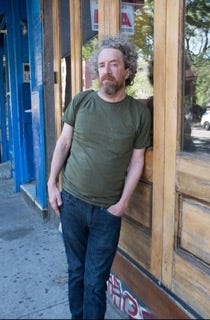

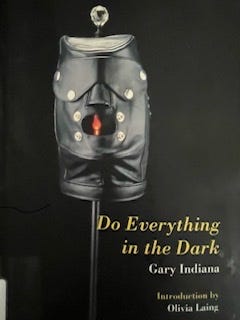
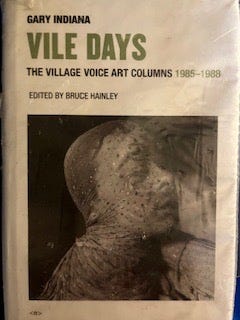

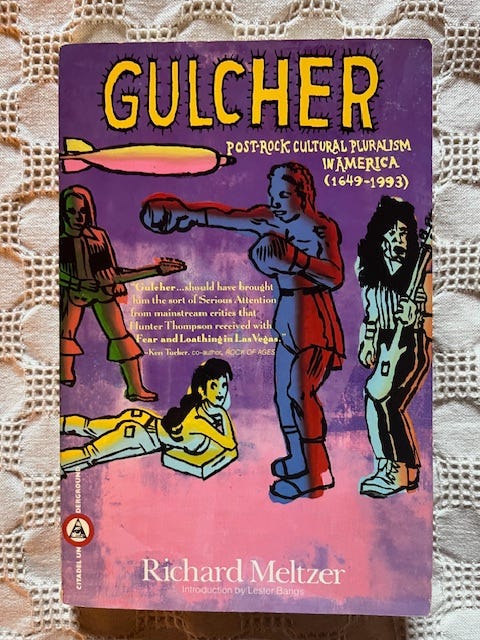
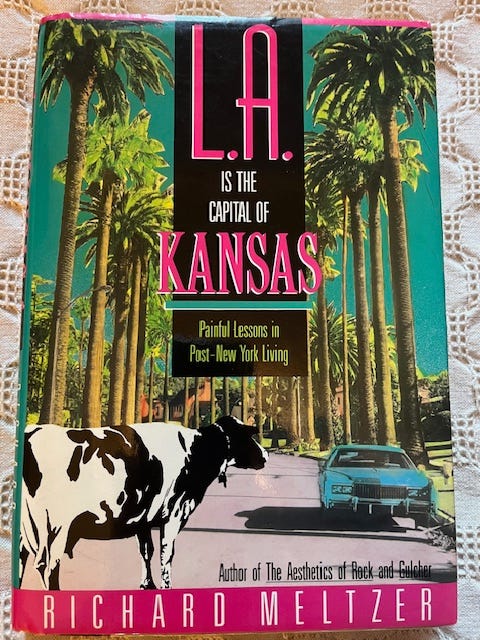
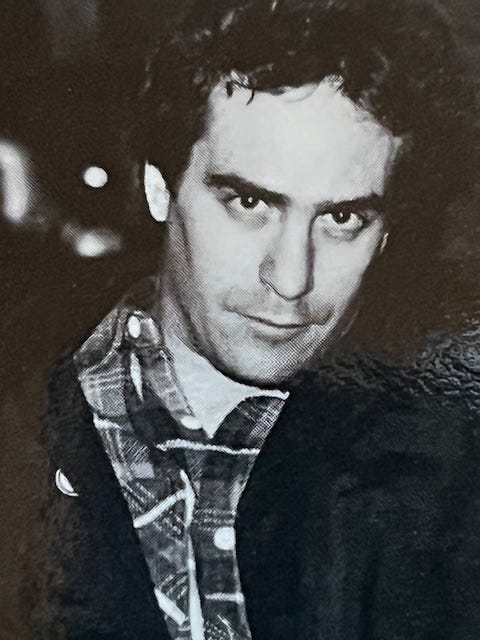

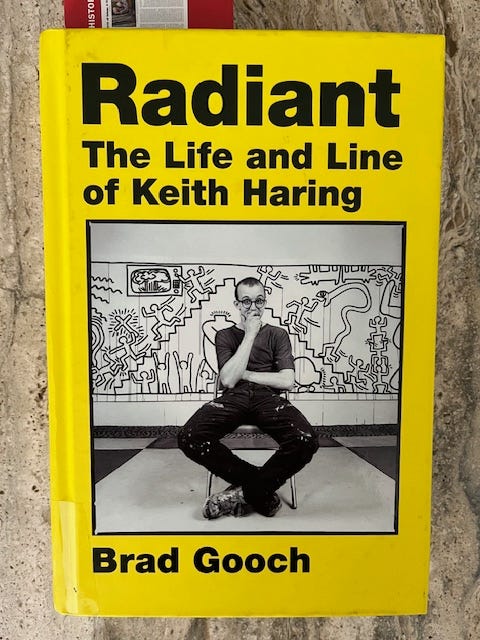

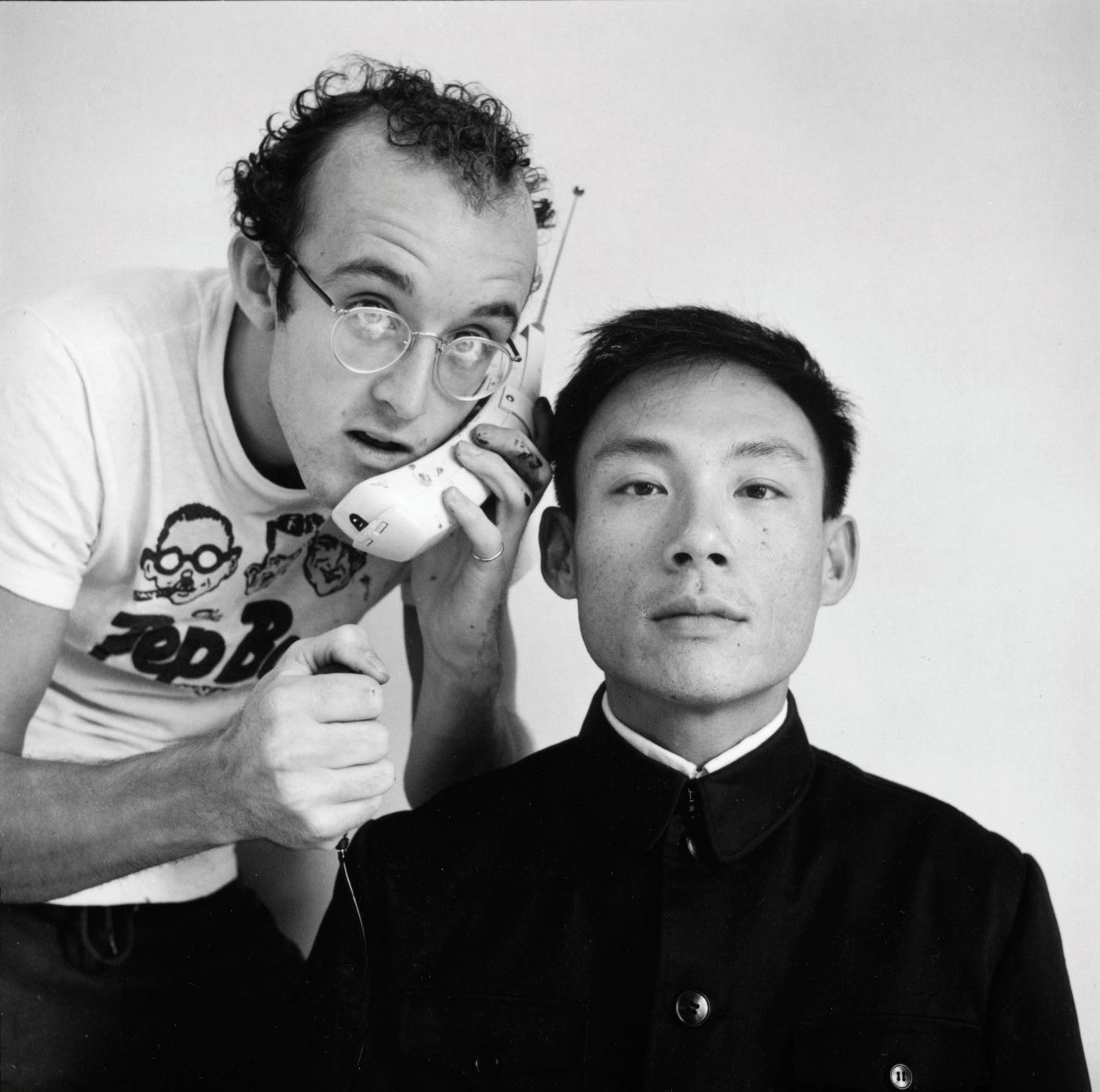
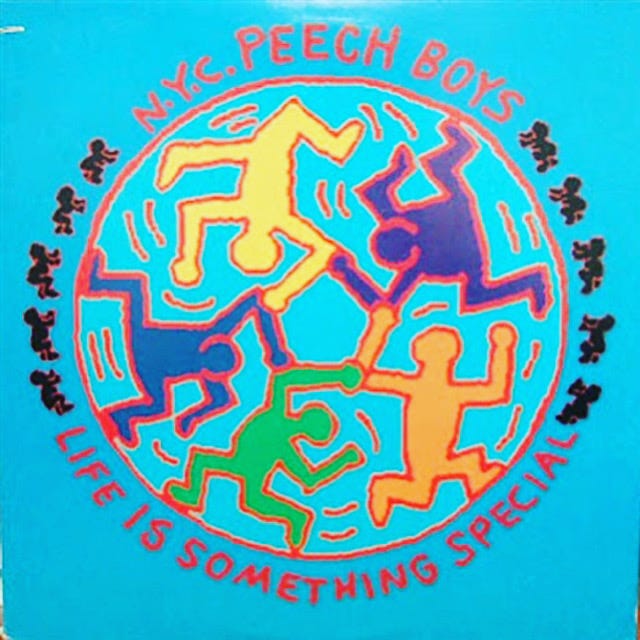


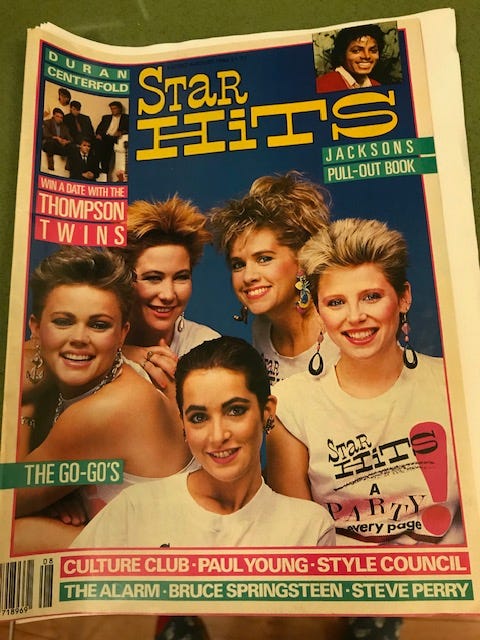
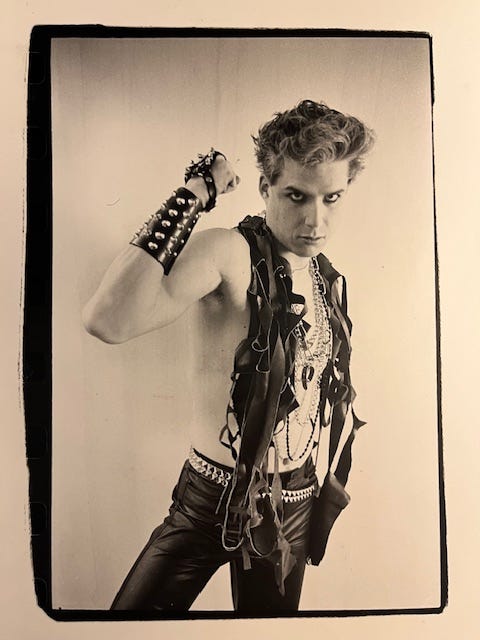
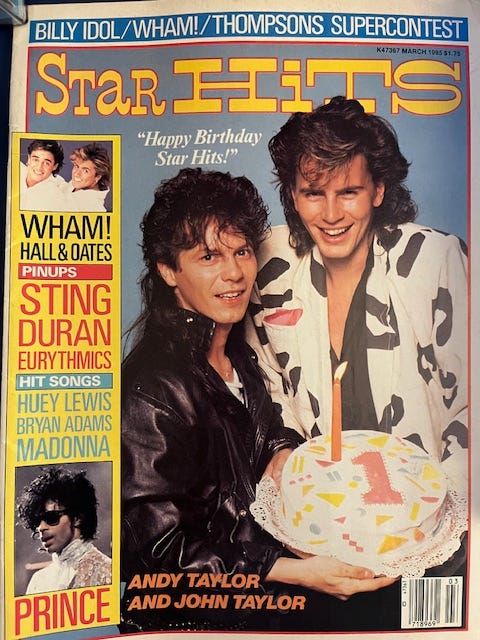

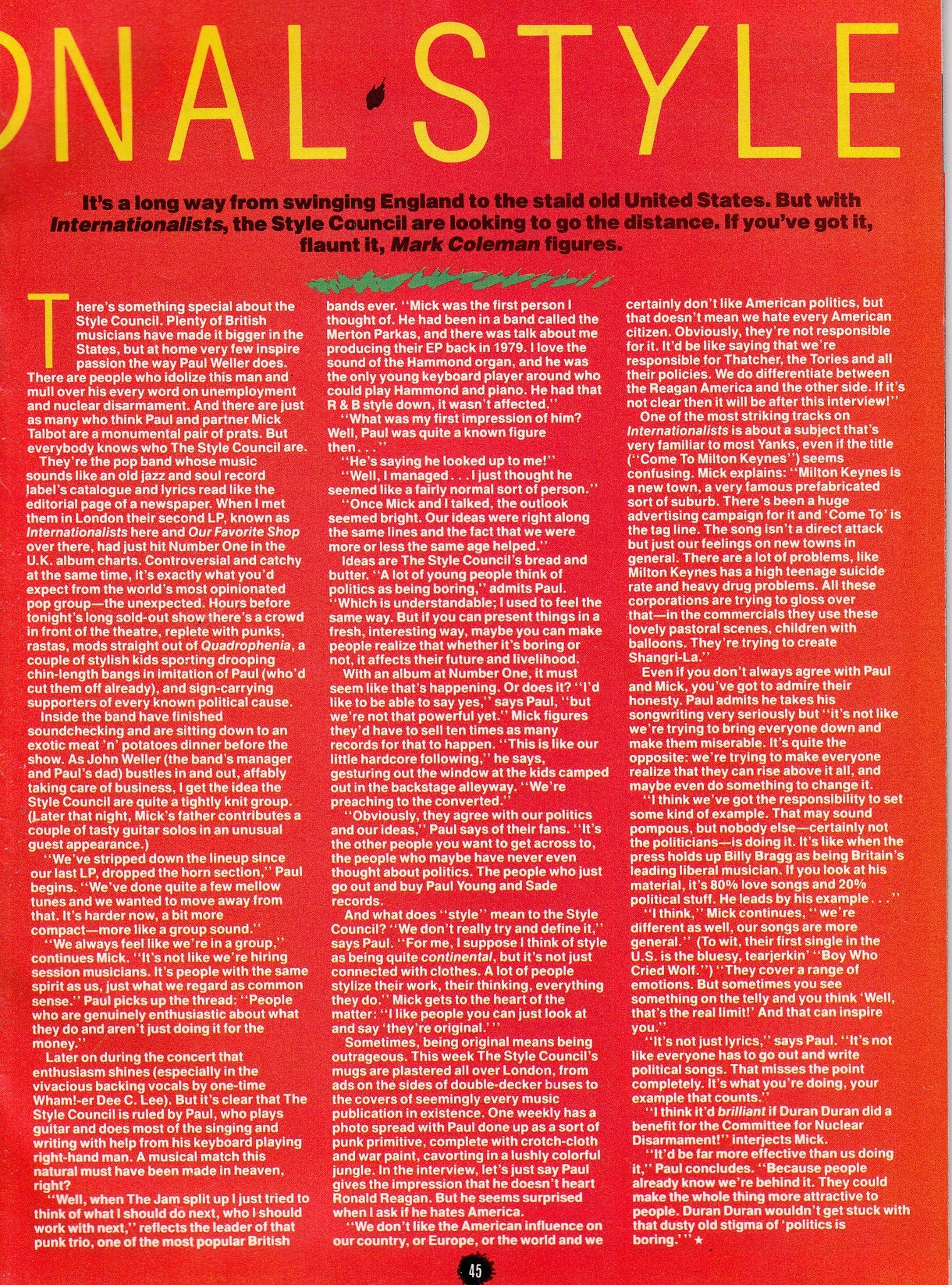

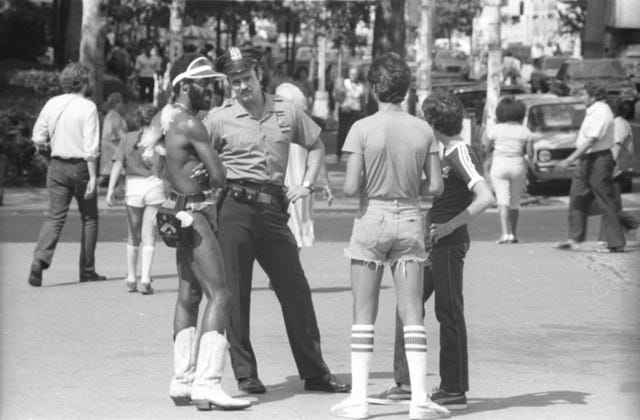

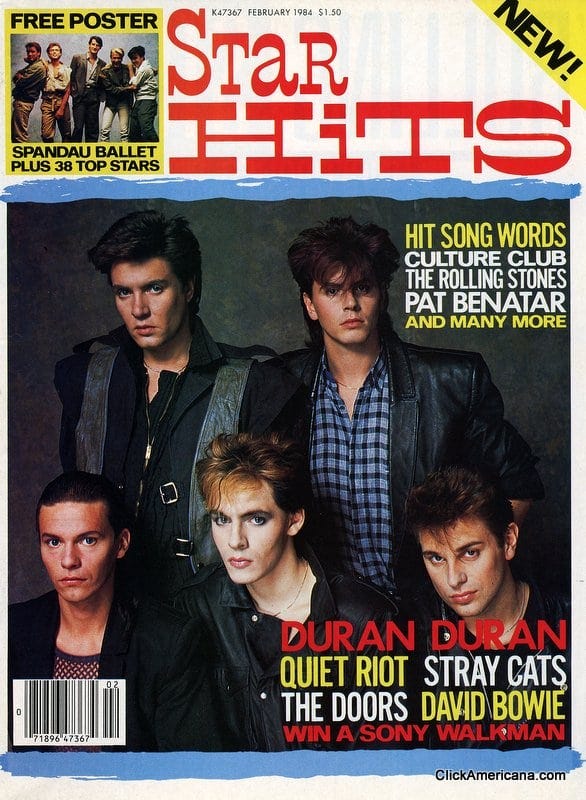

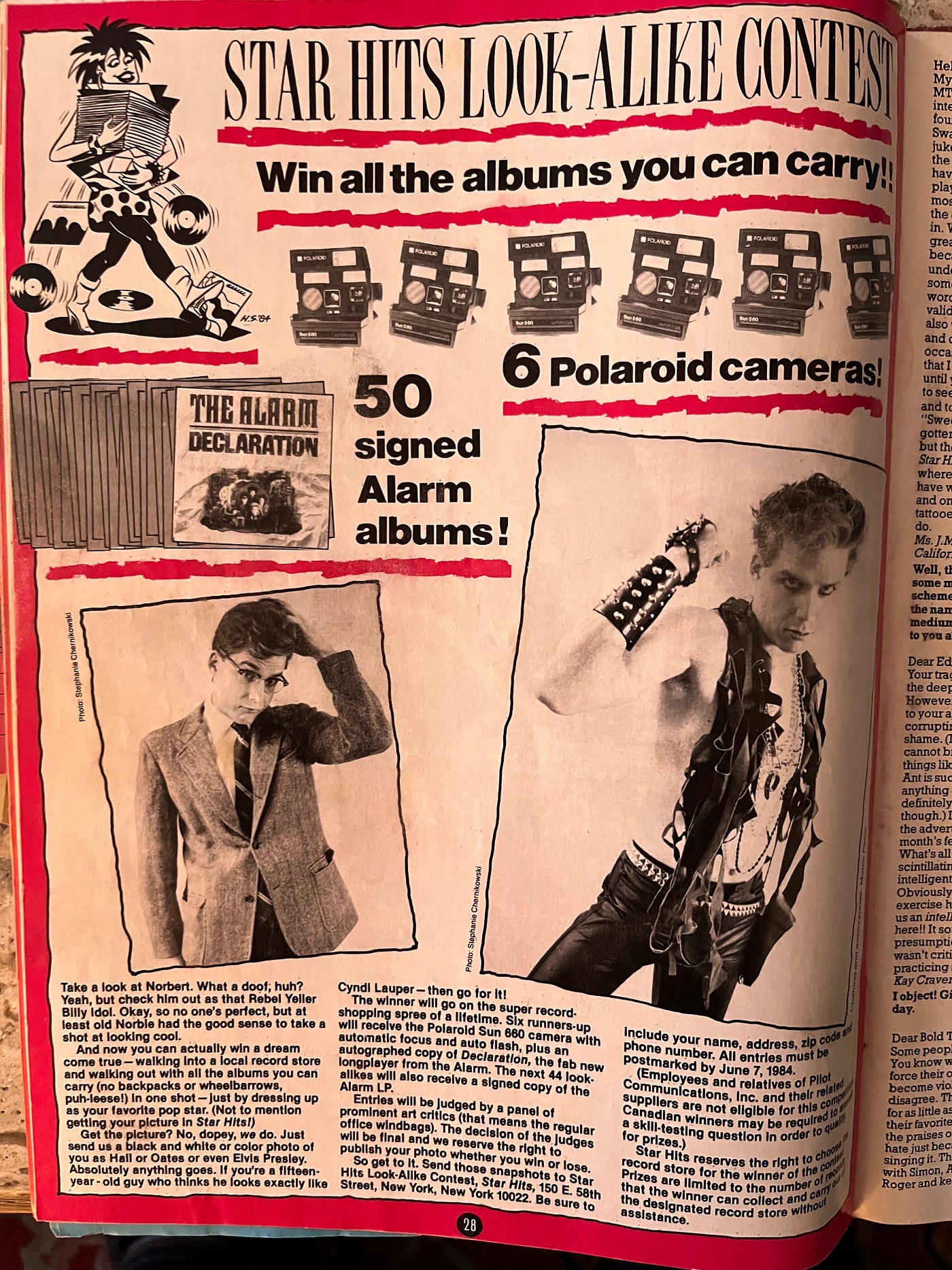
 Mark Coleman