So Far West It’s Nearly In New Jersey

My second NYC apartment sat on the edge of a then-obscure Manhattan neighborhood known as the Meatpacking District
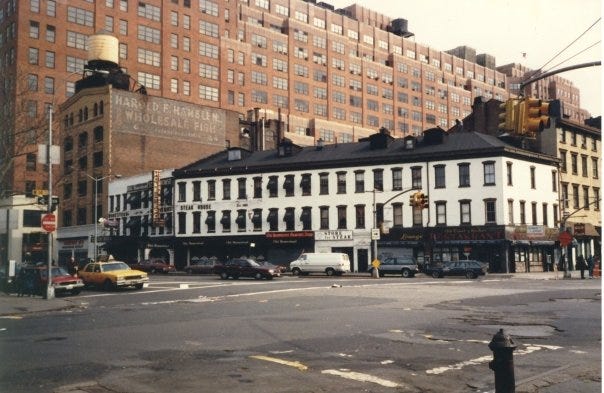
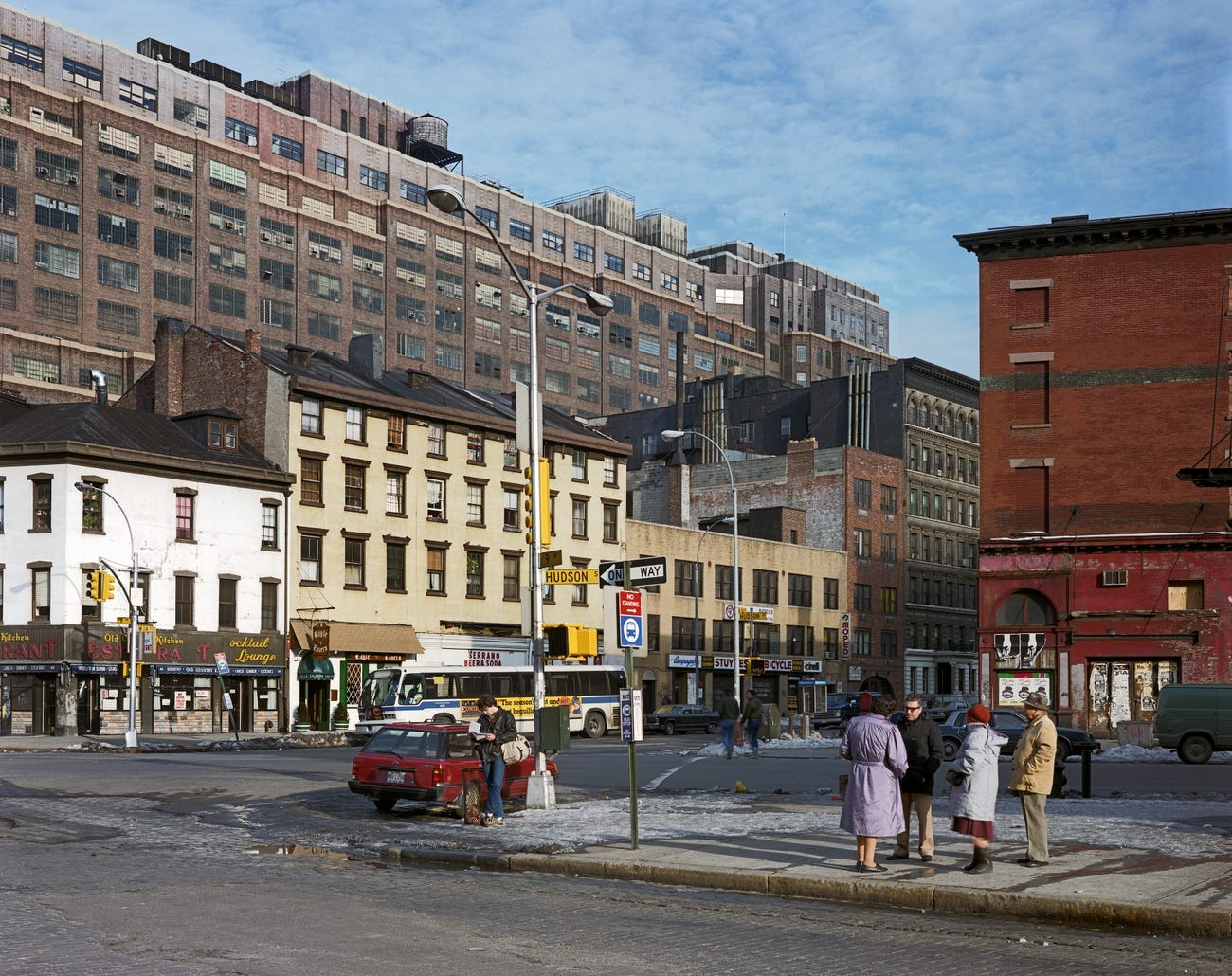
The white building is 48 9th Avenue during the 1980s

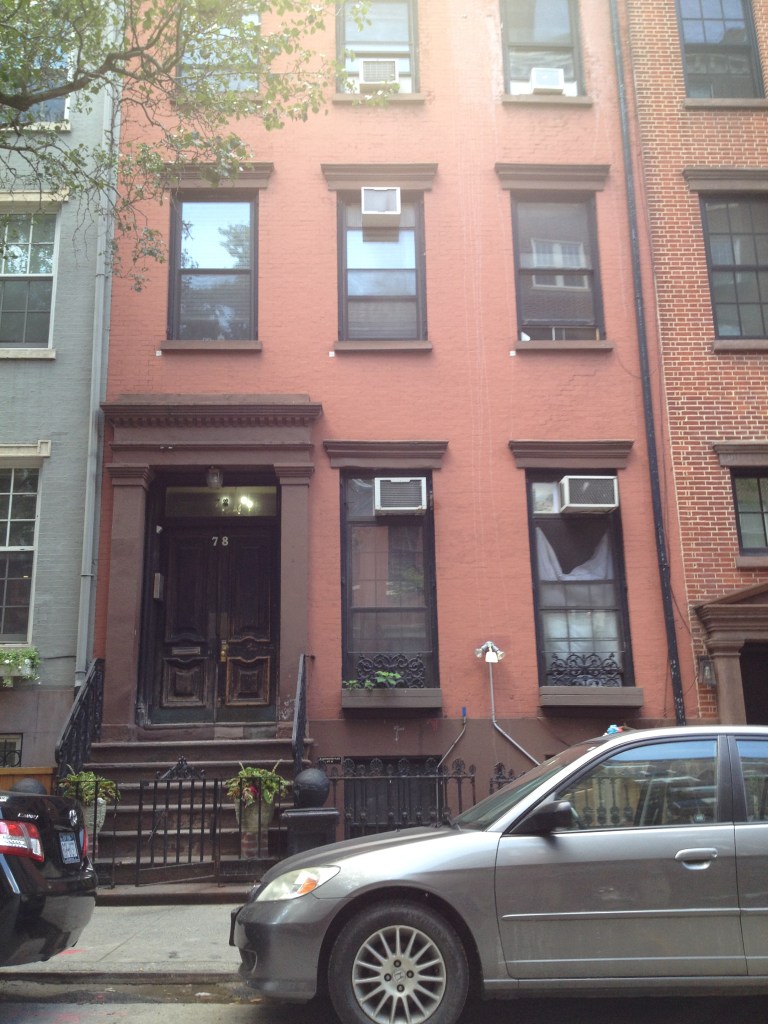
Pressure to move kicked in a day after those heroic firefighters pulled me out of the flaming building. I needed to find a new home in NYC ASAP. My third-floor room was, more or less, as habitable as it had ever been. Smoke damage was contained to the first floor, though the fumy aroma haunted the hallways during my final weeks at 78 Washington Place. Pushing aside the trauma of that fiery August night, I tried to stay focused on the horizon.

I felt desperate, yet also determined not to move into the first available place. At the same time I couldn’t afford to be choosy nor could I risk moving into someplace even more depressing — or dangerous — than 78 Washington Place. Once again, all signs pointed east. The East Village was still dicey, though affordable, not to mention demographically desirable.

I wanted to get the hell out. But investigating a series of East Village apartments ended in frustration: I didn’t hear back about a relatively well-kept studio off First Avenue, and turned down a trim one bedroom in a bombed-out tenement between Avenues A and B. At the latter I decided “no go” when I saw punctured trash bags in the halls and yawning holes in the walls. Though I longed to live in the neighborhood, I needed to feel secure.

In late September I called a building management company, as opposed to the usual real estate agency, in response to an ad in the Times. The advertised apartment in Chelsea had already been rented. As a last ditch appeal, I brought up the recent fire at my current address, and the bland masculine voice on the other end of the line adopted a whole new tone.

“I handled that building for awhile. Oh My God. You’re lucky. We can get you out of there. OK. Go look at 48 Ninth Avenue on the corner of 14th Street. Hold on while I get the super’s number.”

The corner of 14th Street and Ninth Avenue abutted the northern fringe of the West Village. West? So far west it was nearly in New Jersey. I went to see 48 Ninth Avenue after work, heading straight up Hudson Street into the Meatpacking District. Ushered into apartment 9A, first thing I noticed was the back window — I could almost reach out and touch it from the doorway. If my previous studio was small, then this place was a mouse hole. I tried to imagine conducting my home life within these claustrophobic boundaries: eating, sleeping, reading, relaxing. I’d have to exist in this tiny room.

A sink, stove and refrigerator flanked the front door to the left. To the right was a wall. Take half a dozen steps forward and you’d reach the rear wall: two long windows on either side of an ancient radiator, a massive heating unit many times too large for such a small place. Tall ceilings failed to create any illusion of spaciousness. Dull white paint coated every surface.

The closet was barely deep enough to accommodate a jacket. Another door opened onto a narrow bathroom: chipped tiles, battered sink and a paint-flecked white bathtub underneath a shakily installed shower fixture. Lifting the toilet seat, I smiled at the message Magic Markered on the flip side. “I Love You.”

In late September 1981, I signed a two-year rent-stabilized lease for $240 a month.
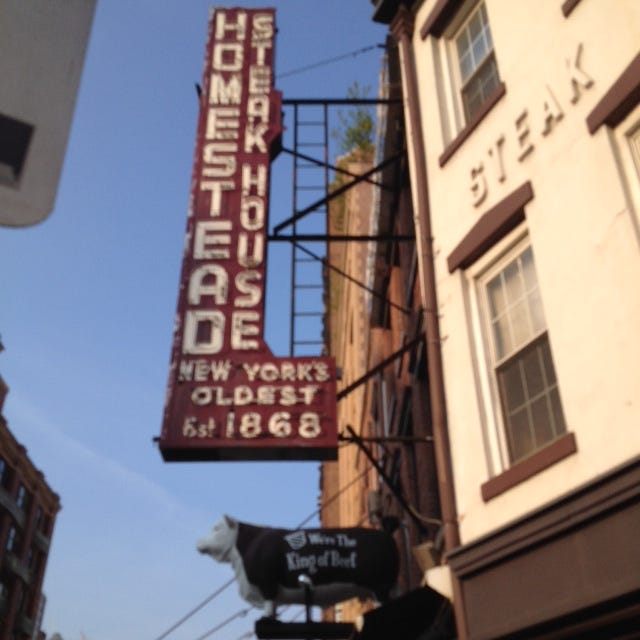
“Look for a red door underneath the cow sign” I told my infrequent guests

In the early Eighties, crossing Ninth Avenue and continuing west on 14th Street felt like falling off the map. During the day, the commercial district surrounding far West 14th Street west of Ninth Avenue — the meatpackers’ marketplace — formed a bleak panorama. The streets reeked all day, even after the cobblestones were cleansed of the pre-dawn bloodbath. Open dumpsters and rubber trash barrels lined the sidewalks, filled to the rims with freshly rendered hunks of peppermint-striped animal fat. Forget about rats; in the Meatpacking District the flies were scary.

After dark the warehouses turned into hives of mostly furtive activity. Camouflaged in black leathers, men prowled the shadowy blocks all night long, loners and duos stalking past the packs gathered near a doorway or loading dock. Were there dozens of people walking around on any given night, or hundreds, bar-hopping between the murky nightclubs and after-hours spots? I can’t say. It looked like a lot of guys from across the street.

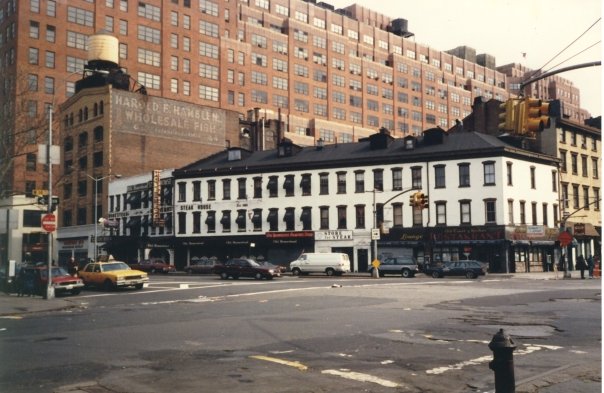
My home was the stark white three-story building on the north corner. A Greek coffee shop, run by two gruff brothers-in-law who both answered to Georgy, occupied the first floor. The battered sign above the restaurant, missing several letters, read The Old Country Kitchen, but I always regarded the diner as a nameless entity since nobody, including the people who worked there, ever referred to it by that name or any other.

On 14th Street, my downstairs neighbors included: faded Irish bar with live bluegrass music, failing Metro supermarket, busy beer distributor’s outlet, busier bicycle shop, not so busy gypsy fortune teller living with her family in a storefront that doubled as her salon. I walked past the picture window almost every day and never once saw Madame with a client.

Around the corner on Ninth Avenue resided The Old Homestead Steakhouse. A brawny replica steer stood (and still stands) guard over the restaurant’s canopied and carpeted entranceway. Our front door, next to the Old Homestead’s satellite butcher shop Store For Steak, had recently been painted a flagrant shade of red in autumn 1981. Look for a red door underneath the cow sign, I’d tell my infrequent guests. You couldn’t miss it.

There was no intercom system in the building. Any visitors had to bring a dime for the pay phone, and announce their arrival from across the street.

Around the building I hardly ever laid eyes on the other tenants. And when I did, passing them in the hall, the majority registered as taciturn, reluctant, grunting avoiders of eye contact.

There were exceptions. Bette lived right across the hall, with her husband Abe, a disabled man who barely left their studio apartment. She played Mom, always asking how I was doing even though she was obviously struggling with her husband. He must’ve been nearly eighty; she looked younger, maybe sixty. Her face was wizened, worn-out, yet Bette had a ready, raspy laugh. Late afternoons I’d occasionally spot her through the window at the Irish bar, smoking and nursing a Bud bottle. She spoke with a warm Appalachian drawl and smiled often, revealing a mildly disturbing jumble of crooked teeth.

Barry occupied the relatively spacious corner apartment; he was a laidback gay man, right around my age, clean-cut and genial. We got along on the smallest of small talk. His next door neighbor Stanley lived alone. A portly man pushing 70, Stanley sported an obvious toupee and insisted that I take his business card the first time we bumped into each other. Stanley Charles: Theatrical & Show Business Agent. I endured his recruiting pitch. Once. Then I enacted a strict policy of saying no more than “hello” to Mr. Charles.

Gradually, even the eye-contact avoiders became familiar figures.

My apartment was located just off the stairwell, conveniently allowing for quick ins-and-outs as well as guaranteeing a bare minimum of neighbor sightings. A pair of virtually identical women lived next door on the other side: dyed-blondes with military buzzcuts, fire-hydrant bodies and severe demeanors. For months or maybe longer, I assumed this happy couple were the same person and I’m still not completely sure.

Beside Barry two other residents appeared to be roughly around my age. The Horror-Rocker was a skinny peroxide-blond scarecrow, the kind of guy who dutifully wore the punk rock uniform year-round: black leather jacket and jeans, Cramps t-shirt, Converse high-top sneakers. His pallid skin, pained facial expressions and stealthy behavior — I regularly spotted him roaming the hallway late at night — led me to suspect he was a junkie.

His sidekick or partner in crime was a middle-aged woman who lived down the hall. She wore the uniform of a school crossing guard. I often saw her in action at the P.S. near the housing projects on 17th Street, leading children across Ninth Avenue. Theirs was an unlikely relationship to say the least. There was no way they could be a couple. Over time, I came to recognize a small gaggle of shifty-looking young men, including the Horror-Rocker, who gathered in her apartment every day. The presence of a junkie salon in the building raised the possibility of a break-in. So I had inexpensive (and ultimately breakable) window guards installed, and ignored the security threat for the time being.

Even more disquieting was my other anonymous neighbor/peer: the Crazy Guy. He sported shoulder-length reddish blond locks and the bushy beard of an Old Testament prophet, or Charlie Manson. Every Sunday his elderly mother came to visit. I ran into them all the time: sitting in the restaurant downstairs or walking arm in arm, painfully slow, the little old lady and the lug. She was, of course, the only person I saw ever with him.

Most of the time the Crazy Guy hurried past me, eyes fixed on the ground. The few instances when we established eye contact were petrifying. His pupils glowed like bloodshot lasers, inflamed with anger, fueled by unfathomable rage. He made me step back.

Occasionally, a knock on the door would interrupt my reveries. On Sunday mornings I received regular visits from Mormons, Jehovah’s Witnesses, Seventh Day Adventists — I learned how to tell the difference.

One Saturday evening I fielded an inquiry from a determined young dude who insisted his sister was hiding from him inside my apartment.

“I know you’ve got her in there!”

I let him take a quick look over my shoulder, and the sight of an empty room apparently calmed him down “Sorry, my man.” After he disappeared down the hall, I realized my heart was pounding

For the most part, nobody bothered me. One benefit of living in the Meatpacking District was close proximity to food. I bought discount groceries from the Western Beef retail outlet one block west, and learned to cook on the creaky gas stove in my apartment. Most of the time, when I wasn’t at work, I became absorbed by the solitary pursuits of reading, writing, watching TV and listening to as much music as humanly possible.

Not long after I moved to Ninth Avenue, my younger brother John performed the Herculean task of transporting my record collection from Ohio to New York in a Volkswagen Rabbit. I bought a decent stereo down on Canal Street, and quickly put it to daily use (until the inevitable burglary in 1983). While I still obsessed on WBLS and the other urban stations (KISS-FM & 92KTU), there were even more unknown realms to be explored on FM radio. Tiny WHBI out of New Jersey was so good on Friday night it could (almost) keep me home: reggae with Jamaican DJ Gil Bailey, followed by hip-hop apostle Mr. Magic’s groundbreaking showcase Rap Attack.

“Saturdays With Sinatra” on WYNY introduced me to Frank’s genius: his sophisticated phrasing and intimate tone, plus the breadth and depth of his repertoire, came as a revelation to my rock and roll ears. Frank Sinatra’s take on the standard “Street of Dreams” spoke to my current living situation. It became a personal anthem, my New York City theme song. “Kings don’t mean a thing on the street of dreams.”

As with many young New Yorkers, living in cramped quarters propelled me outward, into society. And the immediate environs, the neighborhood outside my door, the dank and stinky Meatpacking District, propelled me further still, to the East Village, Soho, Tribeca — any part of town where something was happening. Which in my Manhattan meant downtown. More and more, beginning in late 1981, my life occurred in public places.
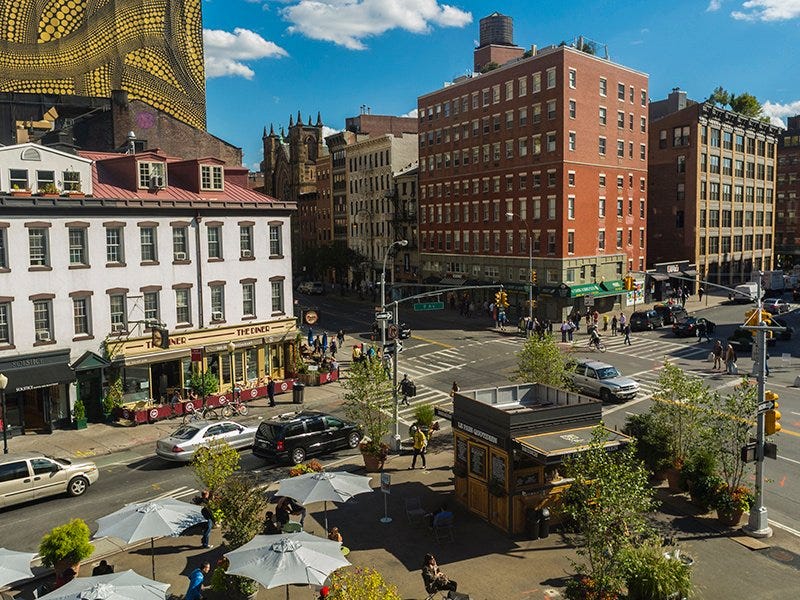
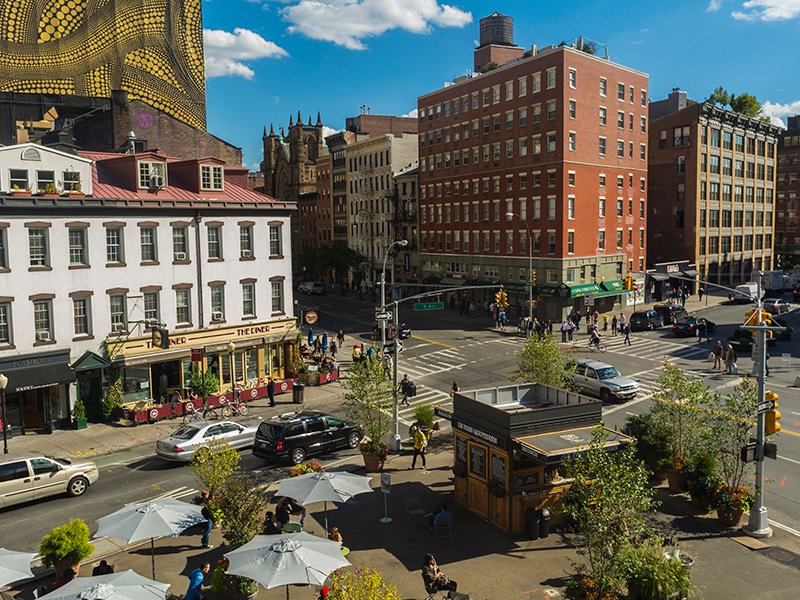
NW corner of 9th Ave and 14th Street circa 2017
SW Corner of 9th Avenue and 14th Street circa 1985, photo by Brian Rose

Career Opportunities

My professional life began with a surprise lie-detector test, and a belated start date that went down in history — as the day Ronald Reagan was shot

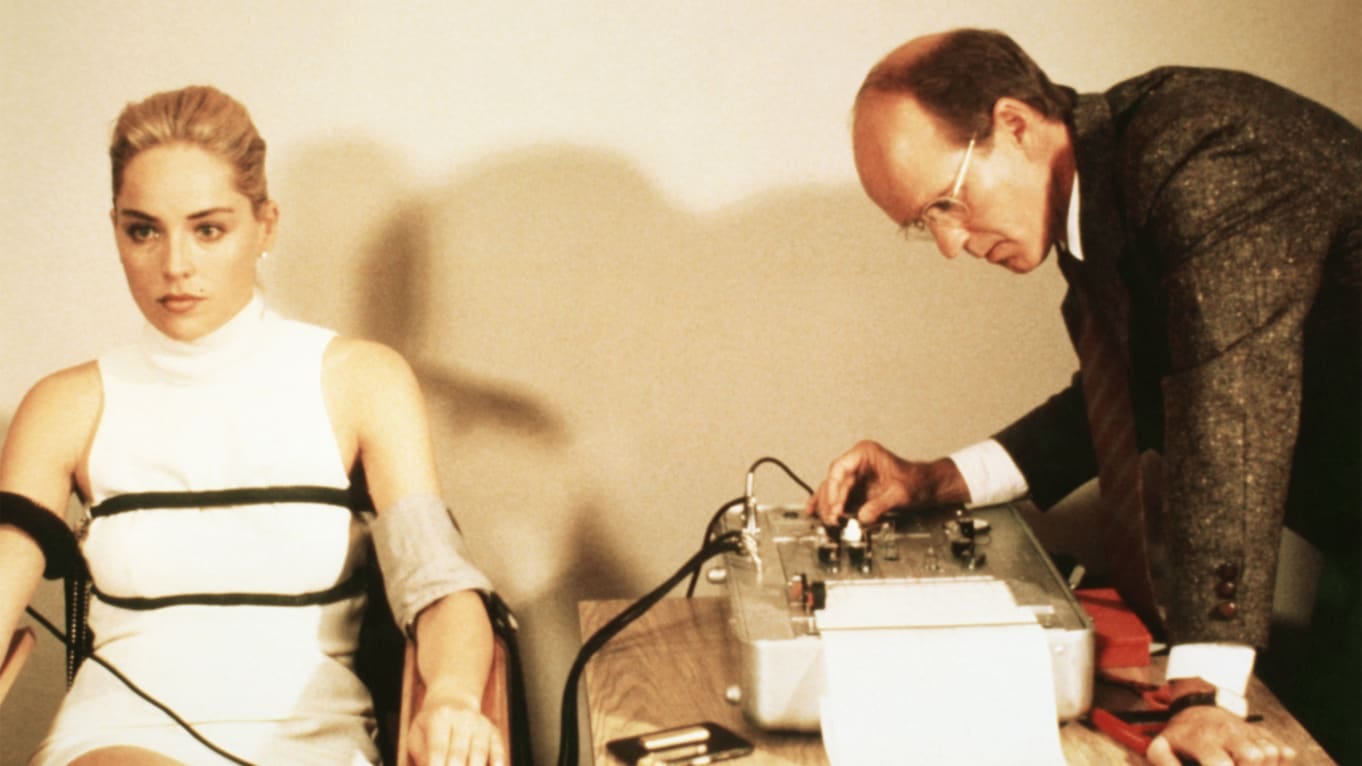
Sharon Stone undergoes the lie detector in Basic Instinct

Incipient panic inspired me to answer a catchall help-wanted ad — Calling All College Grads — during my initial job search in New York City. The role was described as “junior management position in retail.” Since I’d worked for two years at a record store while obtaining my bachelors degree, for the first time in my brief post-college employment quest I felt fully qualified.

This “unique opportunity” turned out to be a training program for branch managers at the freshly christened and franchised American Savings Bank. Visualizing myself behind a desk, I imagined eight-hour days spent filling out forms while wearing the drab navy-blue Brooks Brothers suit that my dad insisted was essential to any working man’s closet. Upon reflection, I calculated that my status as a proud bohemian unconcerned about money just might work in my favor; I could be trusted around large amounts of cash. And on a purely pragmatic level, I realized (or rationalized) that working at a bank would be a steady gig if nothing else.

The interview transpired in the back office of a mint-condition Midtown branch; the Grand Opening was just weeks away. Thin carpets, brittle motel-grade furniture and the thick scent of disinfectant filled the empty rooms. A stone-faced female interviewer, possibly not long out of college herself, volleyed rote queries across an uncluttered desk. Perusing my resume, she expressed deep skepticism (non-verbally), never directly asking yet clearly wondering why in the world I had applied for a banking position. I stressed my “extensive” retail experience and (mostly untested) people-management skills. Declaring my willingness to accept a spot at any branch that was reachable by subway cracked her stern demeanor. She stifled a laugh but hey, I was determined to gain a foothold in New York.

The bank called back mere hours later, not long after I’d returned to my temporary room. We scheduled another interview for the very next day, this time at an address all the way downtown in the Finanical District.

Nervously, I managed to board a train headed in the right direction. Surfacing near City Hall, I proceeded away from the Brooklyn Bridge and headed toward the monumental court buildings. Immediately I got lost, wandering on an anonymous side street. Just before freakout set in, I spotted a sign marked Chambers Street at the other end of the block.

Walking the gauntlet of men (and a few women) in near-identical suits and topcoats, I edged my way into the lobby of an elderly office building. A noisy elevator ejected me into the waiting room of Wall Street Security Inc. What? I double-checked the address; this was it. A paunchy middle-aged man with the Irish-American complexion familiar from my father’s side of the family — freckles and blondish red hair — stood up from behind a desk and abruptly stated my name as a question. “Mark Coleman?” Before I could reply “yes” he had turned away and started walking down the hall, assuming I’d tag along.

We wound up in a windowless room: unadorned brown walls, off-white acoustic tiles barely clinging to the ceiling. A deep silver metal suitcase lay open on a battered wooden desk. Without speaking, my nameless escort curtly nodded toward the two chairs facing the suitcase. My seat was the one that resembled the electric chair in a low-budget prison movie.

A cushion shaped like a toilet seat rested where I was meant to deposit my butt. Dangling from the chair’s arms and back were white straps that resembled bandages with wires attached. Settling in, I flashed back to an underground newspaper article from ten years before. As a 13 year old hippie, I’d come across a radical self-help article titled How To Scam The Man’s Lie Detector or something similar. The specific tactic that resurfaced here in 1981 was “tighten the muscles in your ass.” But the spongy pillow underneath me rendered this impossible. The Man now knew the score.

Meanwhile my interlocutor had settled into his chair, and revved up the polygraph. From inside his silver suitcase emerged a worn console with dials, buttons and switches. On one side of the console sat a series of jacks with rubber tubing and wires attached; on top were needles poised to hop and skip across a looped roll of paper. He strapped a sort of straight-jacket across my midriff, and then fastened thin sensors the size of band-aids around the ring and index fingers of my right hand. An armband-sensor gripped my left bicep.

In ten minutes we covered a mix of neutral questions culled from my resume, alternated with more pointed inquiries relating to theft and deceit. Since my limbs were tightly bound, I mentally crossed my fingers and hoped for the best.

Remaining expressionless the entire time, the polygraph operator didn’t mention results when we finished. “The readout goes back to the bank and they’ll be in touch.” Unsure how to conclude our encounter, on the way out I said “thanks” which seemed to catch him off guard as, for the first time, he displayed a reaction approaching human emotion: his raised eyebrows said cmon buddy ya gotta be kidding me.

The American Savings Bank must’ve been desperate for warm bodies attached to college-educated minds. They offered me the job two days later, and I accepted on the spot.

*

Women who spoke with the most exotic Noo Yawk accents imaginable staffed the receptionist’s desk at every place of business I entered. Or so it resounded in my Midwestern ears. Right after accepting the training position at American Savings Bank, maybe a week into my odyssey, I belatedly checked in at the editorial offices of Sugar y Azucar magazine. Or in the words of the elaborately coiffed and manicured young woman who greeted me, “Shuga Ezookuh.” This was not a nutritional handbook, but a trade journal for manufacturers of refined sugar and suppliers such as my father’s employer. In fact, my dad enjoyed a warm long-distance friendship with Sugar y Azucar publisher Richard Slimermeyer; they often met up at industry events once or twice a year, with their wives in tow, and had visited each other’s respective homes in Cincinnati and New Jersey.

Ushering me into his midtown Manhattan office, Dick emitted flushed-face warmth and aromatic joviality. The aftermath of a two-martini lunch, I decided. After apologizing for not having an entry-level position to offer, he launched a rambling monologue about trade-magazine publishing and how the best thing about it was “doing business with a stand-up guy like your dad.” It almost felt like he was trying to get me to buy an ad.

The meeting was over in twenty minutes, short and ahem, sweet. Hanging around the office after we were finished, I was flummoxed by the minimalist layout: three adjacent cubicles where the editors labored, a separate room for the two-person art department, a tiny library in a converted closet, and Dick’s corner office. The atmosphere was quiet, almost hushed: not exactly a hectic newsroom. An attempt at conversing with the frosted-blonde receptionist quickly declined from polite to pointless. Rescue came when Barbara, the svelte and cerebral-appearing middle-aged woman who’d been introduced as Senior Editor of Sugar y Azucar, called me over to her executive cubbyhole. She spoke in a mid-Atlantic accent and her subdued sense of style stood in stark contrast to the receptionist. Barbara exuded a subtle-but-sure breath of worldliness, an air of sophistication decidedly at odds with her surroundings.

“Mark, hold on a minute before you leave. Let me put you in touch with Luther Miller, my old boss at Railway Age. When I heard you talking to Dick just now, I remembered that Luther recently mentioned that Railway Ageneeds an associate editor. Reporting on the railroad business might not be what you’ve set out to do but you won’t find a better editor than Luther — he’s an old newspaper man, a real pro.

Railway Age is the oldest trade magazine in the country. Honestly, the company needs new blood. Almost everybody who works there is pushing retirement age. If you don’t mind, I’ll also put in a call to Bob Lewis, the publisher. Meanwhile you can drop off your resume for Luther. Here’s the address.”

As I prostrated myself in thanks, Barbara smiled and waved me away while Dick fixed me with an inscrutable look and laughed loudly. “We certainly can’t have YOU working in a bank.” I took that as a compliment.

Barbara’s recommendation was all that Railway Age required. Or else Simmons-Boardman Publishing Co. was desperate for warm bodies too. My follow-up phone call to the American Savings Bank was awkward, and mercifully brief.

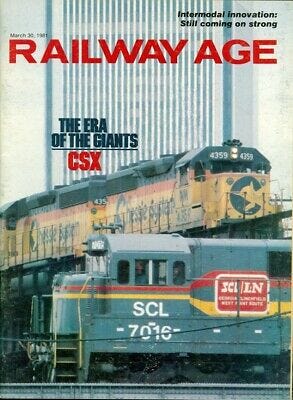
Railway Age March 30, 1981 issue

Simmons-Boardman Publishing took up the entire 17th floor of an unassuming office tower on Hudson Street. In 1981, the western fringes of Soho were commercial and industrial. Walking to work at rush hour on March 30, I heard the heavy metal clanking of printing presses rebounding through open windows. On King Street, I came upon a boisterous group of young men gathered in the driveway entrance of a vacant parking garage. I can’t recall exactly what they wore; probably jeans and t-shirts under light jackets. But I remember thinking they weren’t dressed for 9–5 type employment. Their carrying-on rang in my ears down the rest of the block.

I had no idea that the old garage was a nightclub. Not just any run-of-the mill disco, either. This garage turned out to be the famed Paradise Garage, home base of the innovative and trend-setting DJ Larry Levan. More about his profound influence on the New York music scene, and my evolving musical taste will follow; at present, duty calls.

I presented myself to the receptionist at the appointed hour of 9 AM. A red-haired woman, fortyish and friendly, greeted me in dense Outer-Bouroughese. “You must be Mark. Mistuh Milluh ain’t heah yet, deah. June’ll be outna minute. Have a seat.”

The wait was only five minutes but I fidgeted, having no idea what would come next. My heels were cool by the time managing editor June Meyer appeared.

As it turned out, I was in good hands. June was gruff but kindly, a middle-aged grandmother who lived in Queens. Her husband was a retired firefighter, and her son-in-law was currently “with the department.” In the ensuing months, June supervised me like a patient schoolteacher, gently correcting my misspellings and grammatical lapses. But in general her professional demeanor resembled a drill sergeant’s. She was iron-willed about enforcing deadlines and keeping the printers on schedule.

June kept the chitchat to a minimum that first day. Once she’d escorted me to the stark cubicle next to hers, she disappeared into the editor-in-chief’s corner office, where my surprisingly cursory job interview had taken place nearly three weeks previous.

So there I sat at an empty metal desk, staring at the manual typewriter. I stood up, opened the top drawer on a file cabinet. There I found folder after folder marking the stages of magazine production: manuscripts, page proofs, blue lines. Not knowing where to begin, I nudged the drawer and it slammed shut, loudly. I turned around and saw Luther Miller, my new boss, standing at the entrance of the cubicle.

“If you had been sitting here,” he said blandly, “reading the paper and drinking coffee when I walked in By God I would’ve fired you. Good morning, Mark, and welcome.” Luther was in his fifties, medium height with a full head of grey hair, mentally keen though obviously far from physically fit. He was fond of massaging his ample belly while verbally holding forth.

My routine, I soon discovered, would be straightforward to a fault. Each morning began with The Journal of Commerce, which I combed for items about the railroads, making copies for June, Luther and the magazine’s publisher Robert Lewis. In every issue of Railway Age, I was responsible for researching and writing three regular features: New Products, People & Promotions, and my favorite, 100 Years Ago in Railway Age. I was also charged with editing one of the three bylined columns, Looking At Labor by the biweekly’s Chicago correspondent. “See if you can make sense of his torturous prose,” Luther said. So concluded our first editorial meeting, in a blue cloud of Viceroy fumes, as June let loose a hoarse giggle.

Luther was a no-nonsense editor of the old school, applying his twin standards of clarity and brevity to learned treatises on arcane subjects like refrigerated boxcars or The Future of the Caboose. The written word was what he immersed himself in every minute of the working day, interspersing his magazine duties with discourse on everything from the daily Timescrossword puzzle to a recent Philip Roth novel (thumbs down on The Ghost Writer). He studied each issue of Railway Age like a raptor, zeroing in for the kill at the first sight of a typo or tautology. Luther abhorred faulty logic.

In matter of days, I determined Railway Age was a train to nowhere. It also became readily apparent that I wasn’t destined to conquer the world of trade magazines. After the first week or so, I managed to complete the grunt work on time: translating press releases, digging up items from the magazine’s rich archives. But the impetus for pursuing longer stories proved to be elusive. My excuse: I was an under-qualified college kid trying to fake it alongside grown-ups who knew what they were doing.

The mail cart arrived around 9:45 every morning. I would accept several bundles of envelopes from Manny, ruler of the mailroom. Garrulous and childlike, Manny was a disabled Vet. He handed over his packages with inane patter, groan-inducing jokes customized for each recipient.

“Avoid engaging in conversation with Manny,” Luther stated flatly that first morning. “If you get him started on Korea, he can turn psychotic in an instant.” My father had seen combat in the Korean War; Manny looked to me as if he was old enough to have fought in World War I.

Sorting actual mail from all the generic submissions and junk took forever the first time. Finally, I was left with a pile of press releases and promotional announcements, and no way to gauge their value. It occurred to me then precisely how little I knew about railroads. So I thought about lunch, more out of boredom than hunger.

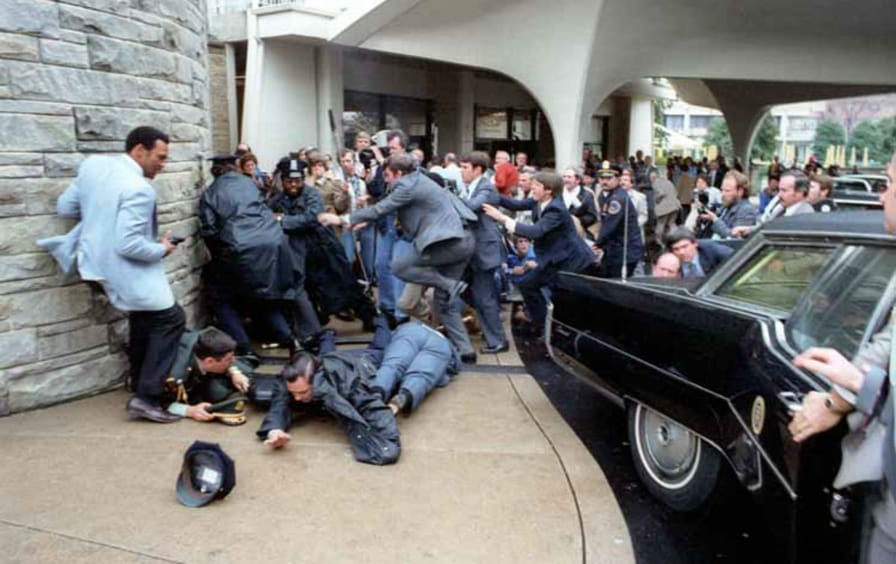
Around one o’clock I was still fantasizing about food and struggling with signal switchers when a stricken June Meyer gave me the news. President Reagan had been shot outside a hotel in Washington, barely three months after his inauguration.

Wikimedia Commons/Sebastião Salgado

June turned on her radio, and left it on for the duration of the workday. Luther conferred with Mr. Lewis in the hallway before he abruptly bolted for the lobby. “There’s a television set above the bar on Spring Street.”

It soon became obvious, from the news bulletins and intuition, that Ronald Reagan would survive the bullets from John Hinckley’s gun. I spent the afternoon thumbing back issues of Railway Age and reflecting on the assassination of John Lennon just four months previous. I wrote his obituary in The Michigan Daily; it was my final article for the student-run newspaper. The thundering pronouncement I’d been so proud of — “last night The Sixties finally ended” — suddenly sounded hollow. Clearly, the election of such a conservative president had ended the lingering countercultural era once and for all. After the shooting, Reagan’s truly awesome resilience just underlined the point. Whatever you thought of his politics and persona (not much in my case), the old actor was tough, enduring. And so was the reactionary social revolution he represented.

Not long after five o’clock Luther stuck his head in my cubicle and invited me for a beer. Startled, I accepted. “Good. Meet me in the lobby in five minutes.”

Our destination was about four blocks north, just off Seventh Avenue South, a corner bar tucked away in the web of twisting sides-streets at the heart of Greenwich Village. My apartment was only a few blocks away yet I had almost no idea where we were. Luther referred to the place as Mary’s, adding that was merely the bartender’s name and not the official name of the tavern. We bellied up and ordered two bottles of Budweiser. Well, I tried to order Heineken and received such a withering glance from Luther that I was relieved when Mary ignored my request and brought me a Bud.

Another round was delivered seconds after Luther sank his last gulp. When a third round materialized the same way, fifteen minutes later, the taciturn woman behind the bar didn’t touch the shrinking pile of bills and coins on the counter. Thanking Mary for the beers, Luther explained to me, “any decent bartender in New York will buy the third round.”

Another three — or four — rounds came and went until Luther suddenly rose to his feet and bid me farewell. I finished my beer in silence and then followed suit. I was out on the street, smashed, by 7:30. I somehow made my way to West 4th Street. A dirty piece of paper stuck to my shoe. It was a ten-dollar bill! I stopped at the first restaurant in my path, one of the few Mexican places in the neighborhood, where I devoured a mediocre burrito. After that I navigated the final blocks and stumbled upstairs to my single room. Though it was early I flopped on the bed and listened to funky and soulful WBLS-FM on my trusty clock radio for a pleasantly hazy hour.

When I awoke the next day, I was a (hungover) workingman at last.

“I used to get by on $5 a day but New York City has gotten so expensive”

So said my first mentor in Manhattan — without irony — in 1981

Moving Day at 78 Washington Place: not much has changed in 40 years

Moving into 78 Washington Place in mid-March 1981 didn’t take long. All I brought: two suitcases stuffed with clothes, briefcase, clock radio, electric typewriter. Luckily Apartment 3C came furnished. More or less.

Fitted with a painfully thin mattress and itchy blanket, the barracks-style metal bed reminded me of bunks at sleepway camp. The boxy college dorm mini-refrigerator appreared to be relatively clean and functioning. An unevenly applied coat of institutional-beige paint on the walls at least smelled fresh. Lodged against the corner wall were a brittle wooden table and mismatched kitchen chair. Dirt encrusted windows didn’t admit much sun during the day and at night, the lonely overhead bulb barely helped. An antique hotplate squatted on the table, its rusty twin burners propping up a dented kettle and warped frying pan. The shallow closet equalled the size of a cupboard; a chipped porcelain sink clung to the wall — precariously — beneath a mirror dotted with paint drips. As advertised, the communal toilet and shower facilities could be found near the stairway in the hall.

My first day began on an industrious note. I deposited the teapot and filthy frying pan in a garbage can on my way out to grab a cup of coffee. Later I took a ten-minute stroll up to West 14th Street and discovered a block of rock-bottom discount stores between Sixth and Fifth Avenues. There I purchased plates, a small pot and pan, a pair of place settings plus a serrated knife, two drinking glasses, a cereal/soup bowl and a large mug for coffee or tea. The whole deal set me back $15 with no mention of tax.

My first NYC neighborhood 1981

Back at home I attempted a grocery list, but it was hard to imagine what I could realistically accomplish on the hotplate besides frying an egg or heating a can of soup. Aromatic fumes from bacon or a burger would no doubt trigger the lunar-shaped smoke alarm on the wall. The severe limitations of this minuscule “studio apartment” sunk in fast. My first New York home was no more than a room. The panic switch in my stomach flipped on for a few manic minutes, until I silently vowed to hang tight.

Just then I heard a knock on the door, rapid taps followed by a voice instantly familiar from my first visit to the building.

“Mark, hi Mark? It’s Jeff, Jeff The Super, you know…oh Hi.”

“What’s up?”

I must’ve looked distracted because he blanched and hesitated, waiting a few seconds before edging his way through the open door.

“Well I heard the radio so I knew you were in here. Where did you go earlier? When I came by before, there was no answer.”

“Yeah I wandered up to 14th Street and bought a couple things for the place, like some glasses and stuff. A new frying pan.”

“Wha-what was wrong with the ones here? You bought new…”

His eager green eyes opened wide in astonishment.

“Jeff, the glasses in the cupboard had spiders living in them.”

This seemed to placate him for a moment.

“You know, this apartment did sit vacant for awhile. Glen, the guy who lived here, he ah died a couple months ago.”

Here Jeff went silent for a moment, reflecting. I anticipated a memorial of sorts, some fact or anecdote about the late tenant.

“That’s why you got this nice new paint job.”

I noticed that Jeff had a plastic shopping bag in hand.

“Looks like you went to the store, too.” I nodded at his bag. This forced social encounter felt like making conversation with one of my widowed great aunts.

“Oh this,” he replied, hoisting it aloft. “That’s why I stopped by. Thought you’d need some toilet paper.”

Four individually wrapped jumbo rolls tumbled onto the table.

“How about some toothpaste? Do you have a toothbrush?”

Whatever illusion I had about Jeff’s visit as a magnanimous get-acquainted session went straight out the window. The toilet paper was no welcome-wagon gift. This old weirdo was trying to hustle me!

“Jeff I think I’m set on toothpaste and stuff. I never thought to ask about toilet paper, though, doesn’t the building provide it?”

“Oh no,” he said with an ashen look.

“Well I can pick some up when I go to the grocery. Thought I’d try Sloane’s over on West 4th Street.”

“B-but you’ll be needing toilet paper.” Suddenly Jeff was upset, almost shaking, plainly offended by my polite demurral. So I wound up paying him $4, undoubtedly an absurd markup, mostly because I felt sorry for him. But my blinders had been removed. Or so I thought at the time.

*

How old was Jeff The Super? Somewhere between 40 and 70 years old was my ballpark guess but at 23 my perception of aging was vague, unformed. Further confusing the issue was Jeff himself. He struck an elderly stance, carrying himself like a premature geezer. As time passed, I could spot him in a crowd because he walked at a crooked slant, unsteadily, swerving across the sidewalk like an imperfectly gripped pencil scribbling on the page. It wasn’t beneath Jeff to accept — or disingenuously solicit — a senior citizen’s discount at an unsuspecting restaurant. And his voice sounded old.

Evasive by nature, he routinely deflected any and all of my inquiries. He’d squint and furrow his brow in mild befuddlement for a few teasing minutes, and then flash an indulgent smile at my futile questions. He was careful not to date any of his meandering anecdotes or boring stories. Essentially he was timeless, or possibly misplaced in time. Rightly or wrongly, I viewed Jeff as some kind of human anachronism.

Arguably, he was my first friend in New York City. Well, next to Frankie Crocker on WBLS-FM. Jeff wouldn’t have argued with that characterization of our relationship. I would have. Still, despite my conflicted feelings about him, from the very start I was impressed by Jeff’s resourcefulness. His not-readily-apparent means of making a living was something he didn’t try to conceal. No, he was eager to share his acumen. The superintendent job provided free rent plus a meager salary. Considering that his duties seemed to solely consist of collecting the monthly rent and (less often) the trash, his $25 a week looked generous from where I slept.

His main gig and true calling, his métier, was scavenging. Jeff was a garbage broker, a speculator in recyclables, a trash tout. He picked investments out of the staggering array of flotsam and jetsam just left there to rot in the city streets. He combed the urban beaches, the New York equivalent of those borderline-derelict Florida retirees who used to patrol the oceanfront, wielding their metal detectors like divining rods.

Naturally, Jeff offered to share his finds with me, asking for a nominal fee only after he’d hauled the junk up to my apartment. None of this was desired nor encouraged. Jeff would show up, plunk down a tattered lamp or rusty toaster oven and start to admire it aloud, conducting a sort of hard-sell seduction until I’d finally fork over the suggested $5 or $10 just to get rid of him. Returning all this weather-beaten house ware to the street wasn’t an option, not after his wounded inquiry the one time I tried it.

“You’re not going to believe this but I found another table fan like yours…hey wait a minute…” Eventually, the unbidden furniture and appliance deliveries wound down. There just wasn’t much room left in my room.

When I wasn’t being judgmental, Jeff struck me as poignant. Not for what I came to see as his shabby, grasping method of survival but for what his existence suggested: the possibility of growing old in the city, what it might be like after twenty, or thirty years. Spending time with Jeff, I’d get swept up by an unfamiliar surge of melancholy. What troubled me, I understand now, was the prospect of growing old alone in New York City.

Jeff was also the budget gourmet supreme, a limitless resource on the culinary underside of downtown Manhattan. He became my guru in the matter of finding cheap, sustaining and delicious meals. Jeff was the first foodie I encountered.

“I used to get by on $5 total for three meals a day,” he’d say, with a sigh. “New York’s gotten so expensive.”

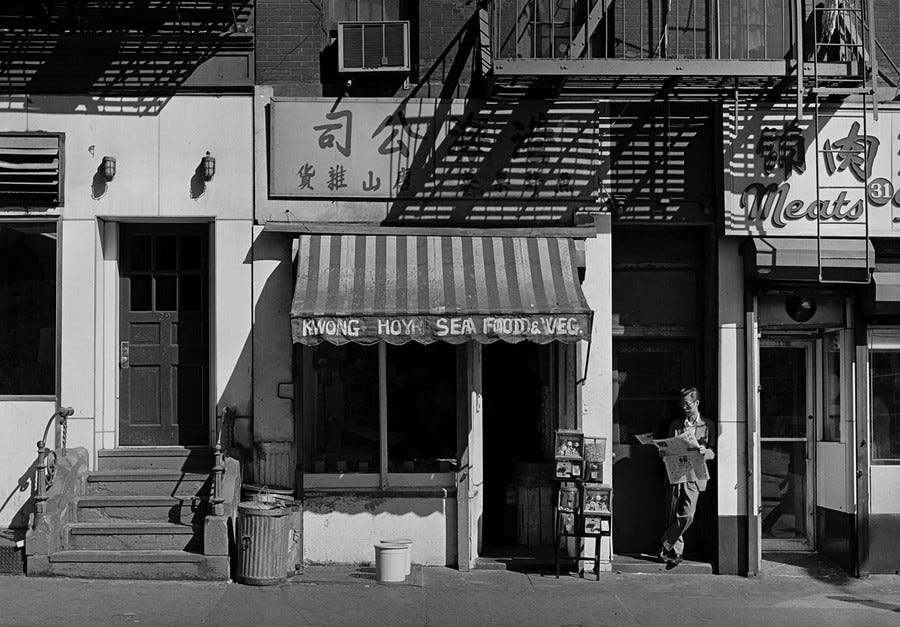
Chinatown NYC 1981 photo by Bud Glick

It was in Chinatown, on the streets as well as in the restaurants, where Jeff introduced me to another side of the city, a world within a world, at once alien and alluring, delectable and disgusting. Chinatown was a melee of sights and smells. Mott Street, the main drag, was lined with restaurants, souvenir shops and outdoor market stalls stocked with oddly shaped fruits and unfamiliar root vegetables that looked to me like unearthed tree stumps. Fishmongers stacked row after row of fragrant whole fish on ice in front of their storefronts, dozens of different species set out in the sun alongside barrels of edible shell creatures ranging from shrimp to snails to wriggling live crabs. Until then, I’d only shopped at suburban grocery stores, and crunchy-granola food co-ops in my college town.

Jeff certainly knew his way around Chinatown’s twisting streets. He favored one tiny basement restaurant that specialized in dense noodle soups: the fatty broth studded with floating islands of meat and bone. I never felt comfortable or especially welcome there; considering that we were always the only Caucasians in the joint, I understood why the service was non-existent. I preferred the row of Szechwan restaurants on East Broadway. The best was all the way down the block, practically underneath the Manhattan Bridge. This restaurant’s name is lost to me now — Shanghai something? The walls were papered with dozens of signs advising patrons on the specials of the day in Chinese characters, though the regular menu offered rudimentary translations: “lions head” was a giant globe-shaped pork meatball served on a bed of savory soft-cooked cabbage. Bony chicken nuggets in sauce had an addictive sweet spicy tang until you accidentally bit into one of the painfully hot red peppers dotting the dish like land mines and lost your sense of taste for the next hour or two.

Kiev Restaurant circa 1980 photo by Michael Sean Edwards

As the summer wore on, I strictly avoided eating with Jeff anywhere east of Broadway. The World War II era décor and cafeteria service at Katz’s Deli suited his taste to a “t”, but at $5 plus their pastrami-mountain sandwiches were too steep for budget-conscious Jeff. And his enthusiasm for global cuisine evaporated before the Indian restaurant row on East 6th Street. On the other hand, the Ukrainian and Polish fare on offer throughout the East Village was right up Jeff’s alley: starchy, filling and cheap. Borscht, pierogis stuffed with meat or potato, kielbasa with sauerkraut. But for me, there was a catch. Unlike the Greek-American diners Jeff frequented in the West Village and Chelsea, east side coffee shops such as Kiev, Leshko’s, Veselka, and Odessa were full of people closer to my age not to mention appearance.

Honestly, I’ve never been much of a fashion maven, and at first acquitance I found my style-conscious peers in New York to be deeply intimidating. Nevertheless, after a few months in the city I altered my look. Slim-cut black jeans (unknown in the Midwest) felt more comfortable than the traditional baggy blue Levis. Minutes after my first short-sides hair cut, I was humbled by a tardy realization: my long wavy locks looked ridiculous in a shaggy Seventies hairdo. As I began to fit into the East Village, or at least not stand out as much, I realized how incongruous Jeff and I appeared as dining companions. Even in New York City, we were one odd couple.

More and more, I dined out alone: another hallowed New York tradition.

Jeff was confused and hurt by my sudden reluctance to discuss the day’s New York Times over leisurely dinners. Looking back, I’m stunned by my callow behavior — bordering on cruelty — toward the unfailingly kind (and oddball) advisor who’d taken me under his wing: “showing me the ropes,” as he invariably put it. But as my raw hunger for human company abated, or became sated in other situations, socializing with Jeff started to cramp my style. To this day I feel pangs of guilt about my abruptly abandoned friendship with my first Manhattan mentor. Belatedly, I want to express gratitude for the nourishment he provided.

Entry Level NYC 1981

Retracing my first steps and recalling a few stumbles

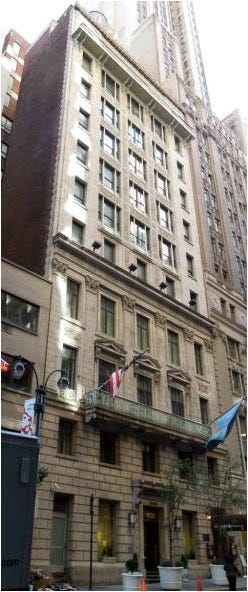
Upon arriving in Manhattan, I checked in at The Chemists Club in Midtown. Basically a hostel for businessmen and scientists, The Chemists Club’s members included my father. When I left Cincinnati for New York in February 1981, with a headful of writerly dreams, he generously fronted me a room there, though not indefinitely. My younger brother and sister were still in college at the time: finances were tight for our family of five. In ten days I needed to find gainful employment as well as a home of my own.

The Chemists Club is now The Dylan Hotel

The Chemists Club stood out on a brusque and efficient block between Madison and Park Avenues. The building was about ten stories tall yet its effect was grander: columns in front, marble in the lobby. The modest wood-paneled rooms were handsome but small, while the spartan communal bathroom and showers on each floor turned out to be a harbinger of my immediate-future accomodations in that department.

Lurking in the vicinity of Grand Central Station, nestled between dirty grey skyscrapers, this particular stretch of 41st Street lingered in twilight all day long, even on the sunniest late winter afternoons. Businesses servicing the labor force from the surrounding towers occupied the storefronts: dusty shoe repair shops and dry cleaners, bustling diners and delis.

From the very first evening I noticed how the sidewalks emptied — same as in Peoria — not long after the workday ended. It makes perfect sense, upon reflection, but back then this sudden retreat into eerie near-silence threw me for a loop. In general, as I acclimated to the city, New York’s stark ambience distorted my senses like a drug; the effect was hallucinatory, like I’d been cast in a moody film noir. Coming off the train at Penn Station on that chilly long-ago Wednesday afternoon, I simultaneously stepped into my future and backed into the cinematic past. Flashes of Technicolor inspiration sometimes broke through the black-and-white city shadows. Right away the graphic reality of Manhattan stimulated my imagination. And in the urban dusk I glimpsed the potential for self-invention and high adventure that loitered amid the ruins of this troubled metropolis.

*

I’ve been fascinated by cults since the late Seventies. My college years coincided with the heyday of these new religious movements and their charismatic leaders. Campuses were fertile recruiting grounds for L. Ron Hubbard’s Scientology and Reverend Moon’s Unification Church as well dozens of other lesser-known (but no less insidious) groups. One of my first impressions of Ann Arbor in 1976 was the outdoor Hare Krishna soup kitchen, where shaved-head devotees in flowing robes served macrobiotic gruel to Sixties leftovers and scraggly street people. While I was co-arts editor at The Michigan Daily during 1980, the student paper ran an expose about a new campus organization, a politically conservative outfit called CARP. The Collegiate Association for the Research of Principles turned out to be a semi-disguised arm of the Unification Church — the dark side of Reverend Moon.

Flash forward to February 1981. My third or fourth full day in Manhattan. In between exploratory visits to a couple of employment agencies, I stopped in a coffee shop. As I laid waste to a hamburger, the young woman next to me politely interrupted my noisy chewing.

“Excuse me but do I know you from somewhere? Haven’t We Met Before?”

Did I hear right? She uttered that old chestnut?

“Well, I doubt we’ve met before because I just moved here from the Midwest.”

“Oh! Where in the Midwest?”

“Uh, Ohio is where I grew up but I just got out of college in Michigan.”

“Where did you go to school?”

“The University of…Michigan, that is.”

“Oh! That’s where I went too.”

Of course her alleged Midwest connection should’ve sounded more convenient than convincing. Careless in my over-confidence, I let the conversation continue despite any half-realized qualms. In retrospect, I was already warming to my new role as wide-eyed rube in the big city.

“What Did You Major In?”

Oh My God I groaned inwardly. There’s no escaping this one.

“More or less, journalism. Actually I majored in psychology but I wrote for the school newspaper, and I was an editor my senior year, so I’d like to get a job of some kind in publishing.”

“Oh! I know some people who work for a newspaper right here in New York City. They’re always looking to hire new people, I could put you in touch with them.”

Since my weirdo early-warning system had yet to be activated, I supplied The Chemists Club’s phone number. She reciprocated the gesture with a business card. Kristine Morgan (let’s call her) held an untitled position at an unfamiliar and altruistic-sounding organization. Something along the lines of World Peace Foundation or Universal Brotherhood Institute, with an address on West 43rd Street. With her card in my possession and the hamburger platter demolished, I politely said thanks and goodbye.

Two days later, as I lumbered through the Chemists Club lobby toward the stairs, the man in a rumpled uniform behind the front desk made a beckoning gesture, gingerly lifting a piece of paper as though it excreted some dubious liquid. My first phone message! Upstairs, I retrieved an inky business card from my hand-me-down briefcase and warily took note of Kristine Morgan’s address. A consultation with the Manhattan phone directory in the lobby downstairs confirmed my better-late-than-never suspicion. It was the same address as the headquarters of the Unification Church. I never called her back.

*

A few days later, I landed an interview at a biweekly business magazine called Railway Age. Up until then I was unaware that specialized trade publications even existed, let alone that there were titles covering every imaginable field of endeavor, from Coin-Op Laundry World to Waste Collection Weekly. An artist friend, who briefly designed pages for a trade magazine, later tagged this under-the-radar media The Hidden Industry.

My interview at Railway Age, conducted by the somewhat curt and clearly preoccupied editor-in-chief Luther Miller, proceeded in a perfunctory blur. Despite my lack of experience, not to mention any prior knowledge of the railroad industry, Luther stunned me by offering the associate editor position, for $13,500 annually, at the abrupt end of our conversation. In a fever dream of disbelief or possibly a mild state of shock, I accepted the job on the spot. With only a few days left at the Chemist Club, I had obtained an actual job in journalism. Or something close enough. Now all I needed was a roof over my head.

*

Any apartment in my price range — $200 a month max — seemed to reside in the unfamiliar-to-me East Village or distant Brooklyn. Armed with a roll of dimes, and The Village Voice classifieds, I commandeered a booth in the Chemists Club lobby (no phones in the rooms), and began dialing. Dozens of calls yielded three possible spots: two roommate shares and an outright lease.

At this point, I really started to get nervous.

*

“Did you have any trouble getting here?” My potential roommate was polite, apparently not bothered by my late arrival. I was secretly frazzled.

“Nah I just took the subway, and then walked straight down Flatbush Avenue like you said. Sorry I’m late but there was a train delay.”

I was inordinately proud of this excuse, figuring it showed my familiarity with the day-to-day hassles of the city. What happened was I boarded the D express line at 42nd Street as instructed — headed in the wrong direction. Thoroughly frustrated, I disembarked at 125th Street and sprinted over to the downtown side of the tracks. By the time I arrived in Brooklyn, I figured not much else could go wrong.

My ultimate destination turned out to be a compact, well-kept corner brownstone. Inside, the building was divided into two long, narrow apartments per floor. The young man who admitted me into 2B said the other occupant was out so he would show me around. “Adam” looked to be roughly around my age and size, 23 and six feet tall, but thinner and bonier, with alarmingly pale skin and frizzy black hair just covering his ears. Immediately he identified himself as an actor and it was easy to imagine the guy onstage as a mime, coated in arty clown makeup. Once he’d shown me the cubicle-sized bedroom for rent, empty save for a sort of thick blanket or lumpy pillow laid across a long wooden frame, we settled into the living room. The décor was decidedly off-campus chic: potted plants, lumber-and-concrete-block shelves containing record albums and paperback books, uncomfortable couch that originally belonged to somebody’s grandmother.

After I ran through my resume, strongly implying that I led an ascetic existence away from the typewriter, the interview took a puzzling turn. Adam kept asking about my “social life” in audible quotation marks, phrasing and re-phrasing his queries. The answer was simple: “I don’t have one yet.” Adam continued undeterred for a spell, irritated by my clever reply. Eventually, he gave up and reclaimed his previous, placid demeanor. His parting promise, “I’ll call you after the vetting process is over, either way,” registered as an insincere formality.

I’m in the process of being vetted all right, I thought while descending the front steps twenty minutes after ascending them, vetted right out the fucking front door. Muttering to myself on the sidewalk, I nearly collided with a lamppost. Adam sounded like somebody talking in code. Ah, OK. The guy wanted to know if I was gay. But what the hell, why not just come out and ask? Maybe there was something I missed in The Voice ad, a tip-off or password that flew straight over my head. Feeling flushed in the cold, I got pissed off at myself for misreading the situation.

Nearing the subway station, I came upon a crew of teenagers, loafing around a massive boom box on the sidewalk. The radio blasted a disco song and its saucy chorus followed me down the reeking stairway, a woman’s silky voice haunting and taunting.

Can you handle it

Can you handle it

Cause you ain’t had nothing like it

Once I was back underground, hurtling toward Manhattan on the spray-painted subway train, I felt surprisingly relieved rather than disappointed or worried. A row of eye-catching underground murals flashed past the dirty windows as we approached the Manhattan Bridge. Abruptly, a blast of deafening static issued forth from invisible speakers, followed by the conductor’s metallic alto in mid-announcement. “…lastop Brooklyn…neckstop Grand Street Manhattan…THIS IS THE UPTOWN BOOGIE DOWN D TRAIN TO THE BRONX.” I laughed and said, “I love this place.”

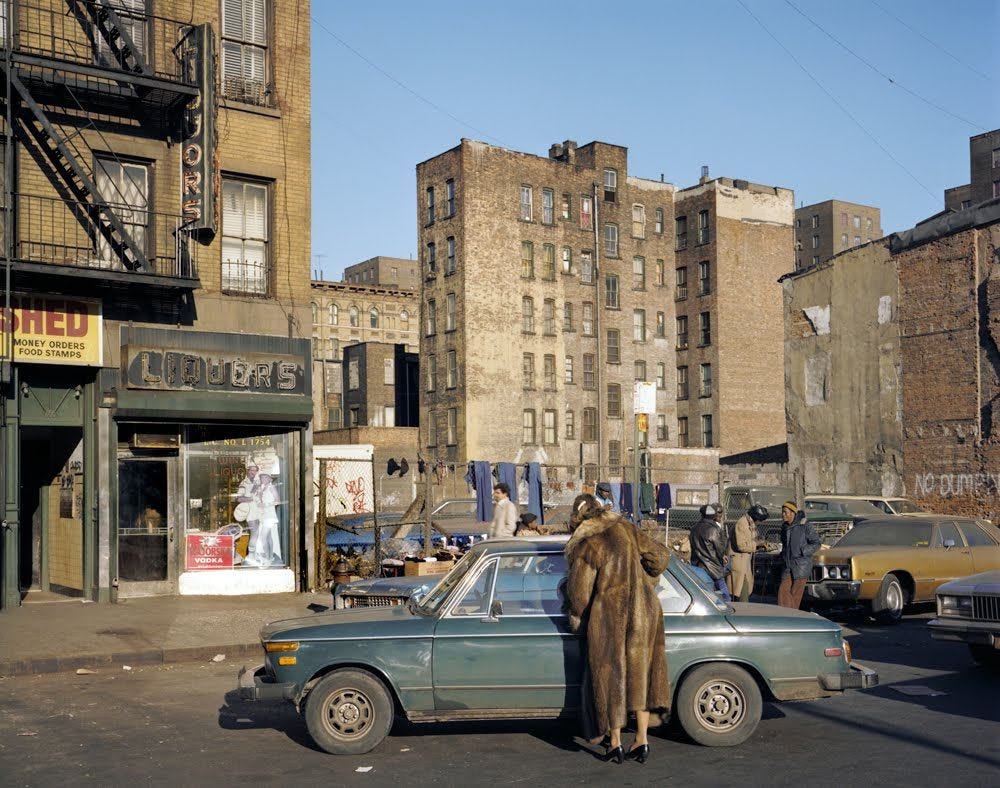
Lower East Side 1981, photo by Brian Rose

Nobody sat me down and advised, Go East Young Man, while I continued my first apartment search. Frankly, I had no idea where I was going or what I was getting into, or I wouldn’t have gone. Not so soon, anyway. Negotiating the area around the alphabet avenues in Manhattan — A, B, C, D between 14th and Houston Streets — was no joke. I learned the hard way.

I read East Village in the apartment for rent ad and assumed it signaled a geographical and spiritual connection to Greenwich Village, the famed bohemian quarter I’d visited as a tourist during college breaks. My grasp of the terrain was tenuous enough that I didn’t realize how far east The Village extended, way past the historic McSorely’s Ale House and the baroque subway station at Astor Place. Geographically, and spiritually, the East Village was another neighborhood if not another universe.

Naturally, as a cultured young person, I’d already made the pilgrimage to CBGB on the eastern periphery. I can’t remember who played that night; it was the tail end of that music-packed spring break vacation during my senior year in college. Twelve months later, the environs surrounding CBGB had stayed the same. The grungy punk bar was a well-lit oasis on the Bowery amid sleazy hotels, storefront Jesus missions and restaurant supply stores where sturdy commercial stoves took up much of the sidewalk space. Inside CBGB itself, the squalor was contained. The Bowery bums of legend were still around, just not stumbling into the club too often.

Walking east of Bowery felt like wading into a deep-water drop off.

The listing for an apartment share in the East Village sounded promising, but I had no real idea where I was headed. Pitt Street, the youthful-sounding woman on the phone explained before I asked for directions, was the continuation of Avenue D south of Houston St. I felt relieved at this evidence of Pitt Street’s obscurity: apparently other people hadn’t heard of it either. “Eve” described both the apartment overall and the vacant bedroom in particular as small; she shared the larger bedroom with her husband. We arranged a meeting the next day. “Turn left on Houston Street when you get off the subway,” Eve said with a rehearsed chuckle, “and keep going till you hit Pitt.”

Feeling edgy, I also hedged my bets with a long shot at an actual lease, inquiring about a one-bedroom apartment for rent on 7th Street east of Avenue B. An unfamiliarly accented voice on the line gruffly scheduled a tour for the next afternoon, conveniently timed right after my Pitt Street interview at noon. “Yus’ buzz thee super,” he said before hanging up. Minutes later, I gathered he meant ring the superintendent’s doorbell.

Houston Street I knew as the east-west artery that bisected the Village and the downtown depths. To the south were Soho’s cast-iron corridors, the old country byways of Little Italy and Chinatown, and nearer the river, the Lower East Side proper, where narrow side streets stuffed with ancient tenements huddled beside institutional-looking housing project blocks.

My East Village initiation began as a stroll along the southern outskirts of Greenwich Village: an Italian neighborhood, with a huge Catholic church and multiple small restaurants, quaint old row houses alternating with newer mid-sized apartment buildings, clumps of medieval elderly people and shrieking kids herded in a concrete “park.” Despite the proximity of cross town traffic and its attendant exhaust fumes, olfactory evidence of pizza and bakeries in the vicinity was everywhere: more nauseating than appetizing, a sign of my general anxiety about the future. Heading due east, the dorms and lecture halls of New York University soon occupied the north side of my vision, almost campus-like. So far, so scenic.

Passing Broadway and that rarest of sights in Manhattan, a gas station, I was engulfed by a stunningly different vista to the east. Reaching Third Avenue a few minutes later felt like entering an alternate sphere, at least to my naïve imagination. I had crossed over into a dystopian landscape that could’ve been dreamed up by my recent literary discoveries Philip K. Dick and J.G. Ballard. Everything — buildings, sidewalk, street, cars and trucks, even my fellow pedestrians — looked older and neglected, if not flat-out damaged by the passage of time, and definitely dirtier than the rest of the city, if that was even possible. Layers of indecipherable graffiti and grime covered every exposed surface. Tumbleweeds of windblown trash bounced on the streets. An alarming number of parked cars appeared to be abandoned. Every third or fourth building sported broken windows and barricaded doors.

The distance between avenues appeared to decrease as the numbers on the street signs turned into letters; the buildings got smaller, narrower, more residential than business. Here the ubiquitous corner grocery stores or delis all displayed the same yellow awnings with red-lettered bilingual signs. Bodega. Crossing over to the south side of Houston, my path traced the perimeter of a two block-long park. Ten yards away, a cluster of lost souls shivered on a pair of benches, despite the unseasonable warmth. A trio of burly young men in unzipped parkas and baggy sweat pants stood facing the benches. My sixth sense said “drug deal going down” and sure enough, before I could avert my eyes, the biggest and baddest-looking guy turned and fixed me in his pitiless gaze: “WHAT THE FUCK YOU LOOKING AT…”

When I turned around two breathless blocks later, the coast was clear. Nobody had followed me, but the sidewalk teemed with people — for the first time I really understood that hoary old expression. Hot and moist from speed-walking, I slowed down as much as possible without stopping. Another concrete park loomed up on the next block, and I glimpsed a vast empty swimming pool, complete with lifeguard chairs, lying behind the rusted fence. As Eve predicted, the street sign above read Pitt Street so I hung a right turn. In the middle of the block sat my destination: a decrepit brick building, shuffled into a deck of near-identical structures, each one hastily painted in muddy shades of reddish brown. I’d telephoned Eve from a pay phone on Houston and she met me at the front door. She looked even younger than I’d imagined, too young to have a husband.

Short and pixie-like, with streaks of blonde in her bottle-black hair, Eve confidently padded up the warped staircase like a mountain-climbing guide. The incline made me feel light-headed. Or maybe that was my nerves. When we got to the apartment on the fifth floor there wasn’t a whole lot to see. The long narrow living room opened into the kitchen area where a greasy white refrigerator and stove shared space with a bathtub. I inspected the windowless bedroom for rent — more like a storeroom or closet — in a manner of seconds.

We sat in the living room for a few semi-excruciating minutes, I stared at undecorated walls and dusty, half-full shelves while Eve bluntly apprised me of the dangers of the neighborhood. But I’d decided against the place before she told me there’d been two break-ins just in the year they’d lived here. The drug scene, she said, shaking her head. My share of $400 a month would’ve been $150, cheap for New York. And for all that you paid a price in terms of personal safety, and maybe in self-respect too. I’m not ready to live like this, I righteously decided. Not quite yet, as it happened.

Down on the street, I easily retraced my steps on Houston for two blocks and then proceeded due north on Avenue B. Every corner was occupied by an open bodega and/or a shuttered shop. Young men clustered in groups outside the stores, laughing and jostling each other. Glancing down the passing side streets, I saw children milling around the front stoops, and clumps of middle-aged men sitting on upended crates, drinking beer and playing dominoes in the 50-degree weather. I carefully avoided all eye contact and briskly made my way to East 7th Street. Rounding the corner on the home stretch, I was stopped in my path by one of the locals hanging out in front of the store. He looked to be my age or maybe younger despite an abundant, sculpted mustache. No time for salutations or small talk: he got right down to business.

“Works, works.”

“Uh what?”

“Works! Five, five bucks.”

Oh shit, I thought, he wants to sell me a syringe.

“Look no thanks man, I don’t do that stuff.”

“Then what THE FUCK you doing here…”

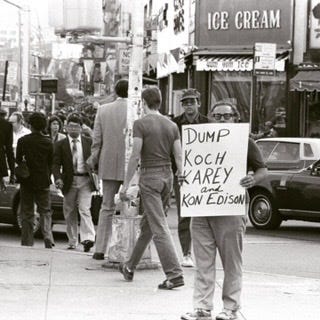
It wasn’t the way he said it that intimidated me as much as the accompanying look: cruel, cold, crazy. Walking down his block no longer seemed like a good idea — forget living on it — so I beat a retreat before our conversation went any further. As I continued up Avenue A, headed toward 8th Street and eventually the subway, a squad of beefy men in inky-black suits plowed past me on their way downtown. Now what? Stepping aside, I spotted a telegenic bald spot bobbing up and down amid these obvious bodyguards. It was Mayor Ed Koch, campaigning for re-election. Not yet an official constituent, I held my tongue as the incumbent passed. What I wanted to do was hurl his signature line back in his face. “How’m I doing?” It was a teachable moment. Ever day in New York City, the upper echelons and lowlifes traversed — or collided on — the same sidewalks.

Onboarding NYC: 1981

A New Introduction To An Old Story

Returning from work on a humid July evening in 1981, my first season in New York City, I wandered through the palpitating heart of Greenwich Village and paused on Carmine Street. I was in no hurry to return home to my humble-ain’t-the-word abode. After browsing esoteric disco records at Vinyl Mania, I pondered a budget supper at Joe’s Pizza. Suddenly, a loud and suspiciously familiar voice pounded my eardrums.

“Mark Coleman! Hey Mark!” “Mark! Hurry Up! C’mon, Mark! Get In!”

It sounded like my neighbor Frank Davol. But I couldn’t locate him until I turned to look at the stretch limo idling on this narrow side-street, directly in front of me. Frank’s statuesque head and shoulders popped out of the open sunroof. He was clearly jacked up, on sheer enthusiasm or possibly something stronger. My dinner would have to wait. Once I tumbled into the Lincoln and we wheeled north onto Sixth Avenue, Frank stood and yanked me through the sunroof. I felt silly, and exhilarated, as we headed uptown, both of us hooting and hollering like fools. The only thing missing was the ticker tape.

It was far from the first display of my neighbor’s extravagant whims I’d witnessed. Still a rented limousine was inexplicably extra, even for Frank. Despite obvious clues, I hadn’t yet determined the source of his mysterious “mad money.” As far as I could tell, Frank appeared to get around in high style — especially for a guy living in a dump.

*

People who didn’t live in New York perceived the city as a fantastically dangerous place in the Seventies and Eighties. Many Americans assumed Manhattan and the surrounding boroughs constituted a wide-open bazaar for muggers, junkies, gangsters, conmen, pimps, whores and hustlers.

But another collective belief — or conceit — about New York persisted throughout the city’s decline and eventual rebirth. Perhaps it still exists in the 21st Century, albeit for a privileged few. (Then again, in the wake of Covid perhaps New York City itself is once again up for grabs.) Anyway this popular myth about New York lured hundreds if not thousands of young people to the city during the waning years of the last century. It was the promise (if not the actual existence) of endless possibilities. There were rumors of buried treasure hidden beneath the city’s bad reputation during the Seventies and Eighties. Young prospectors arrived and unearthed a new identity for themselves in myriad ways. You could assemble a fresh art form from the detritus; make music out of the noise in the street. You could also make a shit-ton of money in all kinds of arcane ways. (You could, I’m still working on that one.) And if you’re lucky like I was, and still am, the greatest inspirations you’ll ever find are the people you meet here.

*

My love affair with an idealized vision of The City began sometime in 1970. My friend Richard and I rode the bus from our sleepy suburb to downtown Cincinnati on a Saturday afternoon. In the chili parlor off Fountain Square, all the other kids were right in our age range, 12–14, and though most of them were black it didn’t matter here, we were all spinning on our stools and eating “coney islands” and bobbing along to the Five Stairsteps’ “Ooh Child” (a heartfelt Jackson 5 knockoff) on the radio. That moment in the chili parlor took root in my consciousness. Soul music and social diversity became forever associated with The City in my searching pre-teen mind.

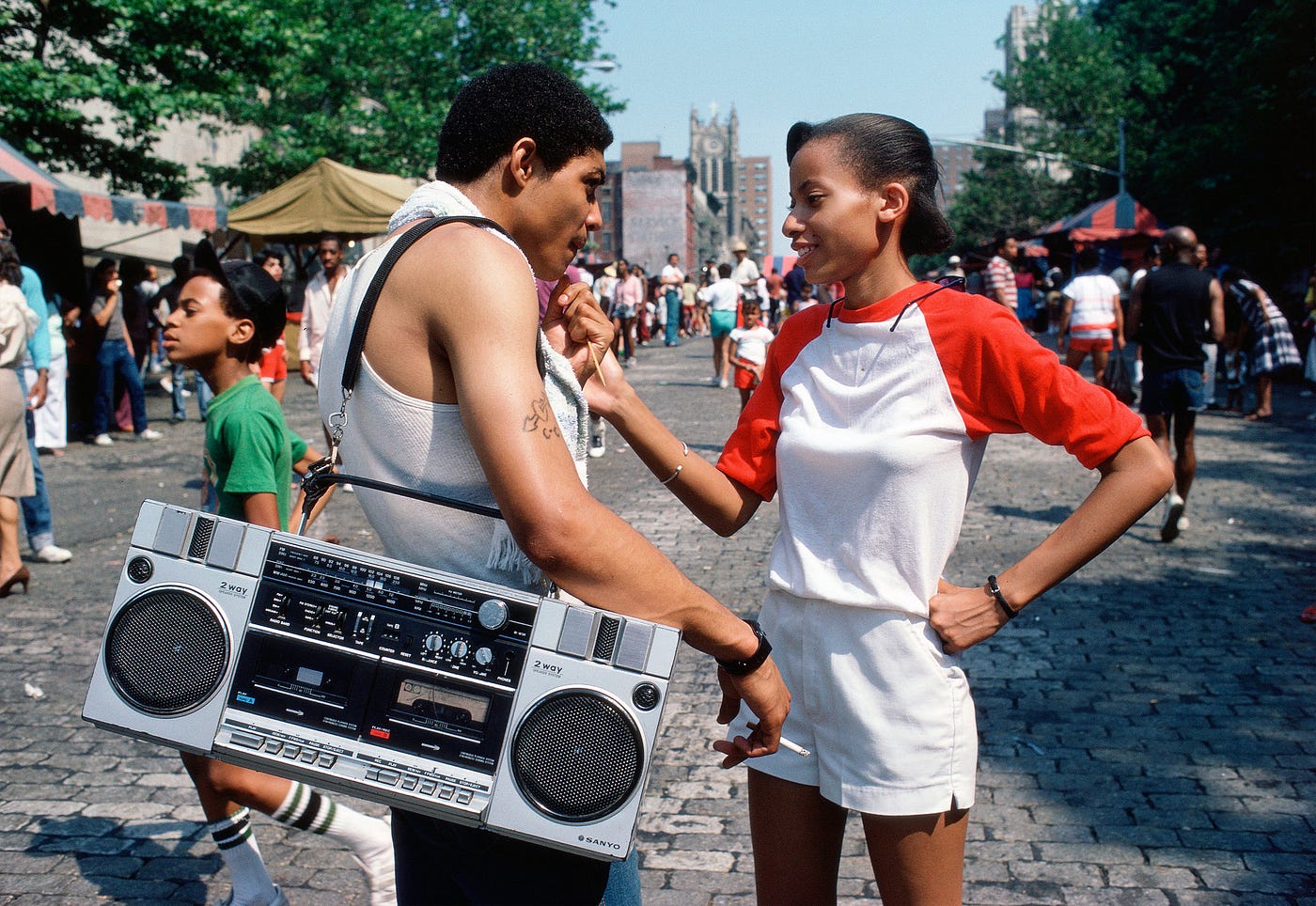
Ten years later, I visited New York City for the first time and experienced another urban epiphany. For five days and nights on that college spring break vacation, everywhere we went, Michael Jackson’s “Rock With You” emanated from storefronts, passing cars and the portable stereos known as ghetto blasters or boomboxes. I attended some great live music shows during that trip, including Parliament/Funkadelic at the Apollo Theatre in Harlem, maybe the best concert I’ve ever seen. But the sound that echoed in my head back in the Midwest was the funky music in the street.

One year later I was back. My first six months in New York were difficult. City life overloaded my senses on a daily basis. Yet at the same time I felt isolated amid the millions and millions of people. Outside of work, I spent much of my time alone, reading or listening to the radio. I couldn’t afford a stereo or television. I lived in a seedy rooming house in Greenwich Village, what was known as an SRO (Single Room Occupancy). One room with no kitchen and bathroom down the hall: I cooked on a hot plate. My neighbors included an opera student who practiced all day in her room, a middle-aged hotel bellhop, the requisite junkie thief and another guy my age who turned out to be a high-end male prostitute. I spent as little time “at home” as I possibly could.

However I did make one fast friend during this solitary period. He proved to be a frequent companion, off and on, for the next few years. There was a catch, however, a complication that meant our platonic relationship would always be unrequited. My first friend in New York was a voice on the radio. But what a voice! And what taste in music!

If Frankie Crocker isn’t on your radio, your radio really isn’t on…

During the long hot summer of 1981 I hung out in nearby Washington Square Park. The big portable radios resounded throughout the square, from the grand arch to the disused fountain, dozens of boomboxes tuned to the same station. So from all corners of the park, I could hear the baritone announcer reading the resonant ID and promo.

W…B…L…S…Number One….Where you hear THIS: five seconds of “Square Biz” by Teena Marie…

AND THIS: “Magnificent Dance” by The Clash…

AND THIS: “I’m In Love” by Evelyn Champagne King…

AND THIS: “I’ll Do Anything For You” by Denroy Morgan…

AND THIS: “Heartbeat” by Taana Gardner…

AND THIS: “Never Too Much” by Luther Vandross…

It’s all happening NOW on WBLS-FM New York

Photo: Martha Cooper/Steven Kasher Gallery

Sometimes, the music in the street commented on my new life like a boombox Greek chorus (“Can You Handle It” by Sharon Redd). I could never quite decide whether it was tragedy or comedy.

The weekend afternoons I spent in the park were my first and only taste of street life. I’d watch people getting cheated at chess, or buying beat reefer from the sketchy vendors who thronged like piranhas near the southwest entrance. In the square itself, student clowns and apprentice acrobats performed stunts with crazed abandon. There was a fire-eating daredevil whose act I watched between my fingers, sensing every performance would end in disfigurement or death. His homemade torches resembled Molotov cocktails. This guy looked like he ran away from the circus.

The fountain basin served as an open-air theatre for itinerant musicians and comedians. People sat in rows on the concrete steps as if they were perched in the ballpark bleachers. The typical bill of fare on a Saturday might include a ragtag bebop ensemble, a troupe of incredibly nimble street-dancers accompanied by drummers pounding plastic buckets, and last but not least, a succession of self-styled funnymen. The unfortunate religious fanatics who strayed into this arena never fared too well.

By far the most popular performer in the park, the star of the circuit, was a wild-eyed guy named Charlie Barnett. He’d come running through the park, banging on a hubcap or blowing a whistle in between in shouts of “Showtime! Showtime!” His high-energy delivery and raunchy riffs weren’t merely derived from Richard Pryor’s, in many cases they were Pryor’s, almost verbatim. His entire act was a cover version; Charlie Barnett was a Richard Pryor tribute band. He was also funny, in small doses.

I rarely ran into any of my neighbors in the park, which was initially part of its appeal.

Eventually I became friends, more or less, with two people in the building. Frank Davol and Jeff Reidel both lived on the first floor, in two-room suites, while everybody else made due with a single. Frank and Jeff provided my crucial primer in the promise and perils of radical self-invention.

*

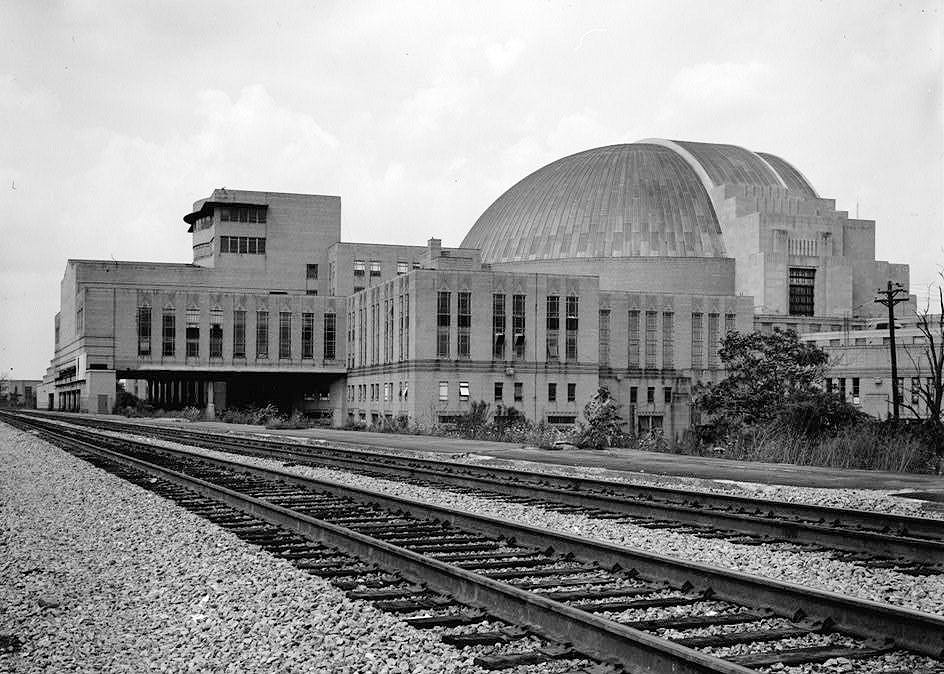
Union Terminal (South Tracks) Cincinnati Ohio 1981

My point of departure for New York City was less than romantic: a forlorn platform in the freight yards outside the grand old Union Terminal. One of Cincinnati’s architectural treasures, with murals by German artist Winold Reiss, Union Terminal was functioning — minimally — as an upscale shopping mall at the onset of the Eighties. Only a few stores huddled beneath the sprawling paintings, and customers were scarce, or at least they had been on my aimless exploratory visit during the holidays.

The Amtrak Cardinal paused in Cincinnati on its way from Chicago to Washington D.C. I said goodbye to my parents, who were (as always) totally supportive of my big move yet visibly apprehensive on this, the big day. It was late afternoon on a frigid Tuesday in early February 1981.

Rural West Virginia passed by my window most of the night. I couldn’t have slept even if my seat had been comfortable. So I restlessly gazed at an endless sea of pitch-black nothing, occasionally interrupted by random islands of illumination: the pointless blinking of a traffic signal over a deserted intersection, a beacon spot-light shining forth from the side of a windowless corrugated shed.

Arriving at Washington’s Union Station in the early daylight is a jumbled blur in my memory. Somehow I managed to jog between trains and climb aboard the northbound Metroliner. The window view looked decidedly different from the night before: disused factories, decayed warehouses. A sign hung on a huge smokestack in Wilmington, Delaware: Documents Shredded. The gory details of Watergate, Nixon’s secret tapes and hastily scrapped transcripts, were still fresh memories at that point in time. So the mention of pulverized documents (years before home shredders!) rendered this commercial service both wildly funny and slightly ominous. I was entering that part of the country — the East Coast — where information mattered. Words and ideas were taken seriously here. Or so I presumed.

Pulling out of Philadelphia, the urban landscape could’ve been a vision plucked from Kurt Vonnegut’s Slaughterhouse Five. (Along with many Seventies teenagers, I went through a devoted Vonnegut phase in high school. Star Trek reruns too. ) In early 1981, North Philadelphia resembled a bomb site: crumbling row houses, junked autos, cracked concrete walls further pockmarked with cartoon-letter graffiti, bumper crops of broken bottles harvested in vacant lots.

The concluding hour or so of the journey consisted of a leisurely crawl through a tunnel deep below New Jersey. Intermittent delays lent a starkly claustrophobic air to the already uncomfortable (cold, crowded) train car.

Talk about being fresh off the boat, wet behind the ears: I got played for a sucker not half a dozen steps into Penn Station. The qualifying exam in urban savvy is easy to flunk.

“Hey my man you need a cab?”

I sure did. However, this helpful stranger — a thirty-ish guy with a big mustache and what I interpreted as a jaunty taxi driver’s cap — grabbed my battered Samsonite just as I nodded in the affirmative, lugging my other suitcase and briefcase. I followed him toward a distant exit sign. A minute later the truth sunk into the pit of my stomach. This dude was no cab driver. His “help” would consist entirely of steering the unwitting customer — me — toward the clearly marked taxi stand where other potential passengers waited in an orderly line while the legit drivers sat behind the steering wheels of their Yellow Cabs. My man demanded $10 and finally accepted $5, while I silently thanked him for a quick education in the potential hazards of public transportation and by extension, the city itself. Apparently, people looking to take advantage waited around every corner.

*

Landing an entry-level editorial spot at the august and obscure (to me) trade journal Railway Age, in a thunder clap of luck, just ten days after my arrival in New York, was only half the battle. The timer was ticking on my temporary lodging. After a harrowing and near-disastrous excursion to the Lower East Side, the final apartment ad I answered sounded too good to be true: a studio (one-room) apartment near Washington Square Park, the center of Greenwich Village, for $300 per month. Fiscally, the rent was a stretch. But I replied in a last-ditch effort, leaving my name and temporary number on a robotic answering machine, never expecting to hear back.

The address turned out to be the best thing about 78 Washington Place: smack dab in the middle of a picturesque block between the park and the commercial strip of lower Sixth Avenue. Arriving early, I conducted a quick surveillance mission before my appointment. The block contained a new NYU Law School dorm and some older three and four-story structures. Several featured cozy-looking Italian restaurants on the ground floor. One building in particular drew my attention because it appeared out of place next to the other neatly rehabilitated town houses. The dirty-red brick recalled the color of dried blood. Makeshift rag-curtains adorned most of the windows facing the street. This had to be it. I knew.

I stepped over a decorative iron fence and ascended the crumbling concrete steps to the front door. After several attempts, the buzzer didn’t summon anyone so I began to knock. Instinctively, I stepped back just as the door creaked open and I finally received an answer.

“Ah are you the guy looking for an apartment?”

Jeff the Super, as he’d identified himself on the phone, was a gangly middle-aged man, well over six feet despite stooping a bit. He wore a jailhouse pallor, as if he never got out in the sun. His lank black hair was streaked with grey, his incongruous green eyes magnified by gigantic bug-eyed glasses: ocular relics of the previous decade that had survived time’s ravages thanks to a tactical deployment of rubber bands. He immediately qualified as the strangest person I’d met in New York so far. Yet somehow his oddball manner wasn’t off-putting; to the contrary Jeff was cheerful, friendly, projecting a loony infectious optimism right from the start.

Entering the front hallway we were met by the musty, stifling aroma of a long-neglected attic. Sloppily applied globs of bilious red paint didn’t hide the cracks in the walls. Bare light bulbs in half-broken fixtures provided what passed for illumination.The place gave me the willies. As I caught up with Jeff on the creaky staircase’s first landing, a squat, sour-faced man in what could have been a fancy headwaiter’s or bellhop’s uniform appeared from above, grunting something cryptic about toilet paper as he pushed past us.

“There are a couple things that Anita — she’s the landlord — forgot to put in the ad,” Jeff said as we resumed our ascent to the third floor. “The bathroom is in the hall and there’s no kitchen.”

At least he didn’t say a couple little things.

“But every room has a sink, and a hotplate.”

To cut a long story short I moved in two days later.

*

Book Review: Paging Dr. Mueller

Walking through Clear Water in a Pool Painted Black: Collected Stories by Cookie Mueller

“Firstly, you’re right about my mind being open, in fact it’s so open at times I feel the wind whistling through it.”

— Cookie Mueller, “Ask Doctor Mueller” column, East Village Eye circa 1983

During her attentuated forty years on earth, the inimitable Cookie (born Dorothy Karen Mueller in 1949) amassed a resume that would short-circuit LinkedIn.

By her own account (“Haight-Ashbury — San Francisco 1967”), after surviving high school and a less-than-idyllic upbringing in Baltimore, teenaged Cookie split for the West Coast. She arrived just in time for the so-called Summer of Love, and spent the next two years in communal living.

“Knowing that we were the blessed ones in states of grace, we lived clean lives in preparedness and took drugs to kill time. We got ready with our backpacks and our energy granola. We practiced astrology, yoga, levitation, transcendental meditation, astral travel, telekinesis, cabalism, prayer. We waited and waited, and hoped, but the world didn’t fall apart. It was a big letdown.”

As the power of flowers began to decompose, Cookie’s hippie roommates urged her to check into a mental hospital, after an unspecified breakdown. Upon release she returned East. Over the next two decades she went on to toil at “various inane jobs” including: go-go dancer, clothing designer, underground movie actor, barmaid, drug dealer, herbalist, fish packer, credit clerk, bar mitzvah entertainer (“even though I’m not Jewish”), playwright, advice columnist, art critic and posthumously, book author.

From 1971 up until her untimely death in 1989, she was also a single mom to Max Mueller, the son who, she declared, “taught me more than anyone.”

Back in Baltimore at the turn of the Seventies, Cookie connected with fledgling film maker John Waters and became a key player in his beyond-eccentric repertory company, appearing alongside Divine, Edie Massey and Mink Stole in trash classics such as Multiple ManiacsPink Flamingos and Female Trouble.

On the printed page Cookie Mueller exudes natural talent. She’s a born writer: “I started writing when I was six and never stopped completely.” As the Nobel Prize winning novelist Saul Bellow once said of himself, she was a great noticer. Her peripatetic life supplied scads of material and she knew what to do with it — intuitively. Throughout the first half of Walking through Clear Water…, each of her autobiographical stories lands like a targeted strike, expanding and/or exploding on the page. They’re funny, perceptive, sensitive, sharp and self aware yet never self conscious.

I first encountered one of the Cookie Mueller stories collected here in an 1982 issue of Bomb magazine. Salty and sweet at the same time, “The Pig Farm — Baltimore & York, Pennsylvania 1969” charts the course of an unlikely star-crossed love affair with sly humor and a deep, possibly bottomless well of empathy. As a storyteller, anyway, Cookie fearlessly navigates every curve in her erratic path without ever coming across as lost or directionless. She may not know where she’s ultimately headed but she understands where she’s been.

Her penchant for hitchiking takes a harrowing turn in “Abduction & Rape — Highway 31, Elkton, Maryland 1969.” Yet even here she displays staggering insight — hard-won understanding — into the “assholes” who kidnapped her and two female friends.

“There comes a time when even the most optimistic people, like myself, realize that life among certain humans cannot be easy, that sometimes it is unmanageable and low-down, that all people are quixotic, and haunted, and burdened, and there’s just no way to lift their load for them.”

In her early stories, one crazy incident bleeds into to another, resulting in a tumult of anecdotes and logically impossible sequences that miracuously cohere more often than not. This seeming chaos is grounded by Cookie’s charismatic personality and compassionate instincts, her generosity of spirit, and as Mueller herself admits, more than her share of good luck.

During the mid-Seventies she weathered several unheated seasons in the bohemian enclave of Provincetown on Cape Cod, before moving to New York City. Downtown Manhattan provided a fitting backdrop for her heyday, and perhaps her eventual downfall (“Narcotics”).

Frankly, the 1982–89 art reviews from Details magazine collected here are disappointing, at least compared to the autobiographical tales in the first half of the book. The East Village art scene would appear to be fertile territory and I turned to these pieces anticipating jump-started memories of a now-almost-forgotten underworld. Yet instead of documenting the art and artists, Cookie Mueller hovers above the fray or just meanders — performing, riffing and free-associating, delivering monologues that fall somewhere between a semi-memorable reading at an indie bookstore and a mildly diverting early morning club conversation fueled by a few drinks plus a line or three of cocaine.

The Details columns reflect some of the too-cool-for-school downside of Eighties downtown Manhattan. They’re “inside” to the point of insularity. As opposed to the autobiographical stories, where you read in thrilled disbelief, laugh and shake your head — “who IS this woman?” In Details, and to a lesser extent the tongue-in-cheek East Village Eye advice columns, you’re meant to know “who she is,” and to feel a bit feel left out if you don’t know her. It’s ironic that Cookie became the darling (or den mother) of the Eighties demimonde because in her best writing she’s the living definition of down-to-earth, totally unpretentious, just as satisfied shacking up with a pig farmer as a rockstar (though she inevitably moved on from both).

Ominously, as Cookie eulogizes Jean-Michel Basquiat at the end of 1988, her empathetic spark and gift for casual aphorism finally re-emerge, and combine to moving effect. She attends a lavish (by local standards) party put on by a dissolute and disengaged Basquiat toward the end of his life, and her reaction when the host sneaks out of his own bash is poignant.

“Maybe Jean-Michel had found that packing for the trip was better than getting there, the climb more rewarding than the summit… [L]ooking at him, I began to feel somehow protective, but kind of angry and sort of sorry for him too.”

One year later Cookie Mueller would be gone too, a victim of AIDS-related complications. Her last Details column was about her husband, the artist Vittorio Scarpati, who was mortally ill himself and died in 1989 as well. It’s a beautiful and heart-beaking tribute, not only to Vittorio Scarpati but to an entire community who stood up against a cruel and merciless epidemic.

“Vittorio continues to draw in his hospital room, to compile his illuminated visions, spreading some light around. There is a communique here for all of us that tells of strength and character, bravery, and courage in the midst of adversity and intense physical pain. Vittorio has learned that like a flood of sunlight, hope can vanquish gloom. Things are never so bleak and threatening as we believe.”

Perhaps we can best remember Cookie Mueller the way she encouraged us to remember Jean-Michel Basquiat. And of course by reading her wild and wonderful stories.

“Jean-Michel had a full life. He did everything he could and did all of it well. Don’t feel sorry for him. It’s the rest of us, left behind, we should feel sorry for.”

Dionysian Rave: “Dancing in the Streets: A History of Collective Joy” by Barbara Ehrenreich

Originally published in The Los Angeles Times Book Review January 7 2007

BY MARK COLEMAN

IN the 21st century, most people have experienced at least a watered-down version of what author Barbara Ehrenreich calls collective joy. Many are susceptible to flashes of communal ecstasy in stadiums or auditoriums, nightclubs or public parks, at concerts and dances and sports events. Participation in such familiar — not to say cliched — rituals can spark a vague but intensely pleasurable group consciousness. Feeling that we’re part of something bigger than ourselves is something that doesn’t happen as often as it should, according to Ehrenreich.

In “Dancing in the Streets: A History of Collective Joy,” she spends nearly as much time mourning the absence of ecstatic rituals in modern times as she does taking note of their fantastic past: Greek mystery cults, Roman emasculation rituals, self-flagellation fads, “dancing priests” and their rowdy flocks, bawdy anti-clerical burlesques and medieval dance manias. The history of collective joy as related here is lurid and alluring.

In Ehrenreich’s telling, dance has been a key element in this group behavior almost from the start. Ancient hunting rituals, for example, included rhythmic movements meant to intimidate the prey. “Taken individually, humans are fragile, vulnerable, clueless creatures,” she writes. “But banded together through rhythm and enlarged through the artifice of masks and sticks, the group can feel — and perhaps appear — to be as formidable as any nonhuman beast. When we speak of transcendent experience in terms of ‘feeling part of something larger than ourselves,’ it may be this ancient many-headed pseudocreature that we unconsciously invoke.”

Combining thorough research with her tart, skeptical eye, Ehrenreich constructs a vivid narrative of early Christianity and “deliberately nurtured techniques of ecstasy.” By the Middle Ages, these fervent rituals were a regular feature of peasant life. “[O]ne out of every four days of the year was an official holiday of some sort, usually dedicated to a mix of religious ceremonies and more or less unsanctioned carryings-on,” she writes. “So, despite the reputation of what are commonly called ‘the Middle Ages’ as a time of misery and fear, the period from the thirteenth to the fifteenth century can be seen — at least in comparison to the puritanical times that followed — as one long outdoor party, punctuated by bouts of hard labor.”

Of course, it didn’t take long for church authorities to target these celebrations as breeding grounds of heresy (not to mention the attendant sexual promiscuity and property damage). “Nothing is more threatening to a hierarchical religion than the possibility of ordinary laypeople’s finding their own way into the presence of the gods,” Ehrenreich notes. “The absolute incompatibility of Jesus and Dionysus — or more generally, Christianity and the old ecstatic religions — was a tenet of later Christian theology, if not ‘Western’ thought more generally.”

In her bestselling book “Nickel and Dimed,” Ehrenreich documented the day-to-day lives of minimum-wage workers. So it’s no surprise that “Dancing in the Streets” focuses on the sociological effect of the festive ritual rather than its spiritual thrust: “Whatever social category you had been boxed into — male or female, rich or poor — carnival was a chance to escape from it,” she writes. Throughout, she is less concerned with personal transcendence than with political transformation — the revolutionary potential embedded in ecstatic practices. With characteristic frankness, she identifies the suppression of community rituals and festivals as her larger theme. But her anti-authoritarian edge serves the book’s first half far better than it does the second.

Ehrenreich’s rhetoric reaches a fever pitch in her description of France in 1790; she gets caught up in the public celebrations on the first anniversary of the revolution, and her unabashed intellectual enthusiasm electrifies these pages. “With the shared wine and food, the dancing that wound through whole cities and out into the fields, this has to have been one of the great moments, in all of human history, to have been alive.”

Perhaps inevitably, after that peak a somewhat jaded air creeps in. Ehrenreich angrily points to the cruel legacy of colonial rule and its decimating effect on local religions. She contends that “Europeans generally found themselves in furious opposition to the communal pleasures and rituals of the people whose lives they intruded upon.”

But condemnation by civil and religious authorities was not the only force working against collective joy. In the 19th century, Ehrenreich suggests, there’s a rough parallel to be drawn between the growing acceptance of depression as a malady and the gradual decline of unrestrained public festivities. “Urbanization and the rise of a competitive market-based economy favored a more anxious and isolated sort of person — potentially prone to depression and distrustful of communal pleasures.” Frustratingly, this ripe idea is treated not as an avenue of exploration but almost as an aside.

By the time it reaches the 20th century, “Dancing in the Streets” starts to feel a bit rushed and rather cursory. “The mall may be a dreary place compared to a medieval English fair.” Public expressions of communal joy haven’t been suppressed by political or religious authority as often as they’ve been subsumed by pop culture. Ehrenreich nails the manipulative spectacle of Nazi rallies in a deft phrase (“ersatz participation”). And she draws an instantly graspable distinction between an audience, where “each individual is, ideally, unaware of other spectators except as a mass,” and a crowd, where “people are aware of one another’s presence and … sometimes emboldened by their numbers to do things they would never venture on their own.”

But for the most part, the later chapters of “Dancing in the Streets” lack the animating spark of Ehrenreich’s earlier populist arguments, relying instead on received wisdom and a few incredible generalizations. (“From the nineteenth century on, all forms of Western music were being consumed by immobile audiences.”) Even her evocation of the hedonistic rituals of the 1960s counterculture is curiously ho-hum. “[Y]oung people began to assemble all the ancient ingredients of carnival: They ‘costumed’ in torn jeans, tie-dyed T-shirts, granny dresses, feathers, and billowing scarves. They painted their faces and perfumed themselves with patchouli. They shared beer, wine, vegetarian snacks. They passed around joints. Young anti-war activists, like myself, could take a holiday from our usual work of persuasion and organizing, because peace was already in the air.”

Like many early baby boomers, Ehrenreich typically underrates or ignores the significance of the decade that came after the ‘60s. The disco boom of the late ‘70s precisely fits the ancient criteria of ecstatic ritual with its costumes and customs, its hypnotic rhythms and aura of sexual ambiguity. Perhaps it’s the white-suited John Travolta of “Saturday Night Fever,” not Mick Jagger, who most resembles a modern Dionysus. Yet the rich under-explored tradition of disco, dance music cults and rave scenes rates only a few sentences. Maybe you had to be there. Ehrenreich famously put herself into her previous two books, pulling off a high-wire balance of first-person reporting and social commentary in “Nickel and Dimed” and its sequel, “Bait and Switch.” Though her latest book presents a solid and provocative academic overview of its subject, too much of the current-day material reads like library research. “Dancing in the Streets” might have achieved transcendence if the author had been a face in the crowd.

Andy & Me: Living Vicariously Through The Andy Warhol Diaries

Andy Warhol paved the way for so much current pop culture it’s impossible to measure his impact. He smudged the line between commercial and fine art with his silkscreen paintings from the early Sixties: the Elvises, Marilyns and Jackies that first made him famous (for longer than fifteen minutes). He envisioned the reality TV concept when he made ad hoc, shot-on-the-cheap, boring-on-purpose underground movies with self-explanatory titles such as SleepKissScreen Test and Blow Job.

He sponsored The Velvet Underground at the onset of their career, and then watched as they spawned several successive generations of rock and roll musicians. On a broader canvas, Andy Warhol promoted gender fluidity and LGBTQ culture throughout his life. Despite his extreme (at times neurotic) sense of personal privacy, he made no effort to conceal his own gay identity, beginning at a time when homosexuality was far from accepted in the art world let alone America at large. And he foregrounded his deep, obsessive fascination with celebrity; first in his artwork and later in the pages of his magazine, Andy Warhol’s Interview. Throughout the Seventies, Andy tape-recorded conversations at parties while snapping thousands of Polaroid photos — social media posts in search of a platform! Published two years after he died at age 58 in 1987, much of The Andy Warhol Diaries reads like well, uhm, I guess Twitter.

*

I never met Andy Warhol. Yet I feel an odd affinity with him, a connection that extends beyond revering his aesthetic accomplishments. Full disclosure: Andy and I stood in the same room at a Manhattan night club several times during the Eighties. And how many other people can say that? Thousands? Perhaps by then Andy wasn’t quite as choosy about where he hung out as he once had been.

*

“I had a death threat. I’ll get to it.”

— Monday May 4 1981, The Andy Warhol Diaries

Memorials and memoirs, reminiscences and revisionist histories, mash notes and poison pen letters began to accumulate on the Andy Warhol shelf in the years following his death. I might’ve ignored The Andy Warhol Diaries, edited by Pat Hackett, if not for Martin Amis’ evaluation on the cover of The New York Times Book Review in June 1989.

“On most mornings, Andy Warhol called his former secretary, Pat Hackett, and rambled on for a while about what he did the day before. She made ‘extensive notes,’ she explains, and ‘typed them up while Andy’s intonations were fresh in my mind.’ So that’s what we’re looking at here: 800 pages, half a million words, of Andy’s intonations. But it works, somehow.”

Martin Amis’ review of The Andy Warhol Diaries works both as a critical assessment of this singular volume and its sui generis author as well as a wide-roaming, precisely articulated essay that touches down on art, social aspiration, masculinity, and the cultural differences between the Seventies and Eighties while nailing the poignance and ambivalence of Andy’s public persona. (It’s available in the Amis collection The War Against Cliche.)

“And after awhile you begin to trust the voice — Andy’s voice, this wavering mumble, this ruined slur. It would seem thatThe Andy Warhol Diaries thrives on the banal, for in the daily grind of citizenship and dwindling mortality, the nobody and somebody are one. Meanwhile, here comes everybody, or at least everybody who is somebody.”

Andy’s Diaries resonate for me as a touchstone: the granular document of a rarified but somehow not uncommon Manhattan lifestyle, and a cautionary tale for young strivers just setting out in the city.

The early pages are unpromising. Beginning in 1976, the chronological entries find the artist spending much of his time on the make, hustling portrait commissions from the upper crust in Europe and the Upper East Side of Manhattan, accompanied by Fred Hughes and/or Interview editor Bob Colacello, often supplemented by a well-born female companion.

The Diaries find their rhythm during 1977–78, as the disco era reaches a dizzying peak and Studio 54 commands national media attention. Andy’s morning-after recounts of his nights out with the gang — Halston, Liza Minelli, Bianca Jagger, Truman Capote, Steve Rubell — spill over with dishy bon mots and astringent social observations. It’s the most entertaining section by far though not immune to a subtle, mounting sense of disquiet. Warhol’s admitted use of substances — slyly rubbing cocaine on his gums and quaffing a comped vodka or three — gets eclipsed by the gargantuan intake of almost everybody else hanging out with him. Lurking around the corner is an extended hangover, aka the Eighties.

Andy’s next decade gets off to a rocky start. Calling Warhol emotionally reticent is a gross understatement, so just the fact that he mentions his breakup with romantic partner Jed Johnson, after nearly a decade of cohabitation, is remarkable. Characteristically, the acknowledgments are terse. Tension between the couple had already surfaced throughout the Studio 54 heyday, yet these premonitions are scant preparation for readers and, one senses, the diarist himself. From Sunday, December 21, 1980:

“Jed’s decided to move out and I don’t want to talk about it.”

Despite their twenty year age difference, Jed Johnson by all accounts (including Andy’s) had grown exhausted and alienated by his middle-aged partner’s ceaseless social whirl and longed for a more stable home life and career, which he found. In the ensuing decade, Jed Johnson established himself as an interior designer; he died in the 1996 TWA Flight 800 crash.

Andy Warhol, judging from the Diaries, spent the remaining seven years of his life emotionally adrift. He pursued unrequited, borderline-obsessive romances with increasingly younger men, most notably the thirty-ish film executive Jon Gould, and fell back on that tried-and-true big city method of filling one’s life: going out too much. Martin Amis, again:

“Andy went everyplace that was anyplace — or not even.”

Every night, there was something to do — especially if you were Andy Warhol. With his every-shifting crew of companions (mostly Interview staffers in their twenties), Andy turns up at benefits, concerts, movie screenings, art openings, dinner parties and all manner of hazily defined “events” at nightclubs. As the decade lumbers on, Andy had less time for his peers and old pals (and vice versa), perhaps understandably preferring the energy and input of people young enough to be his children. Broadly speaking, Keith Haring and Jean-Michel Basquiat were his children; they incorporated and furthered his legacy before their own brief, brilliant careers both ended in tragedy.

Keith Haring, Andy Warhol, Jean-Michel Basquiat 1984

And we don’t have to regard Andy Warhol as a vampire or bad influence to observe that his two main inheritors, alongside his encouragement, also on occasion received his snarky wasp-stings.

Tuesday, October 2 1984 : “Jean-Michel came over to the office to paint but he fell asleep on the floor. He looked like a bum lying there. But I woke him up and he did two masterpieces that were great.”

Monday October 29 1984: “So we drove up to 90th Street and East River Drive to see the mural that Keith had done. It’s like 2 1/2 feet wide and 200 feet long, like three blocks long. He painted it white and sprayed little black and red figures, but it would have been better just silver. It doesn’t make the city look better, really.”

*

A couple years after first reading The Andy Warhol Diaries, I attended a party hosted by a former neighbor in the East Village. By this time, the early Nineties, I was newly married and living across town, pursuing a less hectic social life than I had during the Eighties. I was happy to see my friend though as the night progressed, or devolved, it appeared that she (and I) were roughly ten years older than most of the guests at her party. Without judging her, or assuming everyone should tread the same path through life, I half-consciously decided right then and there not to conduct my thirties in the same way as I had my twenties.

Getting stuck in a youthful moment — longing to live on the cusp of ambition, clinging to that all-things-are-possible flash of pure unrealized potential — is the unenviable fate of the middle-aged bohemian. The last pages of The Andy Warhol Diaries illuminate this dilemma. By the end Andy sleepwalks, dutifully trudging across the Manhattan club circuit, miming the nightly charade of fabulousness. Living vicariously through ever-younger friends, no matter how devoted they are, comes with a set of severe built-in limitations. The emotional returns only diminish over time.

Roaming the Upper West Side of Manhattan on an undistinguished day during the pandemic year of 2020, I walked past a public middle school. It was closed but student art projects were visible behind a fence. “Haring and Basquiat” read the sign above, though that was unnecessary as the graffiti-inspired sculpture and Godzilla-with-crown painting on display made for instantly recognizable homages to the two deceased artists. I realized that my peers Keith and Jean-Michael, gone more than thirty years now, were no longer Andy Warhol’s inheritors but his stand-ins, the definition of an artist for today’s young people: the new Warhols. Art is eternal, even if artists aren’t.

“It’s The Cobblestone Streets That Send Me Back”

Working in an office next door to my second NYC apartment -  thirty years later

Corner of Ninth Avenue & 14th Street in 2018: the pre-COVID Meat Packing District

Comprehending the pre-COVID makeover of Manhattan from grunge to gleam requires a deep dive into the recent past. Nothing captures the transformation of New York City in the 21st Century better than a walk on the High Line, an elevated greenway stretching for about a mile and a half above the far west side of downtown. The view from the High Line is startling, even surreal, for both visitors and longtime residents - albeit for different reasons.

Looking at the lopsided and cantilevered architectural design of the many new buildings, the uneven peaks and jagged angles, is disorienting; it takes a minute for your eyes to adjust. Especially if you remember the not-so-distant period when this neglected neighborhood - and the city overall - appeared to be on the verge of collapse. In fact, a section of the old elevated West Side Highway (now incorporated into the High Line) actually did collapse in 1973.

Opened in 2009, the main section of the High Line promenade is a former railroad spur for the New York Central Line. The area below the walkway around West 14th Street is known as the Meat Packing District. Before the pandemic, weekend evenings found the narrow side streets jammed with young people and well-heeled visitors. They all stumbled over cobblestones on their way to browse in boutiques or sip cocktails in rooftop hotel bars. A few warehouses remain but it’s the cobblestone streets that send me back.

When I lived nearby, from fall 1981 to spring 1985, the crumbling railroad spur was partially torn down yet still accessible to intrepid urban sunbathers and alert joggers who stepped over the gaping holes. In the early Eighties, crossing Ninth Avenue and continuing west on 14th Street felt like falling off the map. During the day, this commercial district - the meat-packers’ marketplace - formed a bleak panorama. The streets reeked all day, even after the cobblestones were cleansed of the pre-dawn butchers’ bloodbath. Open dumpsters and rubber trash barrels lined the sidewalks, filled to the rims with freshly rendered hunks of peppermint-striped animal fat. Forget about rats; in the Meat Packing District the flies were scary.

After dark the warehouses turned into hives of activity, much of it furtive. Camouflaged in black leathers, men prowled the shadowy blocks all night long, loners and duos stalking past the packs gathered near a doorway or loading dock. Were there dozens of people walking around on any given night, or hundreds, bar-hopping between the murky nightclubs and after-hours spots? I can’t say. It looked like a lot of guys from across the street.

So a stroll along the High Line today, taking in its sweeping second-story views and manicured foliage along the path, in the company of orderly citizens and tourists alike, represents nothing less than the rehabilitation of New York City.

My old building still exists, visible from the High Line two blocks down 14th Street. 48 Ninth Avenue now sits across the street from a polished Apple Store, catty-corner to Google’s New York offices. Our old front door has been impressively fortified, and a pair of relatively pricey retail shops now border that familiar portal. The ground-floor restaurant, where the Greek-American proprietors gruffly dispensed coffee and soup, is no longer labelled a diner though it’s still a faceless (though much more expensive) everyday eatery.

48 Ninth Avenue in the early 1980s

The imperious, looming Googleplex encompasses an entire city block: bordered by Eighth and Ninth Avenues, 15th and 16th Streets. When I lived next door this monolithic structure was a Port Authority facility, primarily a garage. Today giant computer servers occupy the old parking bays.

Besides me, nobody else in the Google cafeteria read a print newspaper while eating lunch. Naturally many employees studied the screens of their mobile phones or company-issued laptop computers while enjoying the delicious and insanely varied array of free food every day. However, more than a few people conducted face-to-face conversations with each other. I was a couple decades older than most of my colleagues but that gap never felt awkward, perhaps because I appeared younger than my 55 years. Working for the tech behemoth as a temporary Senior Editor, during 2012 and 2013, occasionally felt like the best job I’ve ever had. At the very least, I didn’t miss all those print-media egomaniacs and their endless melodrama. Well not too much.

I was one of twenty or so Senior Editors hired in 2012, under non-renewable one-year contracts, to re-brand the venerable Zagat restaurant guide as a digital competitor to Yelp, the popular user ratings website. By the following spring, we’d written and edited data-based reviews of more than 50,000 restaurants, hotels and shopping outlets in major urban markets. But for reasons known only to Google’s top echelon, our work never went online.

Our Zagat team “curated” - churned out - vast amounts of digital content about restaurants, travel attractions and retail shops. We functioned as assembly line workers in a digital-age information factory. In fact, during the last few months of my one-year contract, there was a daily quota of content imposed on our team: a goal I always met and often surpassed. My co-workers were pleasant-enough people, but they came across as self-contained, even timid, at least in comparison to the ambitious and flamboyant personalities I routinely encountered during my years in print journalism. At Google we silently sat in front of our computers, writing while listening to music on headphones. Online research (rather than interviews) formed the basis of what we wrote and the resulting headlines and capsule summaries were measured in characters, not words.

My experience in the late Nineties, witnessing the music and publishing spheres go through wrenching changes, had been traumatic. By 2012 I was happy just to be employed in the brave new world of technology. In any capacity. I didn’t harbor illusions about my future; Google is a young person’s company. My mission there was straightforward; I tried to function as a sponge and absorb as much as possible in the allotted time. And my 40 hours a week (no overtime) ticked by like clockwork: the regularity and predictability were comforting. Especially compared to the preceding 30 years of career chaos. No more deadline aneurisms, no more publisher tantrums, no sudden regime changes upending the masthead.

Nearly every day in the Eighties, on my way to work or wherever via the subway, I traversed the stretch of 15th Street that abuts the Google building’s south side. In 2012 and 2013, commuting via subway from the Upper West Side, I made my daily approach to Google’s Ninth Avenue entrance along the same block. The grand old bank on the corner of Eighth and 15th, long unoccupied, is now a CVS drug store. But the apartment buildings on the south side of West 15th Street still look the same.

Walking to my job at Google, I wondered if any of the same people lived there and soon I had my answer. I began noticing a Latina woman, close to my age, who looked familiar. Every time I saw her, sitting on the stoop or hanging out the front window, the calendar pages flipped back 30 years. It seemed reasonable to assume she’d been living here, on West 15th Street, all this time. When I finally summoned the courage to introduce myself on a spring evening, she replied with pleasure even if she didn’t recognize me from walking past her every day in the early Eighties. Why would she? It’s not as if we ever spoke then. Now she told me about her grandmother’s recent death. “She lived here too, you musta seen her with me.” Only then, I clearly recalled the two of them, a teenage girl and her abuela, watching the sparse parade of people march past on what was then a dead-quiet block across from a hulking industrial garage.

Just before my job contract ended in September 2013, curiosity and nostalgia de la boue propelled me toward the one place in Manhattan I’d tried to forget over the years. So I took an after-work detour to Washington Square Park, before meeting my wife and son for dinner. There it was: my first home in the city, where I lived during the spring and summer of 1981, significantly refurbished but instantly recognizable.

A clean-cut blond man in his mid-twenties sat on the front steps behind a freshly painted iron gate. He looked quizzical as I lingered on the sidewalk in front of him, so I explained the purpose of my visit. “I lived here 32 years ago!”

His mild interest seemed more polite than anything else, though he mentioned that one of his neighbors had lived in the building at least that long. “Marty - and here he comes now.”

Miraculously, an elderly man slowly approached from the west. He pushed a walker down the sidewalk.

It was my former next-door neighbor. The hotel bellhop had grown fleshy and grey.

“This guy says he used to live here, Marty.”

“Hey, wait, I remember you. Sure. Mark, Mark Coleman. You got rescued in the fire.”

After that encounter, my memories of the early Eighties fired off a chain reaction, one recollection sparking another. I began writing them all down.

There He Goes Again

“The Presidential election is just too stupid to watch…you see Ronald Reagan in these neighborhoods with poor people and you can just hear him saying ‘Oh my God what am I doing here?’ But his hair looks really good.”

The Andy Warhol Diaries on August 21, 1980

My mom, a moderate-to-liberal Rockefeller Republican, intuited the political future in 1976. Though my intention was pulling the lever for the Democratic nominee in my first Presidential election, Mary Louise insisted that I register as Republican so as to vote against Ronald Reagan in the primary. Switching parties could come later. “If that lousy actor becomes President, I’m moving to Canada!” Four years later, he did and she didn’t.

Though the fourth and final installment in Rick Perlstein’s chronicle of the conservative revolution is titled Reaganland, it might just as easily been called Carter Country. Jimmy Carter dominates this capacious narrative’s first half and then some. Which is only appropriate, as he was President during the years under scrutiny. Regarded as a failure on both sides of the aisle, Carter nevertheless was much more than a foil or fall guy for the opposing party, and he emerges from Reaganland‘s thousand-plus pages as a complex character: equally earnest and arrogant, insightful and inept, pious and prickly.

Perlstein’s newest doorstop volume, similar to its three predecessors, is a comprehensive social history. Roughly, Reaganland encompasses three overlapping narratives: the post-convention 1976 election and Carter’s presidency, the so-called Religious Right’s rise to power, the 1980 campaign and election. The book’s sheer breadth and depth prove the adage about history being messy yet this deluge of information offers clarifying flashes of foresight while avoiding pat summary of the past. It’s no data dump.

Still, little is left out of the dismal late Seventies hit parade: Son of Sam, New York City’s blackout, Jonestown, SALT II, Phyllis Schlafly’s successful blockade of the Equal Rights Amendment, Anita Bryant’s shockingly hateful anti-gay rights crusade, the murders of San Francisco’s liberal mayor George Moscone and gay city supervisor Harvey Milk, the Soviet invasion of Afghanistan, and, inevitably, the events leading up to and including the seizure of the U.S. Embassy in revolutionary Iran, even the “Disco Sucks” melee at Chicago’s Comiskey Park during the summer of 1979.

Though Jimmy Carter was in fact a devout born-again Christian, the self-styled Moral Majority, fueled by the booming popularity of religious broadcasting aka televangelism, was ripe for plucking by Ronald Reagan. To this day (though perhaps not eternally), the Religious Right forms the Republican Party bedrock.

“Do you ever feel that if we don’t do it now, if we let this become another Sodom & Gomorrah,” mused Ronald Reagan to the Reverend Jim Bakker, “that we might be the generation that sees Armageddon?” As transcribed by Perlstein, their televised exchange reminded me of first encountering televangelism in 1976, snowbound in a Canton, Ohio motel: Jim Bakker simultaneously raising funds & faith-healing while Tammy Faye shed crocodile tears was the most outlandish television spectacular I’ve ever witnessed.

Reagan’s Armageddon rhetoric about nuclear weapons and the Soviet threat served red meat to his grass-roots supporters, and indigestion to power brokers in both parties. Basically, he had to reassure Republican leaders that he wouldn’t push the doomsday button in a fit of pique. Remembered now as an all-conquering hero, Reagan secured the 1980 nomination at a slow, steady turtle-like pace. He systematically knocked off formidable challenges from Howard Baker, Bob Dole (maybe not that formidable), George H.W. Bush, John Connally, and eventual third-party candidate John Anderson. As Perlstein unpacked the convention drama surrounding Reagan’s vice-presidential pick, I momentarily got lost in a counterfactual daydream. What if Reagan had chosen Gerald Ford as running mate, instead of George Bush, as he seriously considered? We may have been denied, or spared, both future Bush presidencies.

Of course there’s truth underlying the clichés about Jimmy Carter being a scold and Ronald Reagan a sunny optimist. “This is a painful step,” Carter told the American people, “and I’ll give it to you straight: Each of us will have use less oil and pay more for it.” Funny thing is, this speech and others where Carter took to the pulpit and sounded a severe note, did not result in a drop in his popularity. Not at first. Not until the Republican front-runner began to offer a contrasting note of uplift. Even when facts – those funny things – contradicted his homespun anecdotes, Reagan radiated Hope.

“Once Ronald Reagan convinced himself of something,” writes Perlstein, “no one was better at crafting a persuasive case for it, even if it was based on evidence that existed mostly in his imagination.” For the record, this is not at all what our current President practices on a daily basis. Donald Trump doesn’t invest belief in anything or anybody but his own bad self.

Even political mavens who weren’t alive forty years ago will recognize the decisive “There you go again” moment in the fateful debate between Jimmy Carter and Ronald Reagan. I recall watching it on a portable black and white TV in the offices of The Michigan Daily. However, until I read Rick Perlstein’s detailed recounting, I had forgotten how a stolen briefing book helped Reagan best Carter in that celebrated contest. At the time, I was dead certain Carter won but hey, I was living in a lefty college-town bubble.

Throughout Reaganland, Rick Perlstein mostly avoids facile comparisons with Donald Trump so I’ve tried to follow suit here. Yet in conclusion I can’t help reflecting that whether or not one highly rates Ronald Reagan as a leader, it’s hard – impossible – to imagine him or Jimmy Carter (or frankly any subsequent President through Obama) not rising to the challenges of the pandemic in a manner that puts to shame the current White House occupant.