Ten years after 1967 and the alleged Summer of Love in San Francisco, on the opposite coast a different vibe was in play. A seemingly uncatchable serial killer known as Son of Sam dominated the news and a citywide blackout triggered widespread looting. Both were symptomatic of the rapidly escalating urban decay that defined New York City during the summer of 1977. Just as psychedelic rock soundtracked trippy good times for the hippies, a startling signature sound emerged in the lengthening shadows of punk rock and its slightly more civilized sibling New Wave. More unrefined and confrontational, the downtown sound of No Wave was hopelessly uncommercial by definition and yes, empowering for performers and audience alike. Because the boundary between the two was erased.
Clerking in a record store during the late 1970s provided me with a birds-eye view of punk and new wave (disco too for that matter). I clocked every new release, from homemade singles the store bought on consignment from local bands to pricey imports from England. I cracked the plastic seals and played as many of these raucous records as humanly possible.
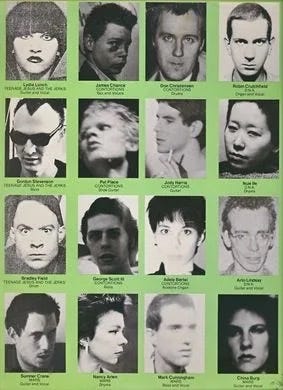
One incoming album, however, threw me for a loop out before I even heard it. Produced by Brian Eno, No New Yorkdocumented the latest sonic onslaught from Manhattan. Four songs each from four No Wave bands: Mars, DNA, Contortions plus the exquisitely named Teenage Jesus and the Jerks. The music actually fulfilled the promise (or threat) implied by the No Wave tag. Before that happened, however, merely eyeballing the band members on the album’s back cover filled me with disquieting awe. Their black-and-white photos looked like mug shots of petty criminals, refugees, mental patients. Whoa, I thought. These New York City people are serious.
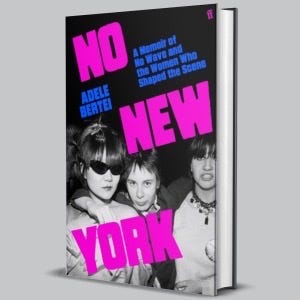
“No Wave was never meant to last,” writes Adele Bertei. A Cleveland escapee and Manhattan emigrant, Adele played keyboards in The Contortions. Subsequently she fronted a straightforward (though decidedly not straight) all-female rock and roll band called The Bloods. And then she embarked on a fitful mainstream solo career through the 1980s. In No New York: A Memoir of No Wave and the Women Who Shaped the Scene, Adele Bertei recounts her young-adult adventures on the rough-and-tumble Lower East Side with a riveting blend of transparency and heart. Her clarity and insight, about herself as well as others, is equal parts unsparing and generous. The net effect is transportive. Whether you were there or not.
“Self-destruction was inherent in the DNA of the scene’s fierce, combustible resistance to commodification.” Yet Adele Bertei was an outlier even in this community of outsiders. Most important she was a naturally talented musician; her gutsy soulful singing voice would eventually come to the fore and set her apart from her No Wave peers.
In the memoir Adele describes her on-stage persona in front of The Bloods as “tough boy gamine with an attitude.” She also reveals an extremely rugged childhood, in detail, without a trace of self-pity. Surviving multiple stints in reform school, Adele emerged in her late teens with deep scars and an unbreakable store of resilience. Recognizing her nascent ability, the similarly gifted (and deeply troubled) Cleveland musician Peter Laughner recruited Adele for his band Peter and the Wolves. Shortly before his death in 1977 (at age 24), Laughner accompanied Adele on an inspiring and low-budget visit to New York. In Manahattan this unlikely dynamic duo crashed with Peter’s friend and mentor, writer Lester Bangs.
“Lester’s apartment was a mess of typed pages, assorted rock ephemera, empty food containers and beer cans,” Adele recalls. “A narrow path snaked through the stepped-on pizza boxes, leading to the couch where, in the seams and cracks, a confetti of pharmaceuticals mixed it up with crumbs of unknown origin.”
At the end of a predictably drunken night on the town, the boys with Adele in tow end up back at Lester’s hovel on Sixth Avenue just above 14th Street. And then Bangs introduces Adele to jazz via The Black Saint and The Sinner Lady by Charles Mingus. The doors to a brave new world opened wide.
“‘Mingus spent some time in the nuthouse previous to writing this suite of songs, written as a ballet,’ Lester emphasized. ‘And if you listen carefully, everything you need to understand about jazz is right there within those grooves.’”
He wasn’t wrong. Adele listened, and dug deeper than her new friend might’ve imagined.
“As the guys nodded off, I stood at the window looking out over Sixth Avenue and the New York night…I felt a strange rush of fear at being in love with it all: the colors, their words, this music. The horns sounding like so many yellow taxis, cymbals and the night, shimmering out there as I imagined lovers, mothers, drug fiends, workers, runaway kids. Ghosts from every corner of the world walking this avenue below me, stepping in time to a ballet, a vision in Mingus’s head and in that moment, my soundtrack to the city.”
A couple months later she was back to stay. Unsurprisingly she gravitated east, where Manhattan looked as if it “had been attacked, or was at war.”
“A wasteland for its surviving immigrants, the East Village would proved to be our very own junkyard of surrealistic mayhem. Crumbling tenements lined the dangerous, poorly lit streets, and the rats far outnumbered us as we danced between them through the ghostly fairytale landscape.”
In the East Village she found kindred spirits such as the deadpan vocalist and all-purpose provocateur who led Teenage Jesus and the Jerks: an escapee from upper New York state who had christened herself Lydia Lunch. “This was no baby Patti Smith,” Adele writers of her new comrade, “more like Medusa resurrected to riot and rip your face off. The music was painful, disturbing, bombastic. And liberating.”
That was the No Wave formula: no formula. Or any formal training.
Another formative musical encounter for Adele was with a combative — belligerent — young saxophonist. Somewhere between his native Wisconsin and New York, James Siegfried became James Chance. Equally enarmored of James Brown’s tightly syncopated funk and the in-your-face explorations of free jazz, he forged a sound incorporating both. And his confrontational antics with the Contortions, onstage and off, brought a new level of volatility to a scene already in no short supply of aggression.
“Although I didn’t know what I was hearing or seeing back then,” Adele says about her first exposure to James Chance, “I understand it now as polyrhythm. Rhythms and silences punctuated with wildly dissonant squeals. It worked on some crazy level that made you want to hear more.”
Her stay in that band was unsurprisingly short lived, yet hugely influential. Adele bonded with Contortions guitarist Pat Place, relating to both her androgynous look (“winner of the psycho haircut contest”) and searing slide-guitar sound (“pure zombie apocalypse”). Throughout the memoir, Adele delivers on the subtitle with revealing anecdotes about the many women musicians in this world, along with visual artists (Kiki Smith and Nan Goldin), film makers (Susan Seidelman) and writers (Kathy Acker). This never feels like name-dropping (besides who would know); it’s more like recognition of a once-thriving and now forgotten creative hotbed. When Adele crosses paths with and briefly sings back-up for Madonna in the early 1980s, their aborted collaboration feels anticlimatic — at best.
No Wave was built to implode, as Adele fully admits. It was never meant to last. Sonic Youth and Swans picked up the mantle and carried it forward, expanding their respective sounds far beyond the template. The original No Wave lingers as a half-remembered dream: disturbing yet pleasurable.
After leaving The Contortions, Adele by her own admission was at loose ends. She acted in underground films, worked as a personal assistant to Brian Eno, longed to be Edith Piaf or Nina Simone singing “heart-centered” music.
“I was 24 years old but still an emotionally stunted kid from the streets and would remain that way for quite some time, due in no small part to the extended use of various unhealthy panaceas. We all tended to operate on automatic when it came to dealing with any past hurts, ramming any pain down into the deep. Drugs became a balm that kept you pain-free and in the present, an often-addled idea of the present.”
Despite these dangerous and potentially deadly distractions, Adele Bertei began the new decade the best way she knew how: by forming a new band.
“I knew nothing when it came to building any sort of smart life for myself; healing the traumas of my past was the furthest thing from my mind. I had no family, and only a few friends. Could barely hold on to a job. What I was sure of, with a shattering clarity that only cocaine can heighten in your heart and head, was the moment had finally come; I’d found the Keith to my Mick.”
This Keith was guitarist Kathy Rey, who joined forces with Adele’s Mick in The Bloods. Their relatively short lifespan coincided with my arrival in New York. I must’ve seen The Bloods perform half a dozen times during 1981. Along with No Wave survivors DNA, The Bloods quickly became my favorite band on the scene. Though I have remarkably specific memories of my first year in the city, what I recall about The Bloods is generic: they (pardon the expression) rocked. I was impressed with Adele’s supple voice and fierce stance along with the band’s focused energy. Their readily apparent musical skills set them apart even more than the all-female thing. No doubt I assumed they were gay (as the Au Pairs sang “It’s Obvious”) but even to a straight dude it was par for the course in NYC at that time. People were who they were and nobody judged. Though I don’t doubt Adele’s tales of experiencing homophobia at the hands of nominally hip music bizzers.
As told here, Adele’s memories of The Bloods’ foreshortened tenure and painful dissolve feel not so much regretful as slightly guilty. As if she’s embarrassed by the clouding effects of drink and drugs. Her downfall was not a bottoming-out but more a sheepish admission of excess getting in the way of success. “I had turned into a control freak devoid of all control.”
During the 1980s, Adele Bertei recorded adventurous dance music for major labels yet felt she was ultimately relegated to the sidelines. To me, this suggests that she remained an iconoclast at heart despite her legit talent. Finally, Adele didn’t possess the ruthless genes necessary to make it in the music business; for instance she was reluctant to drop or fire creative partners, lawyers, or managers when so advised. As she sees it, her sense of personal loyalty and longing for the community of only a few years previous got in the way of her ascending the golden ladder. Readers of this passionate and forthright memoir may disagree about exactly how much she accomplished. But we can acknowledge that Adele Bertei ended up in a better place than many of her peers, and we can be grateful that she gained, and shared, the wisdom of her experience.

