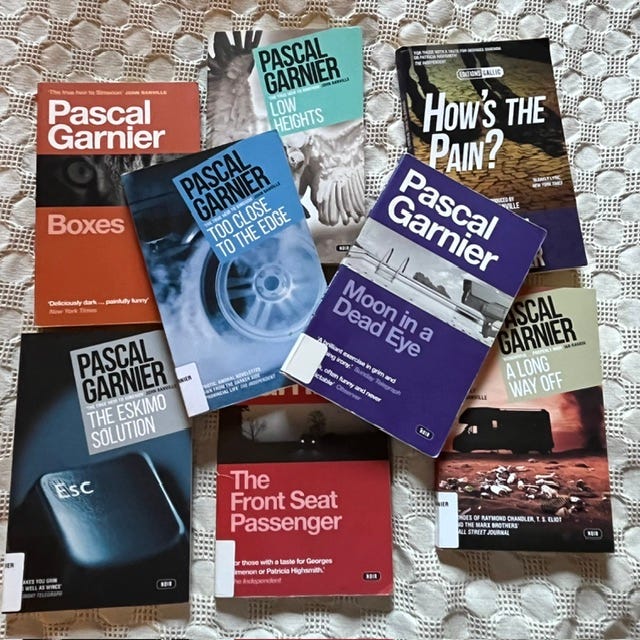
“Consecutive presentation is not a very adequate method of presenting complicated processes going on in different layers of the mind.” — Sigmund Freud
His narrative style can resemble free association. In that spirit, it’s advisable to read Pascal Garnier as if one were a psychoanalyst at work: remain neutral yet observant, defer any judgement, try not to deter the patient from their twisting, digressive path — wherever it leads.
Pascal Garnier’s compact novels don’t adhere to conventional notions of plot: they don’t unfold dramatically or follow traceable narrative arcs. These tightly wound stories proceed fitfully, unspooling anecdotes and scenes in the manner of psychological case histories: they follow the convoluted, contradictory interior logic of transcribed therapy sessions.
Background check: Pascal Garnier was born on the 4th of July, 1949, in the 14th arrondissement of Paris, France. He died in Cornas, France at the age of 60. Dropping out of high school, he led a peripatetic existence until he began to write at age 35. This late start didn’t hold him back; he published around 60 books: the noir-ish novels for adults that we’re examining here as well as children’s books, many of which he also illustrated. I latched on to the recent Gallic Books reissue series of English translations, ripping through ten of his twisted adult novelettes. Let’s put Pascal Garnier on the couch, considering his books in a suitably random sequence.
The Eskimo Solution switches between a novel-in-progress (in LARGE typeface) and the novelist’s meta-narration. Like Garnier himself, this nameless novelist/narrator is a successful children’s author who’s attempting a crossover to crime fiction. He begins to envy his created character’s wayward life, as well as his casual propensity to murder. “He lives; I bluff; he’s a magician, I’m a con artist; he touches, I manipulate.”
When the would-be crime novelist becomes entangled with his girlfriend’s precocious 16 year old daughter, their involvement unveils his real-life laziness and gross moral laxness. In all his novels, Garnier displays an utterly original, offhand way with words. Here he describes an elderly man’s crumpled physique as being “like origami, folded into eight.”
The Front Seat Passenger features the most complex and vexed narrative of all these novels. Middle-aged Fabien is something of a lost soul, “the child of two phantoms, with absence of one and the silence of the other providing his only sense of family.” When his wife Sylvie perishes in a car accident, Fabien’s life spirals out of control. Discovering she was accompanied by an unknown man who also died in the crash, he tracks down and stalks Martine, the front seat passenger’s widow, along with her overly protective friend Madeleine. “It was exhilarating to inhabit the lives of others; any others, it didn’t matter.”
The situation goes from grim to grimmer to downright uncanny. “Martine should never have left the house. Misfortune had got its foot in the door, like a grubby door-to-door salesman. It would never leave now.”
The A26 could be a print adaptation of “Riders On The Storm” by The Doors. There’s a killer on the road, gradually revealed to be bland Bernard, “who looked like the sort of person you would ask for some small change, the time, or directions in the street.” He cares for his reclusive sister Yolande, whose social isolation and bitter attitude are at least in part due to her wartime dalliance with an occupying German soldier. Bernard’s caregiver role functions as a built-in alibi for any crime, and the highway itself sets a perfect stage for random murders: “The A26 was swarming with foreign workers…that was where the fingers of suspicion would be pointed.” Hatred of immigrants explodes into plain sight by the novel’s end — or maybe it was there all along.
Boxes is where I began with Garnier. It’s his mildest in comparison, more eccentric than disturbingly unhinged, though any adaptation of this brief novel would require a trigger warning for suicide. Brice turns inward when his wife Emma fails to return from a business trip. He leaves their apartment in Lyon, moving to a small farm without ever completely unpacking the moving cartons of the title — or fully accepting the fact of his wife’s death. He becomes infatuated with an oddball local beauty named Blanche, who swears that Brice is a virtual doppelgänger of her late father, and may well be his reincarnation.
The two new lovers engage in an star-crossed affair, turning their daily routines into a mutual dance of denial and delusion. “Don’t believe what they tell you. There’s nothing above us, and nothing beneath. Just us, here and now, like survivors of a shipwreck.”
Low Heights is the essence of Pascal Garnier, sleazy behavior and surreal circumstances invading mundane lives: Patricia Highsmith adapted by the Coen Brothers. Here Garnier’s dark humor is on full display. Initially, Low Heights is also a moving look at aging and its accompanying lack of companionship. In the words of bluesman Albert King, “I have heard of loneliness blowing some good people’s minds.”
Édouard Lavenant is a retiree, widower and all-purpose curmudgeon, living in an increasingly foggy past, ceaselessly bitching about well, everything to his long-suffering live-in housekeeper Thérèse. “There’s no better age to write your memoirs than when you’re losing your memory.”
In typical Garnier fashion, as his grasp on reality slips, Édouard is confronted by a lookalike son he didn’t know he had fathered. “Children steal your past in order to make it their own; they take you apart like an old alarm clock and leave you in bits.” That’s not my experience, for what it’s worth; your mileage may vary.
The Panda Theory records a visitation. Gabriel, a Christ-like man of intrigue or possibly a lunatic, arrives in a small town and ingratiates himself with the locals. Until he doesn’t. Eventually, some of the residents suspect Gabriel is “a false saint” or even “an angel with no balls.” Besides, saints and angels aren’t as innocent as they once were, as one helpful senior citizen informs Gabriel. “Angels used to turn up nice plump faces like well-fed toddlers, blowing on their trumpets. But today, young man, they all look like junkies. They just hover around not giving a fuck about anything.”
This is Garnier at his most cryptic and pithy; he drops wry philosophical riffs on every other page. The title refers to a stuffed toy Gabriel totes around. “Above the counter, the panda’s continued presence demonstrated its ability to be happy everywhere and anywhere.”
How’s The Pain? Even hitmen reach retirement age. Simon, a contract killer who bills his services as “pest extermination” decides to wrap up his deadly career after one last job. “He took lives the way others removed furniture.” Simon enlists a “young blockhead” named Bernard to assist him, without explaining the true nature of the “vermin” they’re pursuing. “He displayed a kind of gutless common sense which Simon found refreshing…Bernard’s vulnerability made him invincible.”
The novel hurtles along the erratic course of their journey, with all the curious side trips, sudden detours and random encounters that are Pascal Garnier trademarks. “Everything was going so fast, even the present day had to be glimpsed through a rear-view mirror.” The novel’s title refers to Simon’s past as a mercenary. “In which part of Africa was it that people greeted each other with the question ‘how’s the pain?’ Simon could no longer remember.”
Moon In A Dead Eye takes place in La Convivialves, a brand new gated community/retirement village. Two couples — Martial and Odette Sudre, Maxime and Marlene Hode — are the initial buyers and as it develops, almost the sole residents. They have little choice but to socialize with each other, awkwardly. “They engaged in the customary small talk for a quarter of an hour, all the while studying each other closely out of the corners of their eyes, like naturalists examining a new species.”
Garnier is at his most acidic and observant here. “Odette had done as she was told her whole life, not simply out of laziness or lack of courage, but because she sincerely believed that modeling her existence on a train timetable would put her on the right track for success in the workplace and at home.”
For these late middle-aged urban professionals, aka yuppies, the lines between work and home life are blurred or non-existent, even in their privileged retirement. “Maxime was the one who introduced everybody, showing them off as though trying to get a good price for them.” The slow-building tragic conclusion, inevitable yet shocking, is a dystopian societal collapse reminiscent of later J.G. Ballard novels such as Super-Cannes.
Too Close To The Edge revolves around car wrecks, both literal and figurative. Recently retired to her country home. 64-year old Éliette opens her door one day to a mystery stranger named Étienne, who comes seeking roadside assistance for his abandoned car. When his daughter Agnes arrives on the scene, and Éliette’s next-door neighbors reveal their son has just died in an automobile accident nearby, the situation thickens and congeals into a morbidly fascinating hot mess. “The conversation covered all kinds of topics, but everyone made a conscious effort to avoid talking about themselves. Hiding behind tales of other people’s adventures was like swanning about at a masked ball.”
The relationship between heedless Agnes and shifty, rationalizing Étienne grows increasingly and deeply perverse while Éliette is gradually relieved of her naiveté. Or is she? “You think you’re safe,” Étienne tells her, “like when you’re on the motorway, it’s a bit boring. You lose concentration and then…a loose bit of gravel, an insect, and whoops! You’ve lost control, spun round, and find yourself facing the wrong way. But hey, if you’re not dead, you’ll still end up somewhere!”
A Long Way Off was Pascal Garnier’s final book and perhaps appropriately it revolves around a 60 year old man named Marc who experiences a sort of late mid-life crisis. He’s searching for — what? The meaning of life? “To think people went to the trouble of climbing mountains to look down on the world when a magnifying glass did the same thing.” Or possibly just a diversion from the inevitable? “We wake up one day and all our toys which were once so magical and full of life are suddenly nothing but inert, futile, useless objects.”
Leaving behind his partner Chloé and acquiring an aging cat called Bordu, Marc springs his adult daughter Anna from the mental health facility where she involuntarily resides and they embark on another Garnier-branded quixotic journey. “The things going through his head were not, strictly speaking, thoughts, but rather random snapshots of apparently unimportant moments in his life, scattered pieces of a puzzle that sometimes came together to form a semblance of coherence.” Which feels as close as we can get to a summary of this novel, and Pascal Garnier’s entire oeuvre.

